Body & Movement
Strong body, long life
How to move every day, which health problems hit Black women harder, what to get checked and when, the numbers to know by heart, and how to make the doctor really hear you.
Start the 4-week walkScreenings by age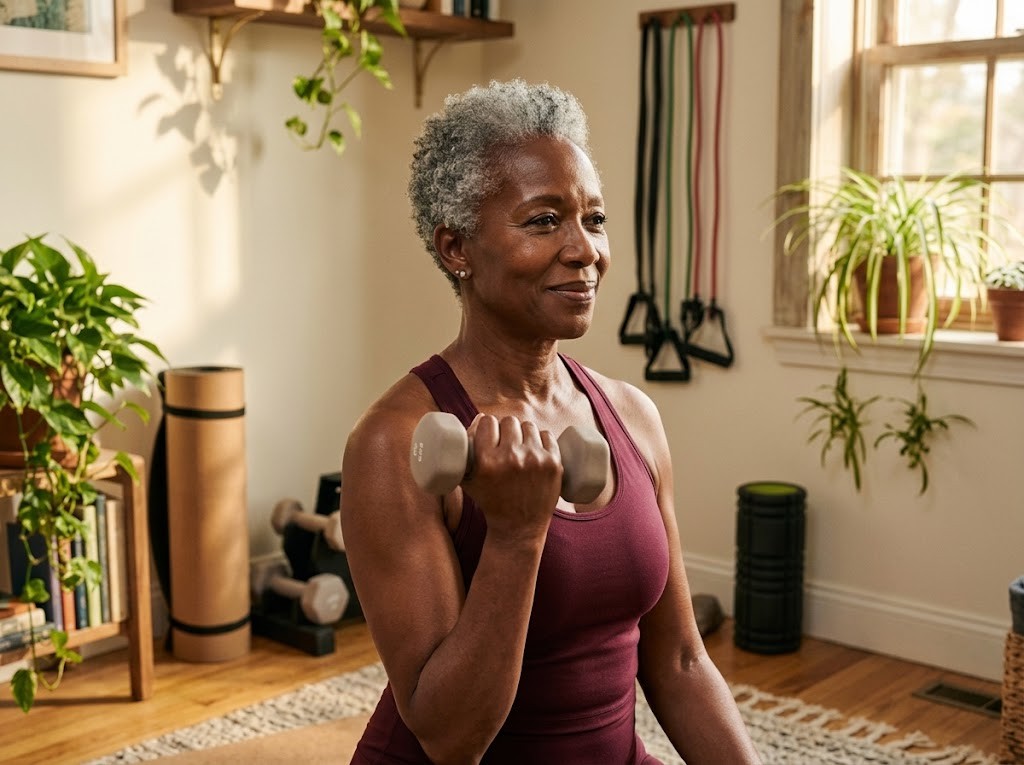
Start here
Your body has carried everybody. Let it carry you, too.
So many of us put our own health last. We drive Mama to her appointments, sit up with the babies, cover the shift, run the church kitchen. Then our own blood pressure creeps up and nobody notices until it's loud.
This page is your plan. Not a diet, not a "bikini body." Just the things that keep a Black woman walking, lifting groceries, climbing the steps to her own bedroom and dancing at her grandbaby's wedding.
- Move: 150 minutes a week, plus strength two days.
- Check: blood pressure, blood sugar, cholesterol, breasts, cervix, colon, bones on schedule.
- Know: your own numbers, and the warning signs that mean "go now."
- Speak up: you are the expert on your body.

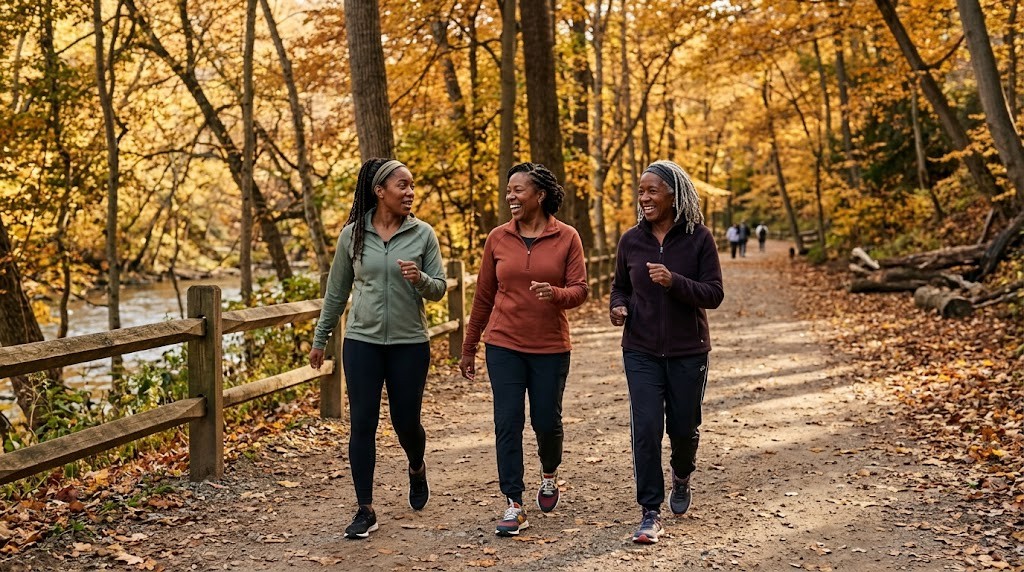
Baby, I didn't start walking on purpose until I was past fifty. Start where you are. Ten minutes around the block counts. Then come back tomorrow and do it again.
The guideline
How much movement do we really need?
These are the national guidelines from the CDC and the U.S. Physical Activity Guidelines. "Moderate" means you can talk but not sing.
60 minutes a day
Play, dance, sports, walking to school. Muscle- and bone-strengthening (jumping, climbing, push-ups) at least 3 days a week.
150 minutes a week
That's 30 minutes, 5 days. Brisk walking counts. Plus muscle-strengthening on 2 or more days.
150 + 2 + balance
Same 150 minutes and 2 strength days, plus balance practice to prevent falls.
150 minutes, if healthy
ACOG says healthy pregnant and postpartum women can aim for 150 minutes of moderate activity a week. Check with your midwife or OB first.
What counts as moderate?
- Brisk walking
- Dancing (moderate or vigorous, depending on pace)
- Water aerobics
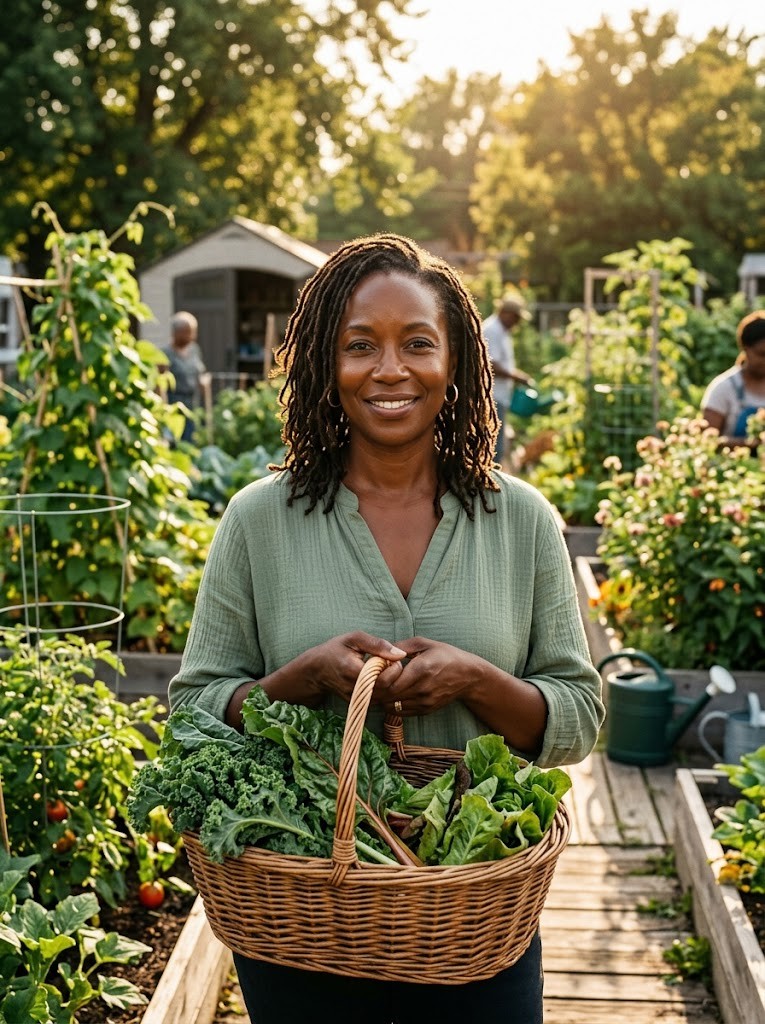
- Gardening, raking, pushing a mower
- Riding a bike on flat ground
What counts as strength?
- Body-weight moves: squats, wall push-ups, bridges
- Resistance bands
- Dumbbells, or a gallon jug of water
- Heavy gardening: digging, carrying
- Carrying groceries up the steps (yes, really)
Yoga and stretching
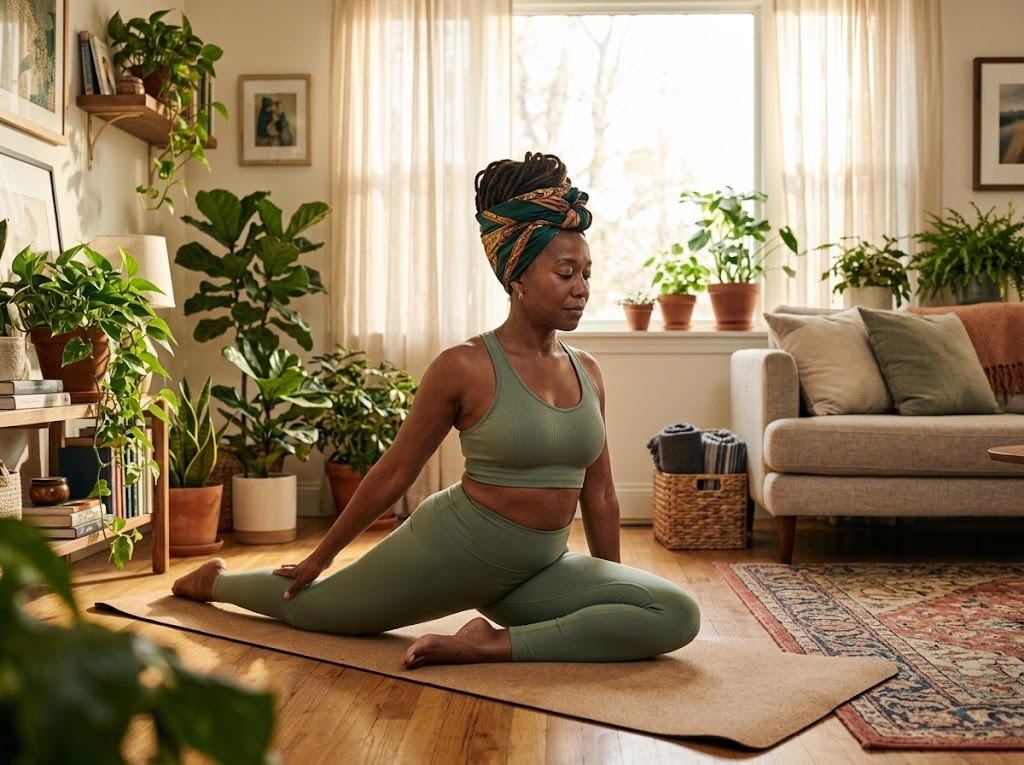
Some evidenceThe NIH's NCCIH reports evidence that yoga may help with stress, sleep, balance and low-back pain. It's a lovely add-on, not a replacement for the 150 minutes.
Sources: CDC adult guidelines · CDC children & teens · CDC older adults · HHS Physical Activity Guidelines · ACOG · CDC measuring intensity · NCCIH yoga
Beginner plan
The 4-week walking plan
From the couch to 150 minutes a week in one month. Walk at a pace where you can still talk. If you miss a day, don't "make it up." Just pick back up.
| Week | How long | How often | Weekly total | Your focus |
|---|---|---|---|---|
| Week 1 | 10 minutes | 5 days | 50 minutes | Just show up. Same time each day. Comfortable shoes, water bottle. |
| Week 2 | 15 minutes | 5 days | 75 minutes | Pick up the pace for the middle 5 minutes. Swing your arms. |
| Week 3 | 20–25 minutes | 5 days | 100–125 minutes | Add a small hill or a few flights of steps. Invite a friend. |
| Week 4 | 30 minutes | 5 days | 150 minutes ✓ | You've hit the guideline. Add 2 strength days (below). |
Sources: CDC adult guidelines · GirlTrek · Black Girls RUN! · Black Girls Do Bike
No gym needed
Strength training at home
Weight-bearing and resistance exercise help build and keep bone, the NIH says. Strength also keeps muscle, which helps blood sugar and balance as we age. Do these 2–3 days a week, not two days in a row.
How to do the routine
- Warm up: 5 minutes of marching in place or walking around the house.
- Do each move 8–12 times. That's one "set."
- Rest a minute, then do the whole list again. Work up to 2–3 rounds.
- Slow and steady. Breathe out when you push, breathe in when you lower. Don't hold your breath.
- When 12 feels easy, make it harder: slower, a band, or heavier jugs.
- A little muscle soreness the next day is normal. Sharp pain is not. Stop.
Chair squat
Stand in front of a sturdy chair. Sit back slowly until you touch the seat, then stand up. Push through your heels. Legs, hips, bones.
Wall push-up
Hands on the wall at shoulder height. Bend your elbows to bring your chest toward the wall, then push back. Move to a counter, then the floor, as you get stronger.
Glute bridge
Lie on your back, knees bent, feet flat. Squeeze your seat and lift your hips. Lower slowly. Great for back and hips.
Step-ups
Use the bottom stair. Step up with one foot, bring the other up, step down. Switch the leading foot. Hold the rail.
Band or jug row
Hold a band anchored in a door, or a jug of water in each hand. Pull your elbows back, squeezing your shoulder blades. Good for posture.
Overhead press
Hold light weights or jugs at your shoulders. Press up, then lower slowly. Sit if you need to.
Calf raises
Hold the counter. Rise up onto your toes, lower slowly. Helps ankles and balance.
Bird dog
On hands and knees, reach one arm forward and the opposite leg back. Hold for a breath, switch. Core and balance.
Sources: NIH Osteoporosis and Related Bone Diseases Resource Center · CDC older adults
Movement for every age
What movement looks like across a life

Girls 6–12
60 minutes of play a day. Double Dutch, tag, dance class, bike riding. Jumping builds bone that lasts a lifetime.

Teens 13–19
Still 60 minutes a day. Team sports, step team, dance, walking with friends. Strength 3 days a week.

20s–30s
150 minutes plus 2 strength days. Build the habit now; schedule workouts around wash day.

Pregnancy
Walking, swimming, prenatal yoga. Avoid lying flat on your back for long later in pregnancy, contact sports and fall risks (ACOG).
40s–50s
Strength becomes non-negotiable: estrogen falls and bone loss speeds up. Lift 2–3 days a week.
60s and beyond
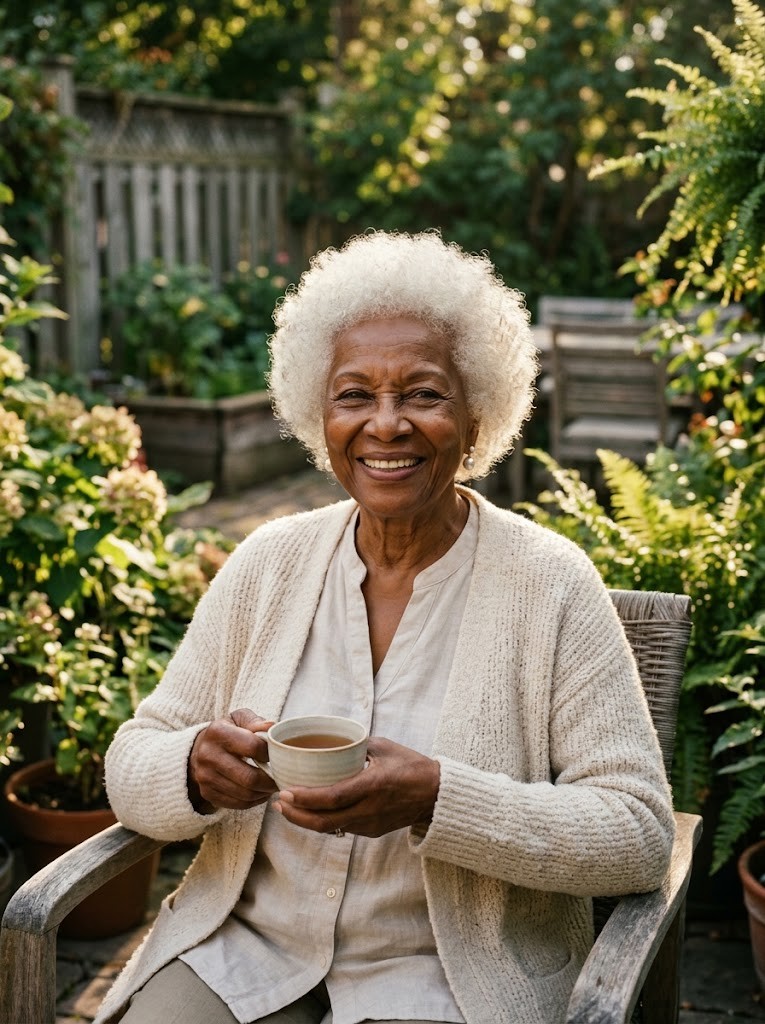
Walk, lift, and practice balance. Chair exercises count. Water aerobics is gentle on joints.
Sources: CDC children · ACOG exercise in pregnancy · NIH osteoporosis overview
The real barrier
"I can't work out. I just got my hair done."
You are not vain. This is real, and researchers have studied it. In a Wake Forest survey of 103 African American women, nearly 40% said they had avoided exercise at times because of their hair. (It was one clinic in one region, but it rang true for a lot of us.) Later research agreed: hair is a real, cultural barrier to movement.
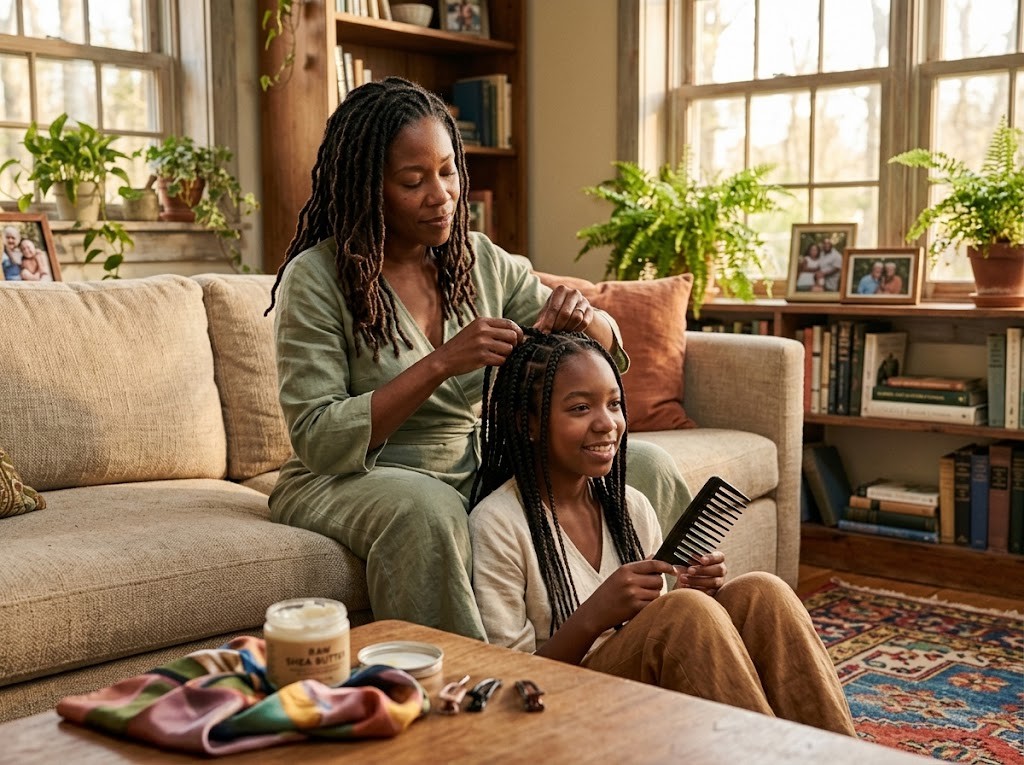
Hair has always been a gathering. Across West and Central Africa, styles could show a woman's people, age, marriage or mourning, and braiding was a social ritual: hours of talk with hands in each other's hair. We can carry that same care into styles that hold up to a good sweat.
So let's solve it instead of skipping the walk.
Sweat-friendly styles
- Braids, twists, cornrows
- Locs
- Buns and puffs
- Wash-and-go styles
Keep it loose Tight braids, ponytails and extensions can cause traction alopecia (AAD). Your edges should never hurt.
During the workout
- Satin- or silk-lined cap or scarf under a hat
- Moisture-wicking headband at the hairline to catch sweat
- Pineapple the hair up high and loose
After the workout
- Plan hard workouts the day before wash day
- Co-wash or rinse-and-refresh instead of a full restyle
- Dry shampoo or a cool blow-dryer on the roots
- Re-moisturize the ends, then bonnet
Sources: Hall et al., Archives of Dermatology (ScienceDaily) · Joseph et al., Frontiers in Public Health · Williams, Rutgers–Camden · AAD traction alopecia · Crowned & Rooted history brief: African hair traditions (documented)
Know the risks
Health problems that hit Black women harder
This isn't about fear. Researchers point to stress, racism in care, where we live, and genes like APOL1, not to anything wrong with us. Knowing the risk means catching things early.
High blood pressure
Black women have some of the highest rates of high blood pressure in the world, the AHA says. It is called "the silent killer" because it usually has no symptoms.
Warning signs
- Usually none, which is why you check
- Emergency: very high reading with severe headache, chest pain, vision changes, numbness or trouble speaking. Call 911.
Prevention
- Check at least yearly from 18 (more if 40+ or at risk)
- Cut salt: under 2,300 mg a day, ideally 1,500
- Move 150 minutes a week; limit alcohol
- Take BP medicine every day as prescribed
Heart disease
Heart disease is a leading killer of Black women, and high blood pressure feeds it. Women's heart-attack signs can be quieter than men's.
Warning signs
- Chest pain, pressure or squeezing
- Shortness of breath, cold sweat, nausea
- Pain in the jaw, neck, back or arm
- Unusual tiredness
Prevention
- Cholesterol check every 4–6 years from 20 if normal risk
- Know your BP and blood sugar
- Don't smoke; move; eat more plants
Stroke
A Women's Health Initiative study found Black women had a 47% higher stroke risk than white women, and Black women in their 50s had about 3.5 times the risk.
Warning signs: BE FAST
- Balance loss · Eyes: vision trouble
- Face drooping · Arm weakness
- Speech slurred · Time to call 911
Prevention
- Control blood pressure early: high BP before 35 was linked to about 3 times the stroke risk by middle age (Black Women's Health Study)
- Manage diabetes and cholesterol
Type 2 diabetes
Black adults are more likely than white adults to be diagnosed with diabetes, and USPSTF tells doctors to consider screening Black adults earlier.
Warning signs
- Very thirsty, peeing a lot
- Blurry vision, slow-healing sores
- Tingling hands or feet; tired all the time
- Dark velvety skin patches on the neck
Prevention
- Take the free CDC 1-minute prediabetes risk test
- Blood test at 35–70 if overweight, or earlier if at risk
- Walk after meals; fewer sugary drinks
Uterine fibroids
An NIEHS study estimated over 80% of Black women have fibroids by age 50, often younger, bigger and with worse symptoms.
Warning signs
- Heavy bleeding, periods longer than 7 days
- Pelvic pressure, belly swelling
- Peeing often; low iron or anemia
Prevention & care
- No routine screening test. Tell your doctor about symptoms.
- Ask about every option, including ones that keep your uterus (medicines, embolization, myomectomy).
Breast cancer, including triple-negative
Black women are about twice as likely to get triple-negative breast cancer, a fast-growing type, and are more likely to die of breast cancer.
Warning signs
- A new lump in the breast or armpit
- Skin dimpling, redness or swelling
- Nipple turning in or discharge
Prevention
- Ask for a breast cancer risk assessment by 25 (American College of Radiology)
- Mammogram every 2 years, 40–74 (USPSTF)
- Limit alcohol; stay active
Lupus
CDC-funded registries found Black women get lupus about three times as often as white women, at younger ages, with more kidney damage.
Warning signs
- Joint pain or swelling; extreme tiredness
- Unexplained fevers
- Butterfly-shaped rash on the face
- Hair loss; foamy urine
Prevention & care
- No screening test for everyone. If signs come and go, keep a symptom diary and ask for a lupus workup.
Kidney disease
Black Americans are much more likely to develop kidney failure. High blood pressure and diabetes drive most of it, and APOL1 gene variants common in West African ancestry raise risk.
Warning signs
- Often none early on
- Later: swollen ankles, foamy urine, tiredness, itching
Prevention
- If you have high BP, diabetes or family history, ask for a urine albumin test and eGFR blood test
- The eGFR formula no longer uses race (since 2021)
Maternal health
In 2024 the CDC counted 44.8 maternal deaths per 100,000 live births for Black women, versus 14.2 for white women, about three times higher. CDC says most pregnancy-related deaths are preventable.
Warning signs (CDC Hear Her)
- Severe headache that won't go away; vision changes
- Chest pain, trouble breathing, fast heartbeat
- Swelling of face or hands; fever
- Heavy bleeding; thoughts of hurting yourself or the baby
Prevention
- Say: "I am pregnant" or "I was pregnant in the last year."
- Blood pressure checks through the year after birth
Sources: AHA high BP & African Americans · USPSTF BP · AHA sodium · Go Red for Women · AHA cholesterol · AHA/WHI stroke · Black Women's Health Study (Healio) · American Stroke Association · HHS OMH diabetes · USPSTF diabetes · Baird et al. 2003 · NICHD fibroids · ACOG fibroids · ACR 2023 · ACS · USPSTF breast · Emory lupus registry · Lupus Foundation · NIDDK · NKF/ASN eGFR · CDC NCHS maternal mortality 2024 · CDC Hear Her
Screenings by age
Your checkup timeline
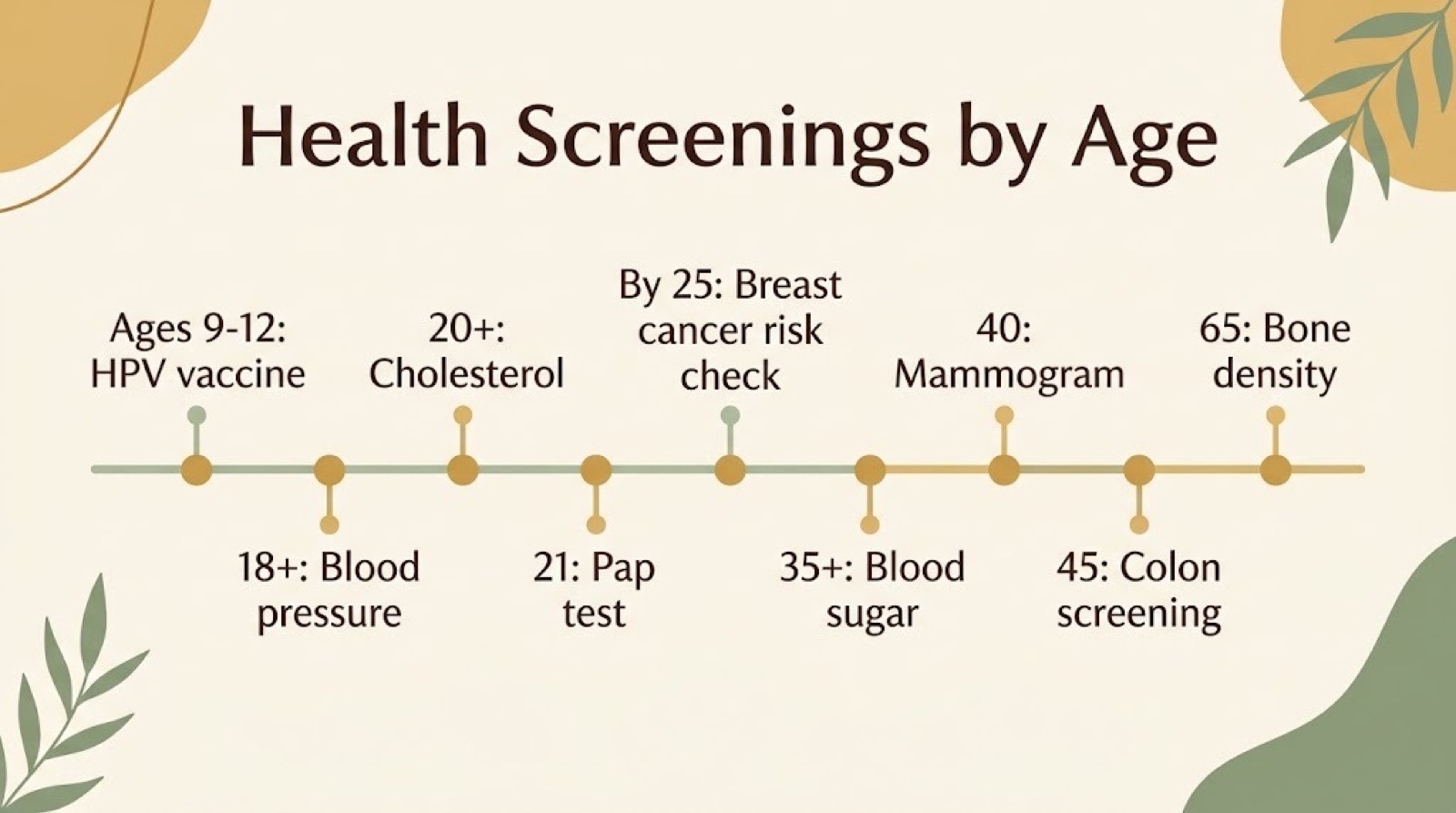
What to start at each age. Everything you started before keeps going unless your doctor says stop.
Screenings by age
| Age band | Screenings & steps | How often |
|---|---|---|
| Girls 9–12 | HPV vaccine; well-child visits; depression screening from 12 | Vaccine series once; checkups yearly |
| Teens 13–19 | Depression screening; HIV test from 15; blood pressure from 18; HPV catch-up | Yearly checkup; HIV at least once |
| 20s | Blood pressure; cholesterol from 20; Pap from 21; breast cancer risk assessment by 25; hepatitis C once; know sickle cell trait | BP every 3–5 years if normal (yearly if at risk); cholesterol every 4–6 years; Pap every 3 years |
| 30s | Pap and/or HPV test; blood pressure; cholesterol; blood sugar from 35 if overweight | Pap every 3 years or HPV every 5; blood sugar every 3 years if normal (ask) |
| 40s | Mammogram from 40; blood pressure yearly; cholesterol; blood sugar; cervical screening; colon from 45 | Mammogram every 2 years; colon per test type |
| 50s–early 60s | All of the above, plus ask about bone density if past menopause with risk factors | As above |
| 65–75 | Bone density scan; mammogram through 74; colon through 75; cervical screening may stop after 65 if past results were normal | DXA as your doctor advises |
| 76+ | Talk with your doctor about which screenings still make sense; keep BP, sugar, kidney checks | Personal plan |
Sources: CDC sickle cell · CDC HPV vaccine · USPSTF depression · USPSTF HIV · USPSTF hepatitis C · USPSTF BP · AHA cholesterol · USPSTF cervical · ACR · USPSTF diabetes · USPSTF breast · USPSTF colorectal · USPSTF osteoporosis · CDC Hear Her
Know your numbers
The numbers to keep in your wallet
Ask for your actual numbers at every visit, not just "it's fine." Write them down. Watching the trend over years tells you more than any one reading.
| Number | What it measures | Healthy range | Watch zone | Talk to your doctor |
|---|---|---|---|---|
| Blood pressure | Force of blood on your artery walls | Under 120 / under 80 | 120–129 / under 80 (elevated) | 130/80 or higher High. Over 180/120 is an emergency. |
| A1C | Average blood sugar over about 3 months | Under 5.7% | 5.7–6.4% (prediabetes) | 6.5% or higher diabetes range |
| Fasting blood sugar | Sugar after not eating overnight | Under 100 mg/dL | 100–125 | 126 or higher |
| Cholesterol | Fats in the blood | Total under 200; LDL under 100; HDL 50 or higher | Total 200–239; LDL 130–159 | Total 240+; LDL 160+ |
| BMI | Weight compared with height. A screening tool, not a diagnosis. | 18.5–24.9 | 25–29.9 | 30 or higher, plus ask about strength and fitness |
| Waist | Belly fat, linked to heart and diabetes risk | 35 inches or less | Over 35 inches raises risk (measure just above the hip bones) | |
| Vitamin D (25-hydroxy) | Vitamin D stores | Darker skin makes less vitamin D from sun. But cutoffs for Black women are debated, and USPSTF does not recommend routine testing without symptoms. Ask whether a test makes sense for you. Don't take more than 4,000 IU a day without supervision. | ||
| Ferritin | Your iron stores | There's no official "hair" target number. Ask for a CBC and ferritin if you have heavy periods, shedding, or are tired all the time. Don't take iron pills without a blood test. | ||
| Kidney: eGFR + urine albumin | How well kidneys filter | Ask for both if you have high blood pressure, diabetes or family history of kidney disease. | ||
I keep a little card in my purse with my blood pressure, my A1C and my cholesterol from every visit. When a new doctor asks, I hand it over. They take you more seriously when you know your own numbers.
Sources: AHA blood pressure readings · NIDDK A1C test · NIDDK diabetes tests · MedlinePlus cholesterol · CDC BMI · NHLBI waist · USPSTF vitamin D · NIH ODS vitamin D · NIH ODS iron · NIDDK kidney
Hormones
Periods, PCOS, endometriosis, fibroids and menopause
Pain that stops your life is not "just being a woman." Name it, track it and ask about it by name.
Periods: what's normal?
ACOG says normal cycles run 21–45 days in teens and 21–35 days in adults. See a clinician if:
- Your period lasts more than 7 days
- You soak a pad or tampon every hour for several hours
- You bleed between periods
- Cramps keep you home from school or work
Heavy bleeding plus fibroids plus low iron is a common pattern for Black women. Ask for a ferritin test.
PCOS (polycystic ovary syndrome)
A 2024 global review put PCOS at about 9 in 100 women. Signs: irregular or missed periods, extra hair on the face or body, acne, thinning hair on top, weight gain, dark velvety skin patches, trouble getting pregnant. PCOS is linked to insulin resistance and type 2 diabetes, so it's worth checking your blood sugar. See an OB-GYN or endocrinologist.
Endometriosis
Tissue like the uterine lining grows outside the uterus and causes pain. It often takes years to get diagnosed. One U.S. study found Black women had much lower odds of being diagnosed than white women. Researchers think that reflects under-diagnosis and bias, not less disease. Black women's pelvic pain has often been blamed on fibroids or infection instead.
Say this: "My periods are so painful I miss my life. Could this be endometriosis?"
Fibroids
Over 80% of Black women have fibroids by 50 (NIEHS). Treatment ranges from watchful waiting to medicines, uterine artery embolization, myomectomy (removes fibroids and keeps the uterus), and hysterectomy. Black women are more likely to have hysterectomies, and younger. Ask about every option.
Menopause and what SWAN found
The average U.S. age of menopause is about 52 (NIA). The SWAN study (Study of Women's Health Across the Nation) followed women of many races through the change. For Black women it found:
- Hot flashes and night sweats lasted a median of about 10 years, the longest of any group (7.4 years overall).
- Symptoms started earlier in the transition and were more frequent.
After menopause, bone and heart risk both rise. That means calcium (1,200 mg a day from 51), vitamin D, strength training, and regular BP and cholesterol checks. There are hormonal and non-hormonal treatments for hot flashes. Ask. The Menopause Society has a clinician finder.
Sources: ACOG heavy bleeding · ACOG first period · Salari et al. 2024 (PCOS) · NICHD PCOS · CDC PCOS & diabetes · Contemporary OB/GYN (endometriosis) · NICHD endometriosis · ACOG fibroids · NIA menopause · Avis et al. 2015 (SWAN) · SWAN · The Menopause Society · NIH ODS calcium
Printable
Questions to ask your doctor
Print this, circle the ones that fit you, and bring it to your next visit.
My visit checklist · Crowned & Rooted
Name: ______________________ Date: ____________ Doctor: ______________________
- What is my blood pressure today? Is it in a healthy range?
- What were my A1C and cholesterol numbers? When do I need them again?
- Which screenings am I due for at my age?
- Should I have a breast cancer risk assessment? Should mammograms start before 40 for me?
- Do I need a kidney check (eGFR and urine albumin)?
- My periods are heavy or painful. Could it be fibroids or endometriosis?
- Could I be low in iron? Can you check my ferritin?
- Does a vitamin D test make sense for me?
- Do any of my medicines or supplements interact? (Bring the bottles.)
- I take biotin. Will it affect my blood tests?
- What are all my treatment options, including ones that keep my uterus?
- I'm having hot flashes or night sweats. What treatments are there?
- I've felt down or worried for two weeks or more. Can we talk about it?
- How is my bone health? When should I get a bone density scan?
- What warning signs mean I should come back or call 911?
- Can you write down what we decided today?
My numbers: BP ______ · A1C ______ · Cholesterol ______ · Weight/waist ______ · Other ______
Advocate
How to speak up in the doctor's office
Black women are too often not believed about pain. You can be polite and still be firm.
Before the visit
- Write your top 3 concerns. Put the biggest one first.
- Keep a symptom diary: what, when, how bad (0–10), what helps.
- Bring every medicine, vitamin and herb bottle.
- Bring a friend or family member to listen and take notes.
- Use your patient portal to look up past results.
After the visit
- Read your visit summary. Ask for corrections if something's wrong.
- Not getting better? Call back. Ask for a second opinion. It's your right.
- Ask for a doctor or nurse you feel comfortable with.
Words that work
I taught school thirty-some years, and I'll tell you what I told my students: there's no such thing as a silly question. If the doctor is rushing, say, "I need two more minutes. This is important." Then ask.
Sources: CDC Hear Her · Contemporary OB/GYN · Talk with your own doctor or nurse about what's right for you.