
Hair & Scalp
Your crown, cared for
Coils, kinks, curls, locs, silver or brand new. How our hair really works, what makes it fall out, what helps, and what is just hype, told plainly and with the sources to back it up.
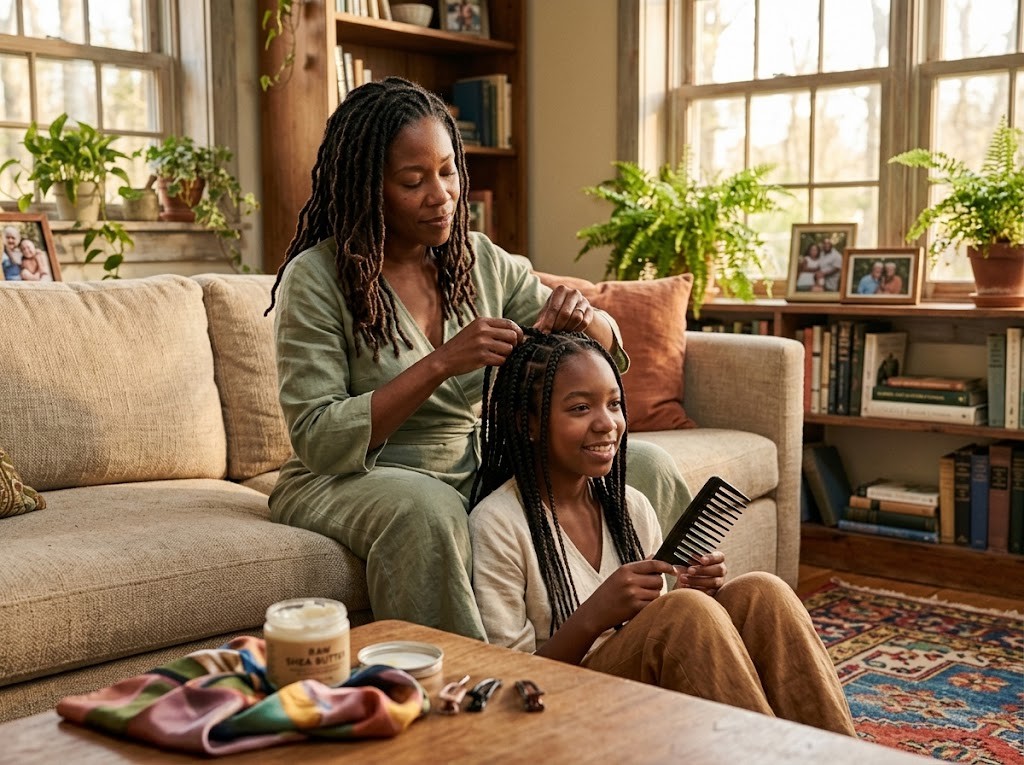
Start here
Our hair is strong in spirit and delicate in fact
Tightly coiled hair looks tough. It is not. Every bend in a coil is a weak spot where the strand can snap. And because the natural oil from the scalp has a hard time travelling down a spiral, our ends tend to be the driest part of the head.
So the goal is not "growing" hair. Healthy scalps grow hair all the time. The goal is keeping it: less breakage, less pulling, more moisture, and catching hair loss early when it is a medical problem and not a product problem.

Baby, your edges are not a project, they are a warning light. If they are leaving, something is pulling or something is wrong inside. Oil will not fix either one. Loosen up, and if it keeps going, see a skin doctor.
Sources: American Academy of Dermatology (AAD), healthy hair tips · AAD, Hair loss in Black women · Crowned & Rooted history brief (braiding as identity, documented)
Know your hair
Seven facts about coily and kinky hair
The "why" behind every tip on this page.
1. Coils break at the bends
Each twist along a tightly coiled strand is a thin spot. Rough combing, dry detangling and tight styles snap hair right there. Breakage, not slow growth, is why many of us feel our hair "won't grow."
2. Ends are the oldest hair
Hair grows from the root, so the ends of shoulder-length hair may be a couple of years old. Treat them like your grandmother's lace: gently.
3. Scalp oil travels slowly
Natural oil (sebum) moves easily down straight hair but gets stuck on curls. That is why the AAD suggests Black women wash less often than every day, and why ends need extra moisture.
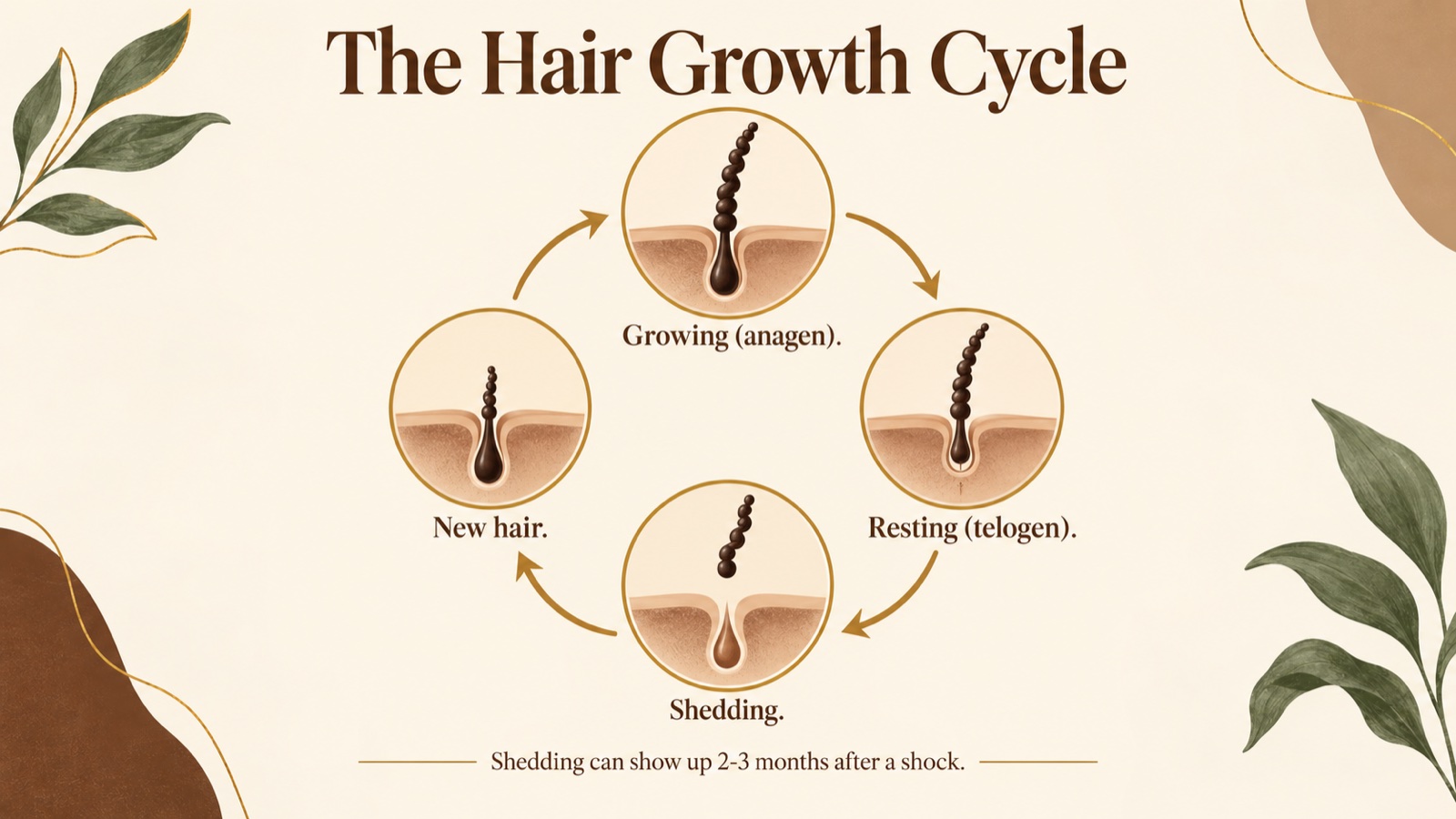
4. Hair lives in cycles
Every hair grows, rests, then sheds. Losing some hairs a day is normal. Losing clumps, seeing more scalp, or a widening part is not.
5. Water is the moisturizer
Oils and butters seal moisture in. They do not add it. Damp hair plus a leave-in plus a light oil or butter is the classic layering method many naturals use.
6. Tension adds up
A tight style once is not the problem. Tight styles back to back for years, on the same edges, is how traction alopecia happens.
7. Grey hair is different hair
Silver strands often feel coarser and drier and can turn yellow from sun, smoke or hard water. They need gentle care, not shame.
8. Your scalp is skin
Itch, burning, scaling, pus bumps or tenderness are skin problems. A board-certified dermatologist, ideally one who treats textured hair, is the right doctor.
9. Healthy hair starts inside
Low iron, thyroid trouble, crash diets, big illness and childbirth all show up in your hair, often two to three months later.
Sources: AAD, healthy hair tips · Cleveland Clinic, telogen effluvium · AAD, Hair loss in Black women
When hair is leaving
Hair loss that hits Black women most
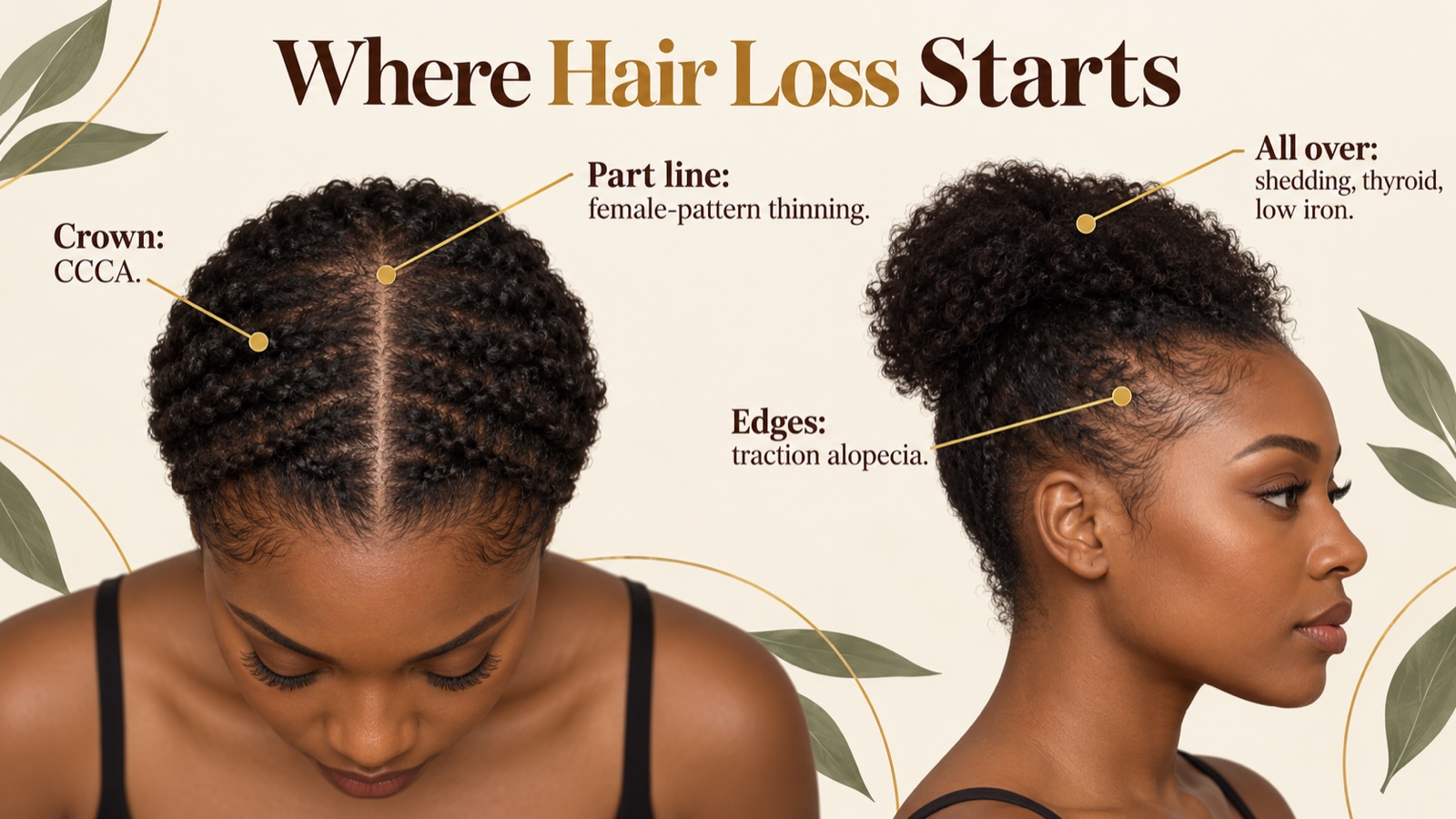
Some hair loss can be reversed if caught early. Some kinds scar the scalp and the follicle is gone for good. Know the signs, and do not wait.
| Condition | What you may notice | Common causes | See a dermatologist when |
|---|---|---|---|
| Traction alopecia | Thinning at edges, temples or along the part; small bumps around follicles; sore scalp after styling | Tight braids, locs, weaves, extensions, ponytails, buns, tight wraps | Any edge thinning, pain or bumps. Early it can reverse; left alone it can become permanent. |
| CCCA (central centrifugal cicatricial alopecia) | Thinning that starts at the crown and spreads outward; breakage; sometimes itch, tenderness or burning, sometimes nothing at all | Scarring inflammation; family history and gene changes play a part; hair practices may add to it | Any crown thinning. It is the most common scarring hair loss in women of African descent, and scarring cannot be undone. |
| Female-pattern hair loss | Part getting wider, thinner on top; front hairline usually stays | Genes, hormones, age, menopause | When you notice it. Proven treatments exist, such as minoxidil. |
| Telogen effluvium | Sudden shedding all over, handfuls in the shower, two to three months after a shock | Childbirth, high fever or illness (including COVID), surgery, crash diets, big stress, new medicines | If shedding lasts more than six months or you can see scalp. |
| Thyroid disease | Thin, dry hair all over, plus tiredness, weight change, always cold or always hot | Underactive or overactive thyroid | Ask your doctor for a TSH blood test. Stop high-dose biotin first (it can throw off thyroid tests). |
| Low iron | Shedding all over, tiredness, pale skin, brittle or spoon-shaped nails | Heavy periods (often with fibroids), pregnancy, low iron intake | Ask for a blood count and ferritin (iron stores) test. |
| PCOS | Thinning on top plus acne, chin or body hair, irregular periods, dark velvety skin patches on the neck | Extra male-type hormones and insulin resistance | Irregular periods with hair changes: see your OB-GYN or an endocrinologist. |
- Scalp pain, burning, itching, scaling or pus bumps
- Any thinning at the crown
- Shiny, smooth patches with no hair openings
- Round bald patches that appear suddenly
- Edges that keep thinning after you loosen your styles
- Photos of your hair over the past year (top of head and edges)
- Your style history: relaxers, braids, weaves, heat, how often
- Every medicine and supplement, especially biotin
- Family history of hair loss, thyroid, lupus
- Ask: "Could this be CCCA or traction? Can you check my iron, thyroid and vitamin D?"
Sources: AAD, Hairstyles that pull can lead to hair loss · AAD, CCCA · AAD, Female pattern hair loss · Cleveland Clinic, Telogen effluvium · American Thyroid Association · NIH ODS, Iron · Cleveland Clinic, PCOS · FDA, Biotin interference
Every age, every stage
Hair routines from little girls to silver queens
The basics stay the same: gentle hands, moisture, loose edges, a satin bonnet. What changes is what our bodies are going through.

Gentle and loose
- Wash about every one to two weeks with a mild, tear-free shampoo and lots of conditioner.
- Detangle wet, with conditioner, in small sections, starting at the ends. Make it story time, not a fight.
- Puffs and ponytails: soft scrunchies, never rubber bands, and not in the same spot every day.
- No relaxers and no tight extensions on growing edges. Tension now can mean thin edges later.
- If braiding hurts, it is too tight. Teach her to say so.
- Satin bonnet or pillowcase at night.

Style without the damage
- Puberty can make the scalp oilier: weekly wash day is often right.
- Rotate styles. Give edges a rest between braids or sew-ins.
- Edge control and gel every day plus hard brushing equals thin edges. Lighten up.
- Flat iron: heat protectant, lowest setting that works, not every day.
- Eat iron foods (beans, greens, lean meat) and enough protein, especially once periods start.
- Sports? See the workout hair tips below.

Build habits that last
- Take breaks between extensions; keep wear time reasonable and take them down gently.
- Do not relax and color the same day (AAD).
- Pregnancy: many women have thicker hair, then heavy shedding about two to three months after birth. That is usually telogen effluvium and most hair returns within months.
- Heavy periods and fibroids can drain iron. Ask for a ferritin test if you are shedding.
- Start watching your crown: photos once a year.

The hormone years
- Perimenopause and menopause can bring thinning on top and a wider part (female-pattern hair loss). Treatments work best when started early.
- Thyroid problems become more common. Dry hair plus tiredness is a reason to get checked.
- Crown thinning is a dermatologist visit, not a wig decision (CCCA).
- Wigs are fine. Choose breathable caps, avoid glue on the hairline, and give your scalp air.
- Keep protein up at every meal.
Silver, thinning, still crowned
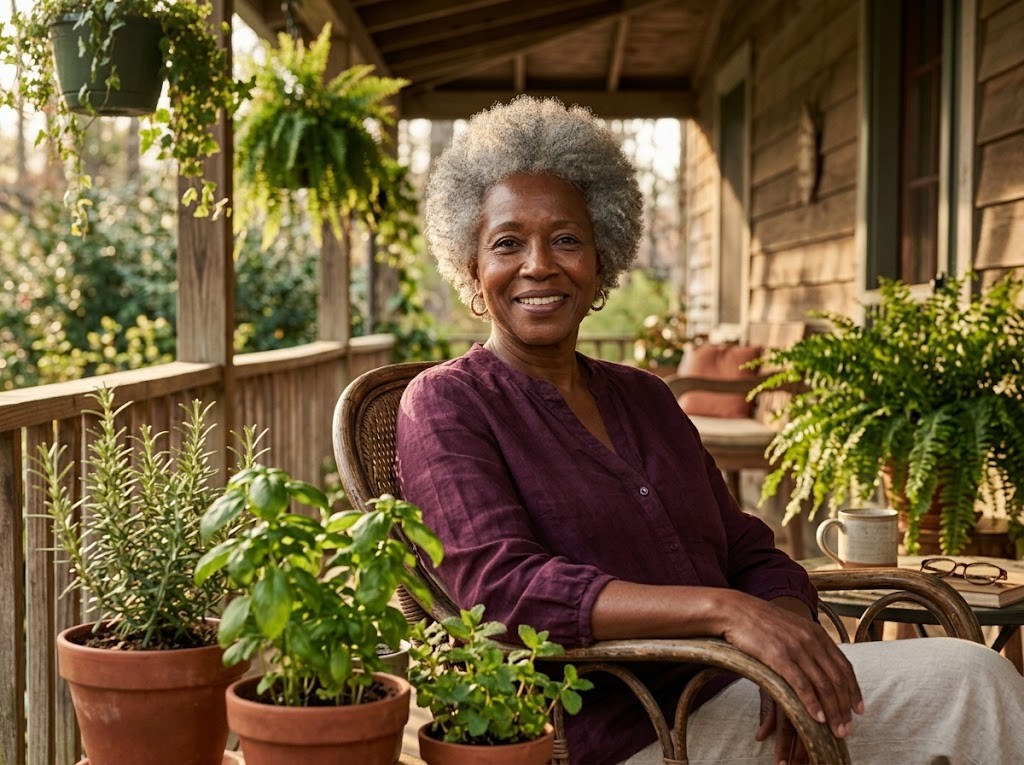
- Grey hair is drier. Use a rich conditioner every wash and a leave-in.
- Yellowing? A purple shampoo once in a while, and protect from sun and smoke.
- Short, low-tension cuts and soft twists are easy on thin hair.
- Ask about B12 if you take metformin or acid reducers, and about vitamin D. Both are often low with age.
- New medicines can cause shedding. Ask your pharmacist.
- Arthritic hands? Wide-tooth comb with a big handle, and a stylist you trust.
The five non-negotiables
- Gentle, wet, conditioned detangling.
- No pain when styling. Ever.
- Satin at night.
- Food first: protein, iron, greens, fish.
- New thinning = see a dermatologist early.
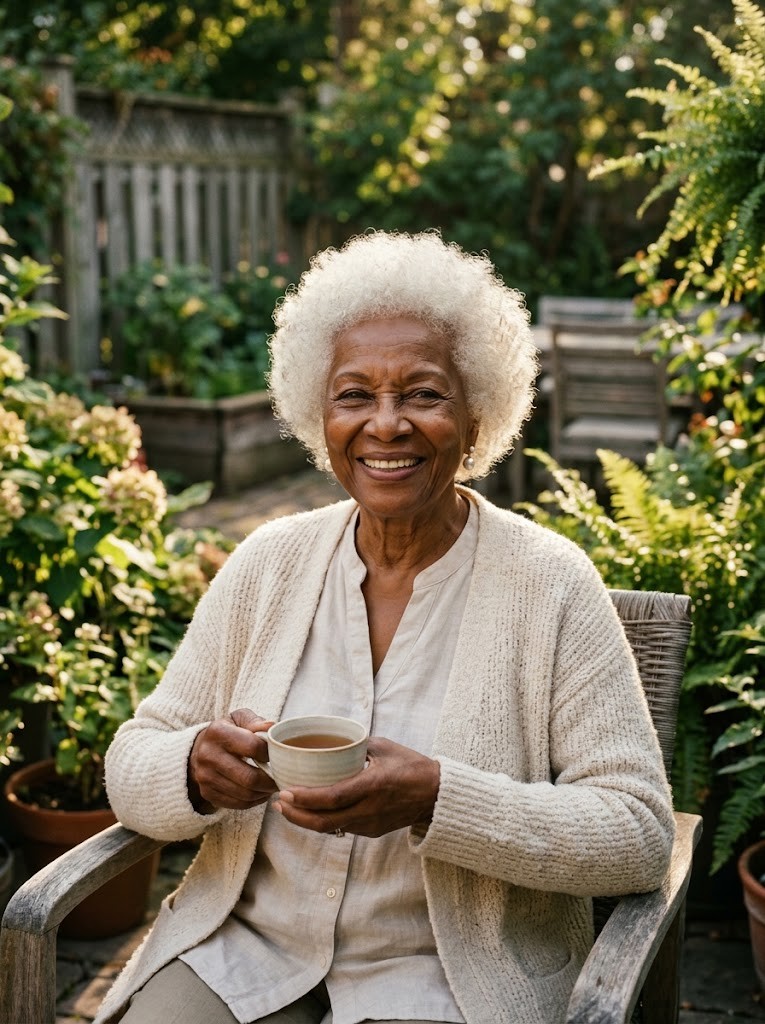
My silver came in at forty-six. I fought it for a while. Now I oil it, twist it and wear it like a crown, because it is one.
Sources: AAD, healthy hair tips · AAD, Hairstyles that pull · Cleveland Clinic, Telogen effluvium · NIH ODS, Vitamin B12 · AAD, Female pattern hair loss
Protective styles done right
Protect the hair, not just the look
A protective style tucks your ends away and cuts down on daily handling. Done too tight, too heavy or too long, it becomes the thing that hurts your hair.
Do
- Ask for looser braids at the hairline, and say so out loud if it hurts.
- Choose lighter, shorter extensions. Heavy, long hair pulls on the roots all day.
- Keep box braids, twists and sew-ins to a sensible wear time, then give your scalp a rest of a few weeks.
- Moisturize and lightly oil the scalp and lengths while in the style; rinse the scalp gently.
- Take styles down slowly with conditioner. The shed hair you see is often weeks of normal shedding that was trapped.
- Rotate where the tension sits: change parts, change the direction of buns.
Do not
- Accept "beauty is pain." Pain, bumps or headache after styling means it is too tight.
- Glue wigs or bonds onto the hairline over and over.
- Put tight braids or extensions on chemically relaxed hair, which is weaker.
- Wear the same tight ponytail or bun every day (AAD lists these as risks).
- Keep reinstalling right away with no break in between.
- Ignore small bumps along the edges. They are an early sign of traction.
| Style | Gentlest when... | Watch out for |
|---|---|---|
| Two-strand twists, flat twists | Done on your own hair, medium size | Tiny twists left in too long can mat at the root |
| Box braids / knotless braids | Knotless, light hair, loose at the edges | Weight and tight edges; small braids along the hairline |
| Cornrows | Larger rows, not pulled at the temples | Tension at the front and the nape |
| Locs | Retwisted gently and not too often | Tight retwisting and heavy, very long locs pulling on the scalp |
| Wigs | Breathable cap, no glue, scalp cared for underneath | Tight bands, glue and lace rubbing the edges |
| Sew-ins / weaves | Leave-out kept small, braids underneath loose | Itch you cannot reach, tight base braids |
| Bantu knots, puffs, low buns | Soft ties and changing positions | The same high, tight puff every day |
Sources: AAD, Hairstyles that pull can lead to hair loss · AAD, healthy hair tips · Snopes, cornrow maps fact-check
Wash day, step by step
A wash day that does not wear you out
Most of us do well washing about once a week to once every two weeks. Set aside time, put on your music, and go slow.
- Pre-poo (optional, 15 to 30 minutes)Coat dry ends with conditioner or a light oil so shampoo does not strip them.
- SectionFour to eight sections with clips or loose twists. Sections stop tangles.
- Shampoo the scalp, not the endsA sulfate-free or gentle shampoo, fingertips (not nails) on the scalp. Let the suds rinse down the lengths. Once a month or after lots of product, a clarifying wash.
- Condition and detangleLots of conditioner. Fingers first, then a wide-tooth comb, from the ends up to the roots.
- Deep condition (every week or two)10 to 30 minutes under a plastic cap. A warm towel helps.
- Rinse with cool or lukewarm waterThen squeeze water out with a cotton T-shirt or microfiber towel. No rough rubbing.
- Leave-in, then sealA water-based leave-in, then a light oil or butter (shea is a classic) on the lengths and ends.
- Style while dampTwists, braids, bantu knots or a wash-and-go.
- Low heat or air dryIf you blow-dry, use a heat protectant and low heat. Flat iron at the lowest setting that works, not every week.

Sources: AAD, healthy hair tips · AAD, hair loss tips · Crowned & Rooted history brief (shea and black soap, documented)
Food for your hair
Feed the follicle
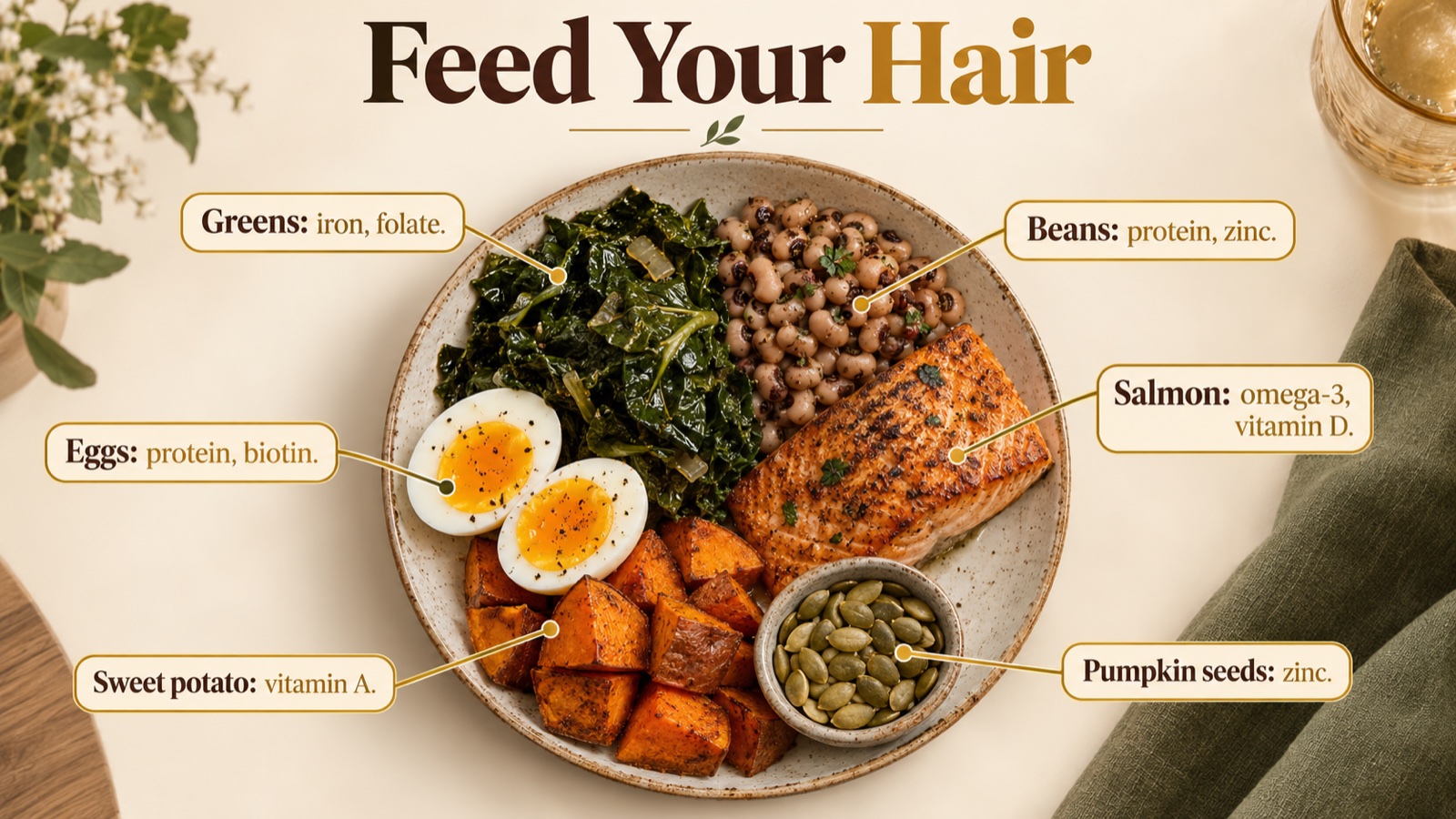
Here is the honest truth: food and vitamins fix hair loss mainly when the hair loss is caused by a shortage. If you are not low, extra pills usually do not grow more hair, and some (selenium, vitamin A) cause hair loss when overdone.
| Nutrient | Food sources | Daily amount for women | Evidence for hair |
|---|---|---|---|
| Protein | Eggs, beans, black-eyed peas, fish, chicken, turkey, Greek yogurt, tofu | About 46 g (71 g in pregnancy) | Strong Too little protein and crash diets trigger shedding |
| Iron | Lean beef, oysters, beans, lentils, collards, spinach, fortified cereal. Eat with vitamin C foods | 18 mg (ages 19 to 50); 8 mg (51+); 27 mg pregnancy | Strong if you are low; test before taking pills |
| Vitamin D | Salmon, sardines, fortified milk and plant milk, eggs | 600 IU (15 mcg); 800 IU at 71+ | Some low levels linked to hair loss; Weak for regrowth if not low |
| Zinc | Oysters, crab, beef, pumpkin seeds, beans | 8 mg (11 mg pregnancy). Do not exceed 40 mg | Some shortage causes hair loss |
| Biotin | Eggs, salmon, seeds, sweet potato | 30 mcg | Weak unless truly deficient (rare). High doses mess up lab tests |
| Omega-3 | Salmon, sardines, mackerel, walnuts, flax, chia | 1.1 g (ALA) | Weak for hair; good for skin and heart |
| Vitamin B12 | Fish, eggs, dairy, meat, fortified foods | 2.4 mcg | Weak unless low (common after 50, vegans, metformin) |
| Folate | Greens, black-eyed peas, lentils, oranges | 400 mcg DFE (600 in pregnancy) | Weak unless low; vital before pregnancy |
| Vitamin C | Peppers, citrus, guava, kiwi, berries, greens | 75 mg | Some builds collagen and helps you absorb plant iron |
| Vitamin E | Almonds, sunflower seeds, avocado | 15 mg | Weak one small trial only |
| Selenium | One or two Brazil nuts, fish, eggs | 55 mcg. Upper limit 400 mcg | Too much causes hair loss |
| Vitamin A | Sweet potato, carrots, squash, greens (as beta-carotene) | 700 mcg RAE | Too much from pills causes hair loss; food beta-carotene is safe |
Sources: NIH ODS, Iron · Vitamin D · Zinc · Biotin · Omega-3 · B12 · Folate · Vitamin C · Vitamin E · Selenium · Vitamin A · Dietary Reference Intakes (protein) · FDA, biotin interference · Selenium outbreak investigation, Archives of Internal Medicine 2010
Oils & herbs for the scalp
What the science really says
Many of these feel wonderful and are part of our heritage. Few have strong proof of growing hair. Here is each one, labelled honestly.
Rosemary oil
Origin: the Mediterranean, including the North African coast. Not a West African plant, but long at home on the continent.
A 2015 trial of 100 people with pattern hair loss compared rosemary oil with 2% minoxidil for six months. Both groups gained hair, with no real difference, and rosemary itched less. But it was small, only men, and had no placebo group, so we cannot say "it works as well as minoxidil."
Use: a few drops in a carrier oil, massaged into the scalp. Safety: always dilute; patch test; avoid eyes; ask first if pregnant or if you have seizures.
Pumpkin seed oil
Origin: pumpkins come from the Americas.
A 2014 placebo-controlled trial of 76 men with pattern hair loss found more hair with 400 mg a day of a product containing pumpkin seed oil for 24 weeks. The product had other ingredients and women were not studied.
Use: as food (pumpkin seeds are also a good zinc source) or capsules. Safety: generally food-safe; ask your doctor before capsules.
Peppermint oil
Origin: a European mint hybrid. Mint tea, though, is a daily ritual across North and West Africa.
A 2014 study in mice found 3% peppermint oil grew more follicles. No good human trials yet.
Safety: dilute well; it can burn and sting; keep away from babies' faces and eyes.
Castor oil (incl. Jamaican black castor oil)
Origin: the castor plant is native to tropical East Africa (the Horn of Africa region). Jamaican black castor oil is a roasted-bean Caribbean method.
Loved for edges and brows. No reliable human proof it regrows hair; it may add shine and reduce dryness. It will not fix traction alopecia. Changing the style will.
Safety: very thick; rare reports of severe matting on long hair.
Chebe powder
Origin: Chad. Basara Arab women mix the ground seeds (usually identified as Croton zambesicus) with oils and apply it to braided lengths, not the scalp.
No clinical trials. Any benefit comes from coating the strands and cutting breakage (length retention), not faster growth. Be wary of websites quoting a "chebe study" that cannot be found.
Safety: can build up; wash out well; patch test.
Aloe vera gel
Origin: likely the Arabian Peninsula; many aloe species are African and it is grown across the continent.
Gel soothes skin and is in many curl gels. Evidence for hair growth is weak.
Safety: use the clear gel on skin and scalp. Do not drink aloe latex or whole-leaf aloe: it is a harsh laxative, and whole-leaf extract caused cancer in rats.
Black seed oil (Nigella sativa)
Origin: Southwest Asia and the Mediterranean; used for thousands of years in Egypt, North Africa and the Middle East.
One tiny 2013 study of 20 women with shedding (telogen effluvium) used a 0.5% black seed lotion and reported improvement. Too small to rely on.
Safety: skin allergy reported with topical use; patch test. By mouth it may lower blood pressure and blood sugar.
Hibiscus rinses
Origin: roselle hibiscus (bissap, zobo, sorrel) is grown and loved across West Africa and the Caribbean.
Hair rinses are traditional only; no trials. Lovely as a tea for blood pressure (see Herbs & Teas).
Safety: may tint light or grey hair pink.
Shea butter
Origin: the African savanna belt, Senegal to Uganda.
A rich sealant for ends and twist-outs. Not a growth product, a moisture keeper.
Safety: tree-nut allergy is not usually a problem with refined shea, but patch test.
| How strong to mix essential oils | Strength | Drops per 2 tablespoons (1 oz) carrier oil |
|---|---|---|
| Face, sensitive skin, older adults | 0.5 to 1% | 3 to 6 drops |
| Scalp and body, daily | 1 to 2% | 6 to 12 drops |
| Short-term, small area | up to 3% | 18 drops |
Sources: Panahi 2015, rosemary vs minoxidil · Cho 2014, pumpkin seed oil · Oh 2014, peppermint oil in mice · NCCIH, Aloe vera · Memorial Sloan Kettering, Nigella sativa · The Zoe Report, chebe · Crowned & Rooted recipe brief (dilution chart)
Relaxers & straighteners
What the Sister Study found
This is not about shame. Plenty of us grew up getting a touch-up every six weeks. It is about knowing the facts so you can choose.
The NIH Sister Study (2022)
- About 33,500 U.S. women were followed for nearly 11 years.
- Women who used chemical hair straighteners more than four times in the past year had about twice the risk of uterine cancer compared with women who never used them.
- Estimated risk by age 70: 1.64% for never-users and 4.05% for frequent users.
- About 60% of the women who used straighteners were Black, so the burden may fall more heavily on us.
- It shows a link, not proof of cause. Brands and ingredients were not recorded.
- An earlier Sister Study report (2019) linked permanent hair dye and straighteners to higher breast cancer risk, with the dye link stronger in Black women.
Where the FDA stands (October 2026)
In October 2023 the FDA said it would propose banning formaldehyde and formaldehyde-releasing chemicals (such as methylene glycol) in hair smoothing and straightening products, with an April 2024 target. That date passed, and so did later ones. The federal regulatory agenda from July 2026 lists November 2026 for the proposal. As of October 2026, no proposed rule has been published and no ban is in place. We will update this page.
The FDA already warns that many "keratin" and "Brazilian" smoothing treatments release formaldehyde gas when heated, even some labeled "formaldehyde-free." It irritates eyes, nose and lungs, and formaldehyde is a known human carcinogen.
Sources: NIH news release, Oct 2022 · NIH, hair dye and straighteners, 2019 · FDA, Hair smoothing products that release formaldehyde · ChemLinked, November 2026 timeline · CNN, missed deadline (Jan 2026) · Crowned & Rooted history brief
What to avoid
The hair-hurting list
Tension and heat
- Tight braids, ponytails, buns and extensions, back to back
- Glue on the hairline
- Flat irons on high heat, often, with no protectant
- Relaxer and color on the same day
- Combing dry, tangled hair from the root down
Harsh or risky
- Frequent chemical straighteners (Sister Study)
- Heated smoothing treatments that release formaldehyde
- Products with no ingredient list
- Heavy fragrance if your scalp itches or burns
- Undiluted essential oils
Diet and supplements
- Crash diets and very fast weight loss (shedding two to three months later)
- Mega-doses of selenium, vitamin A, zinc or iron
- High-dose biotin without telling your doctor
- Smoking and heavy drinking
- Iron pills without a blood test
Sources: AAD, Hairstyles that pull · AAD, healthy hair tips · Cleveland Clinic · NIH ODS, Selenium · NIH ODS, Vitamin A
Thinning hair action plan
Noticed thinning? Do this, in this order
- Take photos today of your crown, part and edges in good light. Repeat monthly.
- Loosen everything. No tight styles, glue or heavy extensions for now.
- Book a board-certified dermatologist, ideally one experienced with textured hair. Crown thinning: book now.
- Ask for blood work: blood count, ferritin, thyroid (TSH), vitamin D, and anything else your doctor suggests.
- Stop high-dose biotin a few days before blood work (ask the lab how long).
- Look back two to three months. Childbirth, surgery, a fever, a new medicine, a diet, a loss? Write it down.
- Check your plate: protein at every meal, iron foods with vitamin C, fish twice a week, greens daily.
- Irregular periods, acne or chin hair too? Ask about PCOS.
- Ask about proven treatments such as minoxidil, and give any treatment at least six months.
- Be gentle with your heart. Hair loss hurts. Talk to someone you trust, and see our Mind & Sleep page.
I have watched too many sisters wait two years with a wig over a problem that needed a doctor in month one. Make the appointment. Wear the wig to it if you want.
Sources: AAD, Hair loss in Black women · AAD, CCCA · AAD, Female pattern · FDA, Biotin
Satin bonnet & pillowcase
The bonnet is self-care, not vanity
Cotton pillowcases grab and dry out coils. Rubbing all night causes friction, frizz and breakage, especially at the edges and nape. Dermatologists commonly recommend satin or silk scarves, bonnets and pillowcases to cut friction and hold moisture.
- Choose a bonnet with a soft, wide band, not a tight elastic that digs into your edges.
- Wear a satin pillowcase too, for the nights the bonnet slips off.
- Pineapple curls (a loose high ponytail with a soft tie) or big twists keep a style overnight.
- Wash bonnets and pillowcases weekly. Product build-up can clog skin and scalp.
- Make it a signal: bonnet on means the day is done.
Sources: AAD, healthy hair tips · Crowned & Rooted health brief (sleep routine)

Workout hair
Don't let your hair keep you off the walking trail
In a Wake Forest survey of 103 African American women, nearly 40% said they had avoided exercise at times because of their hair. Your heart needs that walk more than your press needs protecting.
Pick sweat-proof styles
Braids, twists, cornrows, locs, low buns and wash-and-gos hold up best. Keep them loose at the edges.
Guard the hairline
A moisture-wicking headband or a satin-lined cap or scarf under your hat soaks up sweat and protects edges.
Plan around wash day
Put your hardest workouts the day or two before wash day, so the sweat washes out on schedule.
Refresh, don't restyle
Rinse or co-wash the scalp, blot dry, re-moisturize. Skip the flat iron after every workout.

Walk with your sisters
GirlTrek walking teams, Black Girls RUN! and Black Girls Do Bike all meet women right where they are, sweat and all. Find Philadelphia groups and natural-hair care on our Philly Guide, and more on moving your body on the Body page.
Sources: Hall et al., Archives of Dermatology (via ScienceDaily) · Joseph et al., Frontiers in Public Health 2018 · AAD, Hairstyles that pull · GirlTrek