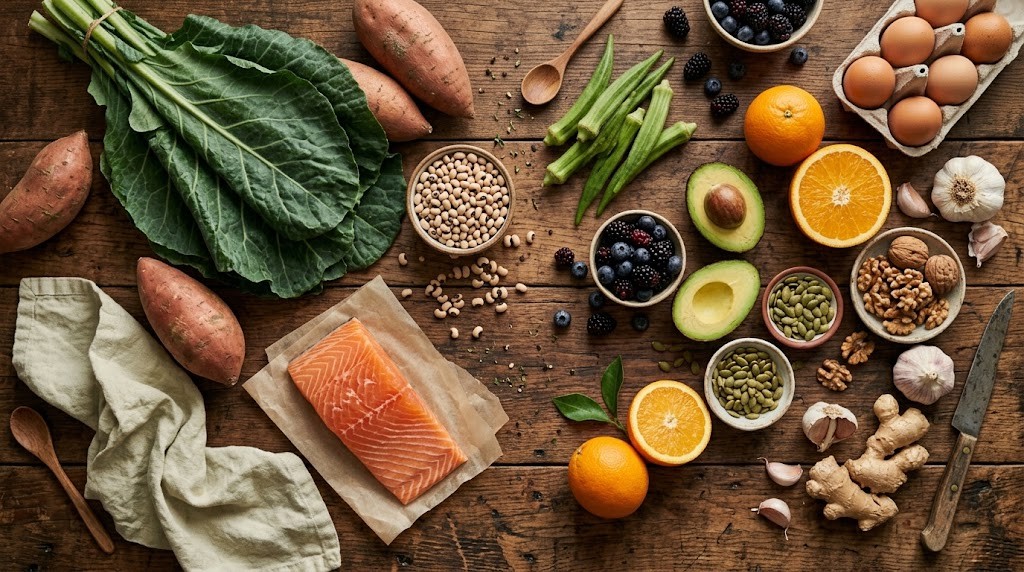
Food as Medicine
Your grandmother's plate, cooked lighter
What to eat more of, what to eat less of, and what to stay away from. Which foods help protect your heart, breasts, colon, bones, brain, hair and skin, and how strong the proof really is.
The honest truth first
No single food saves you. Your everyday pattern does.
No one food prevents or cures any disease. The American Institute for Cancer Research says it plainly: the overall way you eat matters more than any "superfood." So on this page we say "may help lower risk," never "prevents" or "cures."
Here's the good news. The pattern that protects us is the one our foremothers actually lived on: greens, beans, grains, garden vegetables, fish, and meat used as seasoning, not the center of the plate. The heavy salt, sugar and frying came later.
- Strong randomized trials or consistent big studies, backed by groups like the World Cancer Research Fund (WCRF), American Heart Association (AHA) or FDA.
- Good consistent observational studies plus some trials.
- Some mixed or limited studies, small trials.
- Early lab, animal or a few small human studies. A nice food, no promises.

Nobody's taking your collards or your Sunday dinner. We're just taking the ham hock out of the pot and putting the flavor back in with onion, garlic and a little smoke. Same love, less salt.
The three lists
Eat more · Eat less · Stay away from
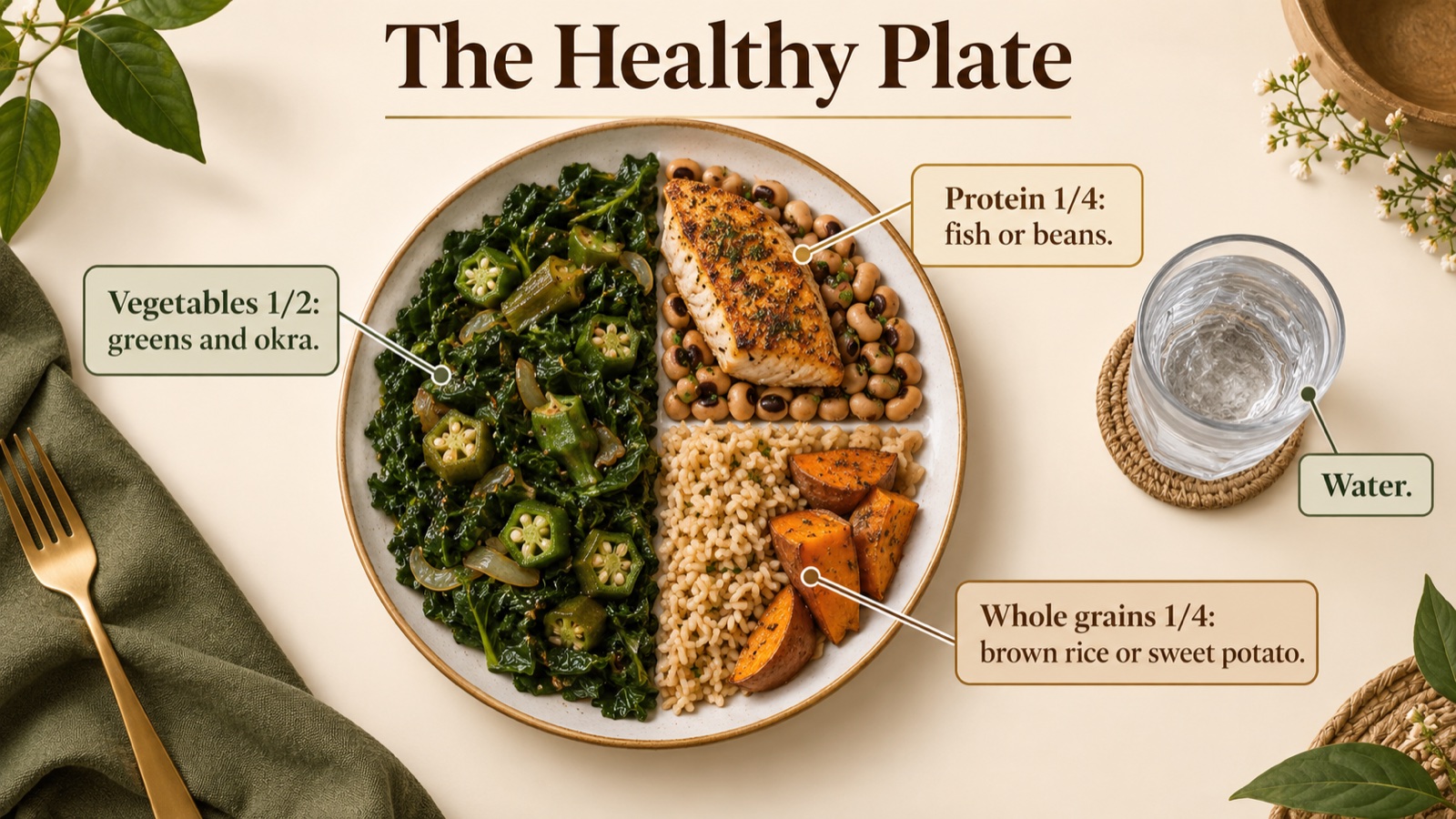
Print these and put them on the refrigerator. Every swap keeps the flavor of home.
Eat more of
| Food | Why it helps | Easy soul / Caribbean / African way to eat it |
|---|---|---|
| Leafy greens (collards, kale, callaloo, mustard, turnip greens) | Fiber, folate, calcium, vitamins A, C and K | Greens with smoked turkey or smoked paprika, not ham hock; Nigerian-style efo (spinach stew) with less oil |
| Beans and peas (black-eyed peas, red beans, lentils, chickpeas, pigeon peas) | Plant protein, iron, fiber, potassium | Rice and peas, hoppin' John, lentil soup, Ghanaian red-red (black-eyed pea stew) |
| Fatty fish (salmon, sardines, mackerel, trout) | Omega-3s for heart, skin and brain | Baked salmon, escovitch-style baked fish, salmon cakes |
| Sweet potatoes, carrots, pumpkin, squash | Beta-carotene (vitamin A) for skin | Baked, mashed with cinnamon, in soups |
| Berries, citrus, mango, guava, pineapple | Vitamin C for collagen; antioxidants | Fresh, or frozen in smoothies |
| Whole grains (oats, brown rice, millet, fonio, whole wheat) | Fiber that helps lower LDL cholesterol | Brown-rice jollof, oatmeal, fonio or millet porridge |
| Nuts and seeds (walnuts, pumpkin, sunflower, flax, sesame) | Healthy fats, zinc, vitamin E, selenium | 1–2 Tbsp on oatmeal or salads; groundnut stew made with natural peanut butter |
| Eggs, lean poultry, Greek yogurt | Protein (hair is protein), biotin | Breakfast scrambles, jerk chicken |
| Okra, tomatoes, peppers, onions, garlic | Fiber, vitamin C, flavor without salt | Okra stew, gumbo with the trinity |
| Avocado, olive oil | Heart-healthy unsaturated fat | Dressings, sautés, smoothies |
| Water and unsweetened teas | Hydration for skin and nails | Spa water, rooibos, sorrel with just a little honey |
Eat less of
| Food | Why | Better swap |
|---|---|---|
| Ham hocks, fatback, salt pork, bacon | High sodium and saturated fat | A small piece of smoked turkey, smoked paprika, liquid smoke |
| Deep-fried foods (fried chicken, fish, fritters) | Extra calories and fats | Oven or air-fried with a cornmeal crust |
| White rice, white bread, white pasta | Fast blood-sugar rise, little fiber | Brown rice, whole wheat, fonio, half cauliflower rice |
| Bouillon cubes, seasoning salt, seasoning packets | Very high sodium | Homemade salt-free seasoning, fresh herbs, citrus |
| Sweet tea, soda, fruit punch, sweetened juices | Added sugar | Sorrel or rooibos with a little honey; spa water |
| Processed and cured meats (hot dogs, sausage, deli meat, scrapple, Spam, corned beef) | Sodium and nitrites; processed meat is linked to colorectal cancer and heart disease | Fresh chicken, fish, beans |
| Butter, lard, shortening in baking | Saturated fat | Olive or avocado oil; a little butter just for flavor |
| Canned foods with added salt | Sodium | "No salt added" cans; rinse beans |
| Full-sugar desserts (pies, cobblers, cakes) | Added sugar | Fruit with cinnamon, a sweet potato pie smoothie, smaller slices |
| Alcohol | Raises blood pressure and breast cancer risk; dries skin | Sparkling water with lime and mint, or a sorrel spritzer |
Stay away from
| Item | Why | Notes |
|---|---|---|
| Trans fats ("partially hydrogenated oil" on labels) | Raise bad cholesterol and lower good | Mostly gone from US food, but check imported and older products |
| Tobacco and vaping | Damage blood vessels, age skin, harm hair follicles | Free help: 1-800-QUIT-NOW |
| "Detox" teas, laxative teas, megadose "hair growth" pills | Dehydration, electrolyte problems; high-dose biotin can throw off lab tests, including heart-attack tests | Tell your doctor about every supplement before blood work |
| Swallowing essential oils | Can be toxic even in small amounts | Diluted skin and scalp use only |
| Unripe or badly prepared ackee | Hypoglycin can cause dangerously low blood sugar | Eat only fully opened, properly prepared ackee from trusted sources |
| Licorice root tea or real black licorice in large amounts | Can raise blood pressure and lower potassium | Avoid especially with high BP or heart problems |
| Grapefruit with certain medicines | Interacts with some statins, BP and heart medicines | Ask your pharmacist |
| Untested sea moss, herbal powders, skin-lightening creams | Possible heavy metals, mercury, steroids or hydroquinone | Buy only products with ingredient lists and third-party testing |
| Honey for babies under 1 | Infant botulism risk | Fine for older kids and adults |
| Mixing herbs with blood thinners, BP, thyroid or diabetes medicines without asking | Can make medicines too strong or too weak | One call to your pharmacist is free |
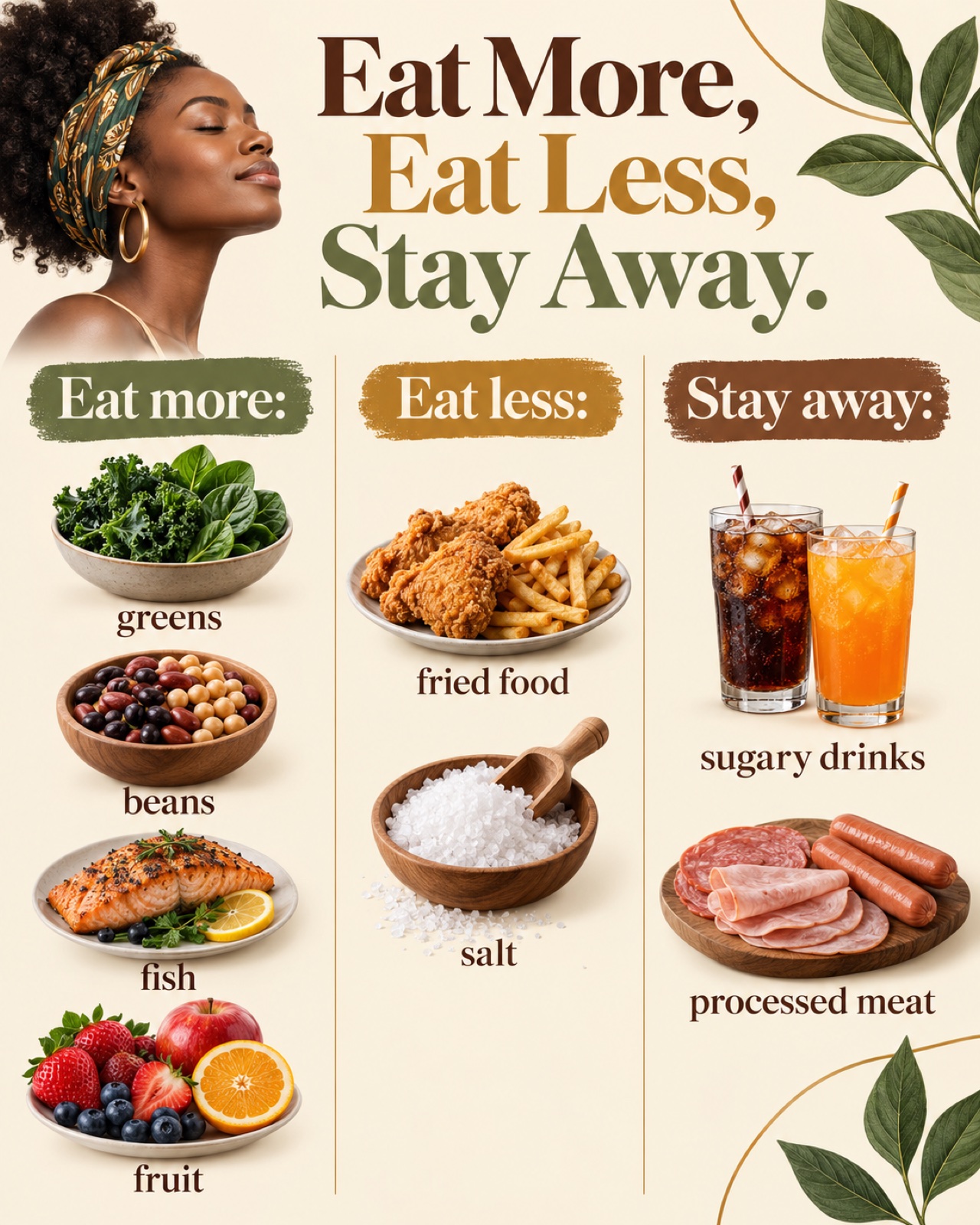
Sources: American Diabetes Association plate method · AHA diet recommendations · FDA trans fat · FDA biotin warning · CDC tobacco · NCCIH licorice root
The master chart
Food → what it may help protect against
Forty-two everyday foods, the nutrient that matters, what the research links it to, how strong that research is, and where the food comes from. Short-hand: heart, BP (blood pressure), cancer, diabetes (type 2), bone, brain, gut, fibroids, inflammation.
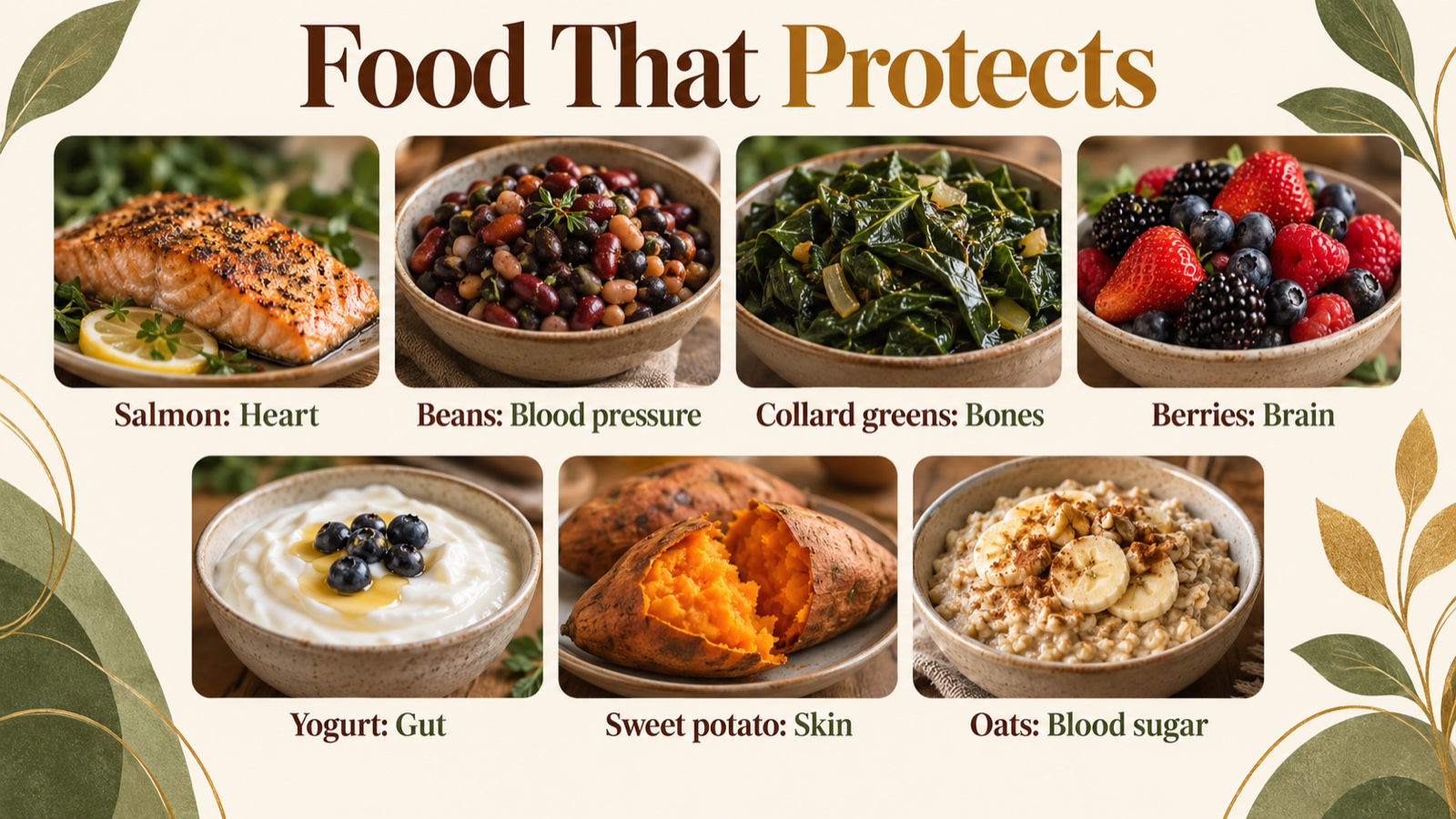
| # | Food | Key nutrient | Helps with | Evidence | African / diaspora roots |
|---|---|---|---|---|---|
| 1 | Broccoli, cabbage, cauliflower, Brussels sprouts, kale | Sulforaphane, fiber, vitamin C, folate | Cancer (colorectal, breast), heart, gut. Human proof is mostly observational. | Some | Mediterranean and European in origin. Cabbage is now an everyday stew and slaw vegetable in Ghana, Nigeria and the US South. |
| 2 | Collard, mustard and turnip greens; spinach | Folate, vitamin K, carotenoids, calcium, magnesium, nitrates | Heart, BP, bone, brain, cancer, fibroids. Non-starchy vegetables linked (limited) to lower ER-negative breast cancer. Warfarin: keep greens steady. | Good | Collards are Mediterranean, but slow-cooked greens with pot likker echo West African leaf stews (efo, cassava-leaf and potato-leaf stews). |
| 3 | Berries | Anthocyanins, vitamin C, fiber | Heart, brain, cancer, diabetes. Brain link is observational. | Some | North American and European. Not African. |
| 4 | Tomatoes (cooked, sauce, paste) | Lycopene, vitamin C, potassium | Heart, skin, cancer. Absorbs better cooked with a little oil. Not a sunscreen. | Some | South American in origin; now the red heart of West African stews and jollof. |
| 5 | Beans, lentils, chickpeas | Fiber, plant protein, folate, potassium, iron | Heart, BP, diabetes, colorectal cancer, gut, weight. Core of DASH. | Strong | Cowpeas and pigeon peas are African crops; kidney and pinto beans are American; lentils are Near Eastern and central to Ethiopian cooking (misir wot). |
| 6 | Black-eyed peas | Fiber, folate, protein, iron, potassium | Heart, diabetes, gut, anemia | Good | Domesticated in West Africa and carried across the Atlantic. New Year's hoppin' John; akara and moin moin in Nigeria. [Documented] |
| 7 | Whole grains (brown rice, whole wheat, barley, quinoa) | Fiber, magnesium, B vitamins | Heart, diabetes, colorectal cancer (WCRF "probable"), gut | Strong | Africa gave the world African rice (domesticated along the Niger), sorghum, pearl millet, fonio and teff. West African women's rice skill shaped Carolina rice culture. [Documented] |
| 8 | Oats | Beta-glucan soluble fiber | LDL cholesterol (FDA-authorized claim), diabetes, gut. Choose plain oats. | Strong | European grain. The African cousin: millet, sorghum or fonio porridge. |
| 9 | Ground flaxseed | ALA omega-3, lignans, fiber | Heart, BP, gut. AICR: safe to eat; breast-cancer benefit not proven. Grind it. | Some | Near Eastern crop long grown in Ethiopia, where flaxseed (telba) is made into a drink. |
| 10 | Garlic, onions | Organosulfur compounds, quercetin | Heart, colorectal and stomach cancer (limited), inflammation. Garlic pills can thin blood. | Some | Central Asian in origin; eaten in ancient Egypt, where an old Greek account says pyramid workers were fed garlic and onions. [Ancient account] |
| 11 | Turmeric | Curcumin | Inflammation, joint pain. Supplements linked to liver injury; use as a spice. | Early | South Asian. Came to the Caribbean with Indian communities. Not African. |
| 12 | Ginger | Gingerols | Nausea (best-supported), inflammation, gut | Good nausea | Southeast Asian, but grown in West Africa for centuries; Nigeria is now a top grower. |
| 13 | Green tea | EGCG catechins | Heart, cancer, brain. Brewed tea is fine; extract pills linked to liver injury. | Some | Chinese. North Africa made it its own: Moroccan mint tea is brewed with Chinese green tea. |
| 14 | Citrus | Vitamin C, flavonoids, potassium, folate | Heart, skin (collagen), iron absorption, immunity. Grapefruit interacts with many drugs. | Good | Asian in origin; limes and sour oranges are now basic to Caribbean and West African cooking. |
| 15 | Sweet potato | Beta-carotene, fiber, potassium | Heart, BP, skin, gentler on blood sugar than white potato | Some | American. Enslaved Africans cooked it in place of West African yams, and the word "yam" stuck. [Documented] |
| 16 | Carrots | Beta-carotene, fiber | Skin, eyes, cancer (limited), heart | Some | Central Asian. Not African. |
| 17 | Okra | Soluble fiber, folate, vitamin K, magnesium | Gut, diabetes and heart (lab/animal studies only). Roast or stew, don't deep-fry. | Early | An African crop. "Gumbo" comes from Bantu words for okra. [Documented] |
| 18 | Salmon, sardines | EPA/DHA omega-3, vitamin D, protein | Heart, brain, bone, inflammation, fibroids (vitamin D). AHA: fish twice a week. Low mercury. | Good | Smoked mackerel and herring are kitchen staples in Ghana and Nigeria; Senegal and Morocco fish for sardines. |
| 19 | Walnuts | ALA omega-3, polyphenols | Heart, brain (PREDIMED trial used nuts) | Good | Not African. |
| 20 | Almonds | Vitamin E, magnesium, fiber, calcium | LDL cholesterol, diabetes, skin. A small handful is a serving. | Good | Near Eastern; grown in Morocco and across North Africa. |
| 21 | Avocado | Monounsaturated fat, fiber, potassium, folate | Heart, BP when it replaces butter or processed meat | Some | Mexican. Kenya is now Africa's leading avocado exporter. |
| 22 | Extra-virgin olive oil | Monounsaturated fat, polyphenols | Heart (PREDIMED randomized trial), diabetes, brain, inflammation | Good | Mediterranean, including North Africa: Tunisia and Morocco are major olive oil makers. |
| 23 | Apples | Pectin fiber, quercetin | Heart, diabetes, gut. Pennsylvania grows lots; keeps all winter. | Some | Central Asian. A Pennsylvania food, not an African one. |
| 24 | Mushrooms | Fiber, B vitamins, selenium; vitamin D if UV-exposed | Bone (UV mushrooms), inflammation, cancer (early) | Early | Local: Kennett Square, PA is the mushroom center of the US. |
| 25 | Yogurt, kefir | Probiotics, calcium, protein | Gut, bone, diabetes (FDA qualified claim, "limited evidence"), fibroids (dairy). Pick plain. | Some | Fermented milk is old African food: Fulani nono in West Africa, Maasai and Kalenjin soured milk in East Africa. |
| 26 | Eggs | Protein, choline, lutein, vitamin D, B12 | Brain, eyes, hair (protein), muscle. AHA: about one a day fits for healthy people. | Some | Eaten everywhere; boiled eggs go into West African stews and Nigerian egg sauce. |
| 27 | Pumpkin seeds | Magnesium, zinc, iron, protein | BP, hair (zinc and iron), bone, diabetes. Good for anemia-prone women. | Some | Squash is American. The West African cousin is egusi, ground melon seeds that thicken soups. |
| 28 | Brazil nuts | Selenium (very high) | Thyroid, antioxidant enzymes. Limit to 1–2 a day: too much selenium causes hair loss and brittle nails. | Some | South American. Not African. |
| 29 | Watermelon | Lycopene, citrulline, water, potassium | Hydration, heart, skin. Small studies only. | Early | An African domesticate, from northeast Africa; it came to the Americas with Africans. [Documented: Carney & Rosomoff] |
| 30 | Beets, beet juice | Nitrates, folate, potassium | BP (short-term in small trials), stamina. High oxalate: careful with kidney stones. | Some | Mediterranean. Not African. |
| 31 | Bananas | Potassium, fiber | BP and heart through potassium (DASH), gut. Kidney disease: ask about potassium. | Good | Southeast Asian, but bananas and plantains have fed East and Central Africa for many centuries (Ugandan matoke). |
| 32 | Hibiscus tea (sorrel, bissap) | Anthocyanins | BP: a small, short trial showed a modest drop. Ask your clinician if pregnant or on BP or water pills. Skip the sugar. | Some | West African: bissap in Senegal and Mali, zobo in Nigeria; carried to the Caribbean as sorrel. [Documented] |
| 33 | Cinnamon | Polyphenols | Blood sugar: trials mixed. Cassia contains coumarin; spice amounts only. | Early | Sri Lankan and Chinese. Not African. |
| 34 | Dark chocolate (70%+) | Cocoa flavanols, magnesium | Heart, BP. The big COSMOS trial's cocoa supplement did not cut total heart events. A treat, not medicine. | Early | Cocoa is American, but Côte d'Ivoire and Ghana now grow most of the world's cocoa. |
| 35 | Coffee | Chlorogenic acids, caffeine | Endometrial and liver cancer (WCRF "probable" lower risk), diabetes. Skip sugary creamers. Pregnancy: under 200 mg caffeine a day. | Good | Born in Africa: coffee comes from the highlands of Ethiopia, home of the buna coffee ceremony. [Documented] |
| 36 | Water | Hydration | Kidney stones, skin, gut, weight (when it replaces sugary drinks) | Some | — |
| 37 | Soy foods (tofu, edamame, soy milk) | Isoflavones, protein, fiber | Heart, bone, breast cancer. AICR: soy foods are safe, even for breast cancer survivors; supplements differ. | Good | East Asian. Not African. |
| 38 | Peanuts, natural peanut butter | Healthy fats, niacin, protein | Heart, diabetes. No added sugar or hydrogenated oil. | Good | South American, taken to Africa, then brought to the South by enslaved Africans; "goober" is from Kikongo nguba. Groundnut stew (maafe) is West African. [Documented] |
| 39 | Cantaloupe, mango, peaches | Beta-carotene, vitamin C, potassium | Skin, heart. Fruit linked to fewer fibroids in the Black Women's Health Study. | Some | Mango is South Asian and now grows all over West Africa and the Caribbean; peaches are Chinese. |
| 40 | Low-fat milk, fortified dairy | Calcium, vitamin D, potassium | Bone, BP (DASH), colorectal cancer (WCRF "probable"), fibroids. Lactose-intolerant? Lactose-free milk, yogurt, fortified soy. | Good | Herding peoples like the Fulani and Maasai built whole cultures on milk; many other Africans are lactose intolerant, so alternatives are fine. |
| 41 | Sardines or canned salmon with bones | Calcium, vitamin D, omega-3 | Bone, heart. The cheapest calcium-plus-D for non-milk drinkers. | Good | Canned sardines are a pantry staple across West Africa. |
| 42 | Lean poultry, fish, beans instead of red meat | Iron, protein | Anemia, hair, muscle, without the colorectal risk of red and processed meat | Good | Our ancestors mostly used meat to season vegetables, beans and grains, not as the whole plate. |
Sources: AICR Foods That Fight Cancer · WCRF/AICR recommendations · Harvard Nutrition Source · AHA fish · NIH ODS selenium · NCCIH turmeric · NCCIH green tea · FDA yogurt claim · USDA hibiscus trial · PREDIMED · COSMOS cocoa · Roots: Carney & Rosomoff, Jessica B. Harris, NPS Gullah
Condition by condition
What food can (and can't) do
Open the one you care about. Each says what to eat more of, less of, what to avoid, and how strong the proof is, honestly.
Breast cancer (including triple-negative)
Black women are about twice as likely as white women to get triple-negative breast cancer (TNBC). In one Women's Health Initiative analysis, about half of that gap was statistically explained by metabolic problems: a large waist, diabetes, high cholesterol and high blood pressure. Those are things eating and movement affect. But be clear: no diet has been proven to prevent triple-negative breast cancer. There is very little direct research.
Other strong levers: staying active; a healthy weight after menopause; breastfeeding (WCRF "convincing"). Honest detail: WCRF found more body fat in young adulthood is linked to slightly lower premenopausal breast cancer, so it's not as simple as "weight = cancer." Mammograms start at 40 (USPSTF 2024).
Alcohol: StrongWeight after menopause: StrongVegetables & ER-negative: SomeDiet for TNBC in Black women: Early
Sources: WCRF breast cancer · Surgeon General alcohol advisory · TNBC risk meta-analysis · USPSTF 2024
Colorectal cancer
Other: body fat raises risk and activity lowers it (both "convincing"). Start colon screening at 45 (USPSTF), earlier with family history.
Strong
Sources: WCRF colorectal · IARC Q&A · WCRF red meat
Uterine (endometrial) cancer
Black women have higher death rates from uterine cancer (NCI). The biggest food-related lever is body weight: WCRF calls body fat a convincing cause.
Weight: StrongCoffee & glycemic load: Good
Sources: WCRF endometrial · NCI uterine cancer · NIEHS Sister Study
Cervical cancer
Truth first: cervical cancer is caused by HPV. The big protections are the HPV vaccine, Pap/HPV screening and not smoking, not food. Fruits and vegetables (folate, carotenoids, vitamin C) support overall cell and immune health.
Vaccine + screening: StrongDiet: Some/Early
Sources: NCI cervical · CDC prevention
Heart disease
The PREDIMED randomized trial found a Mediterranean pattern with olive oil or nuts lowered heart events. Heart disease is the leading killer of American women; Go Red for Women's message is to know your numbers: blood pressure, cholesterol, blood sugar.
Strong
Sources: AHA recommendations · Go Red for Women · PREDIMED
High blood pressure (the DASH plan)
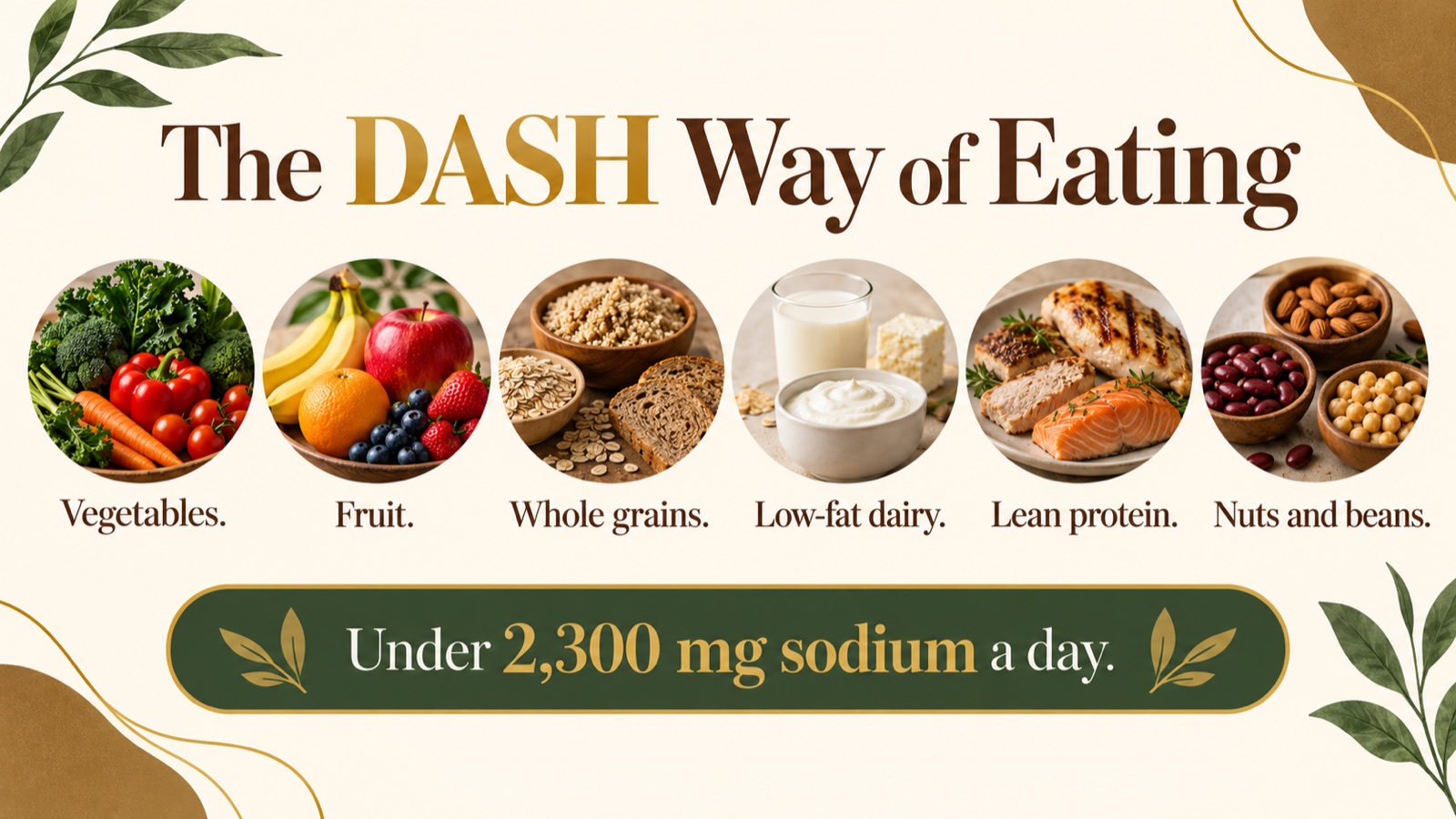
DASH (Dietary Approaches to Stop Hypertension, from the NIH) is built on vegetables, fruit, low-fat dairy, whole grains, beans, nuts, fish and poultry, and is low in saturated fat and sweets. In trials it lowered blood pressure within about two weeks, and more when sodium was also cut.
Strong
Sources: NHLBI DASH · AHA sodium · FDA sodium
Type 2 diabetes
Proof it works: in the original Diabetes Prevention Program trial, modest weight loss plus activity cut the risk of type 2 diabetes by 58%. The CDC's National DPP offers this as a program in Philadelphia and online.
Strong
Sources: ADA food & nutrition · CDC Diabetes Prevention Program · Harvard sugary drinks
Uterine fibroids
Fibroids are far more common and more severe in Black women. The diet research is observational: it shows links, not proof.
Heavy bleeding from fibroids can cause anemia; see the anemia section below.
Vitamin D: SomeDairy / fruit: SomeRed meat: Early
Sources: Baird et al., Epidemiology 2013 · Black Women's Health Study · Wise et al., AJCN 2011 · fibroid diet review
Hair loss
Truth first: for Black women the biggest causes are often traction alopecia (from tight styles) and CCCA (central centrifugal cicatricial alopecia, a scarring loss that starts at the crown). Those are styling and scalp problems, not food. See a dermatologist early; scarring hair loss can be permanent.
Fixing a deficiency: Good"Hair foods" without deficiency: Early
Sources: AAD hair-loss causes · AAD traction alopecia · FDA biotin · NIH ODS iron
Skin aging and dark spots
The biggest levers are sun protection and not smoking. Melanin helps, but it doesn't prevent sun damage, dark spots or skin cancer. The AAD advises broad-spectrum SPF 30+ for everyone; tinted sunscreens with iron oxides help more against the visible light that darkens melasma.
Some
Sources: AAD skin aging · AAD acne and diet · AAD sunscreen
Bones (osteoporosis)
Black women have higher average bone density but still get osteoporosis, and are less likely to be screened or treated; outcomes after a hip fracture can be worse. Ask about a bone density scan at 65, or sooner with risk factors. Lactose intolerant? Use lactose-free milk, yogurt or fortified soy.
Calcium + D + exercise: Strong
Sources: NIH ODS calcium · NIH ODS vitamin D · Bone Health & Osteoporosis Foundation
Anemia (low iron)
Heavy periods, including from fibroids, are a major cause of low iron in women.
Strong
Sources: NIH ODS iron · NHLBI iron-deficiency anemia
Kidneys
Black Americans are more than four times as likely as white Americans to develop kidney failure (NIDDK). High blood pressure and diabetes are the main drivers, and APOL1 gene variants also play a part.
BP and sugar control: StrongDiet details: individual
Sources: NIDDK race and kidney disease · NIDDK CKD eating · National Kidney Foundation
Brain health and Alzheimer's (the MIND diet)
MIND mixes Mediterranean and DASH: leafy greens, other vegetables, berries, nuts, beans, whole grains, fish, poultry, olive oil; less butter, cheese, red meat, fried or fast food, and pastries.
Honest evidence: observational studies linked MIND to slower memory decline. But the 2023 randomized trial in the New England Journal of Medicine (604 older adults, 3 years) found no significant difference versus a control diet. Both groups improved, likely from counseling and mild weight loss.
Still worth it: what's good for blood vessels and blood pressure is good for the brain. Black Americans have higher Alzheimer's and dementia rates, and high BP and diabetes are key drivers.
Some
Sources: MIND trial, NEJM 2023 · MIND review · Alzheimer's Association
Mood and depression
The small SMILES trial (2017, 67 people) found a Mediterranean-style diet with a dietitian's help improved depression symptoms more than social support alone. Big observational studies link ultra-processed foods and sugary drinks to higher depression risk.
Some
Sources: SMILES trial · NIMH depression
PCOS
The 2023 International Evidence-based PCOS Guideline says no one diet type is proven better than another. General healthy eating and activity, plus weight loss where it applies, improve insulin resistance and symptoms.
Healthy eating: GoodSpecial "PCOS diets": Early
Sources: 2023 PCOS Guideline (Monash) · NICHD PCOS
Lupus
Lupus is 2–3 times more common in Black women and often more severe.
Some / Early
Sources: Lupus Foundation of America · Johns Hopkins Lupus Center · CDC lupus
I won't lie to you to sell you a tea. Some of this has strong proof and some of it is just a good habit. Eat the greens anyway, and still keep your mammogram, your colonoscopy and your blood pressure check. Food and the doctor work together.
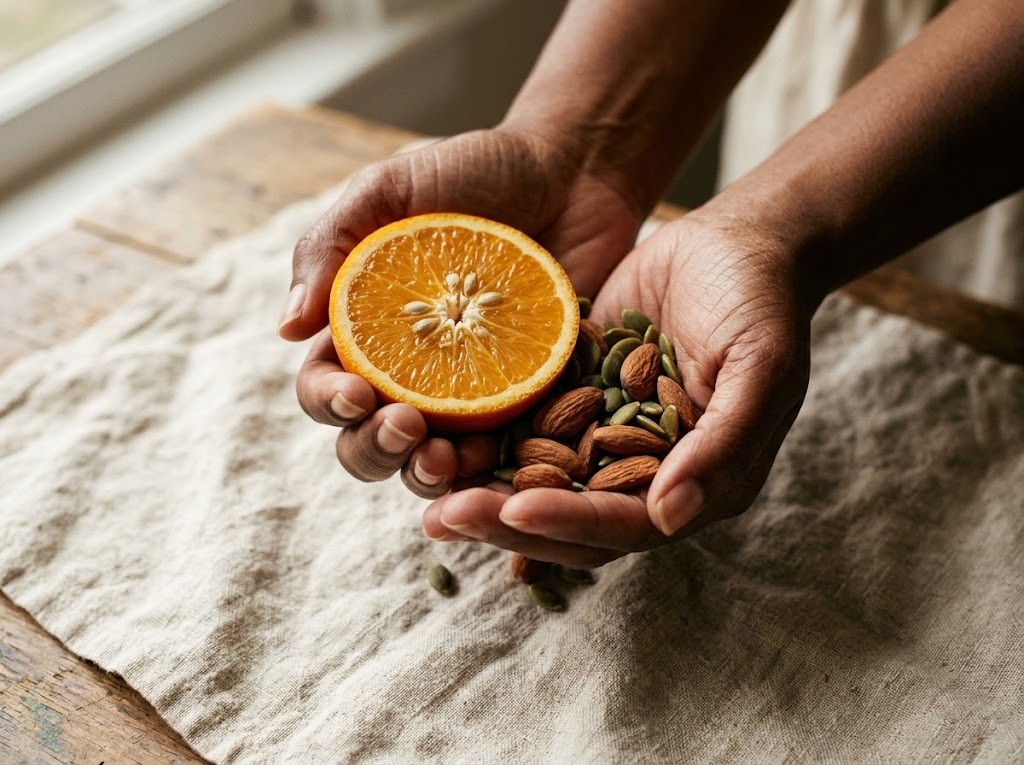
Beauty from the plate
Foods for hair, skin and nails
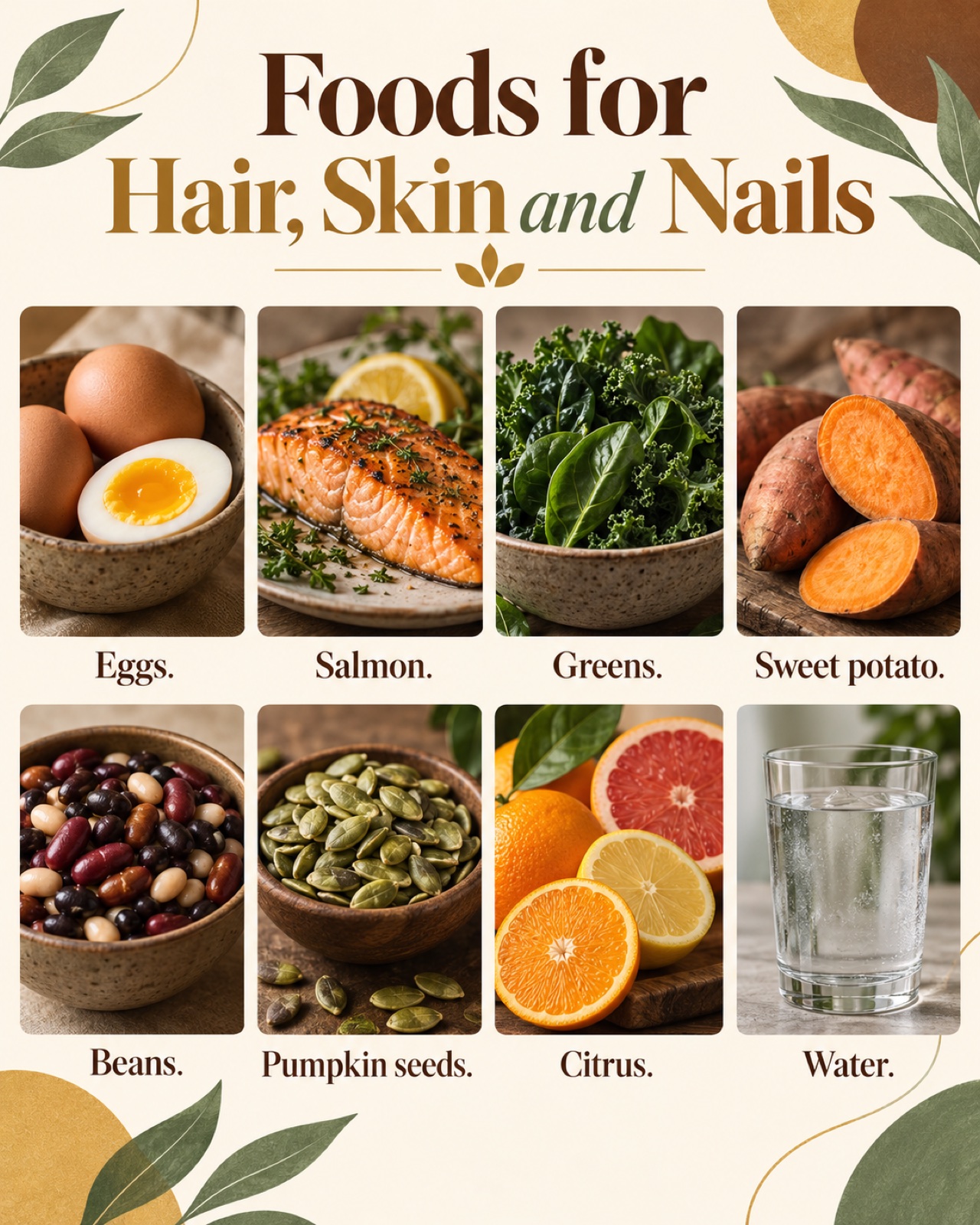
Food fixes hair, skin and nail problems mainly when the problem is caused by a deficiency: low iron, low protein, very low calories. If you aren't low, extra vitamins usually don't grow more hair, and some (selenium, vitamin A) cause hair loss when overdone.
The good news: most of the best foods are already our kitchen staples. Greens, black-eyed peas, sardines, sweet potatoes and okra. Think "your grandmother's plate, cooked lighter," not foreign superfoods.
| Food | Key nutrients | Why it matters |
|---|---|---|
| Eggs | Protein, biotin (about 10 mcg per egg), B12, selenium | Hair is mostly keratin, a protein; biotin and B12 support new cells |
| Salmon, sardines, mackerel | Omega-3 (EPA/DHA), vitamin D, protein, B12, selenium | One of the few natural vitamin D foods; omega-3s support the skin barrier |
| Oysters, crab, lean beef | Zinc (oysters are the richest), iron, B12 | Low zinc is linked to hair loss and slow healing |
| Leafy greens | Folate, beta-carotene, vitamin C, plant iron, vitamin K | Folate supports cell division; vitamin C helps absorb plant iron |
| Sweet potato, carrots, butternut squash | Beta-carotene | Vitamin A for skin cell turnover; food beta-carotene does not cause the overdose pills can |
| Beans, lentils, black-eyed peas, chickpeas | Plant protein, iron, zinc, folate, fiber | Cheap protein plus iron; pair with vitamin C foods |
| Nuts and seeds (almonds, sunflower, pumpkin, walnuts, flax, chia) | Vitamin E, zinc, ALA omega-3, protein | Vitamin E is an antioxidant for skin; pumpkin seeds are a good zinc source |
| Brazil nuts | Selenium, very high | One or two is plenty. 6–8 nuts can pass the daily safe upper limit |
| Avocado | Vitamin E, healthy fats, folate | Fats help you absorb vitamins A, D, E and K |
| Berries, citrus, bell peppers, guava, kiwi | Vitamin C, polyphenols | Vitamin C is required to build collagen |
| Greek yogurt, cottage cheese, chicken, turkey, tofu | Protein, B12 | Enough daily protein prevents protein-related shedding |
| Fortified cereals and plant milks | Vitamin D, B12, folic acid, iron | Important for vegans and women over 50 |
| Water | Hydration | Dry, dull skin and brittle nails show dehydration first |
Sources: NIH ODS biotin · ODS zinc · ODS vitamin A · ODS vitamin C · 2008 selenium outbreak · AAD hair loss
How much do I need?
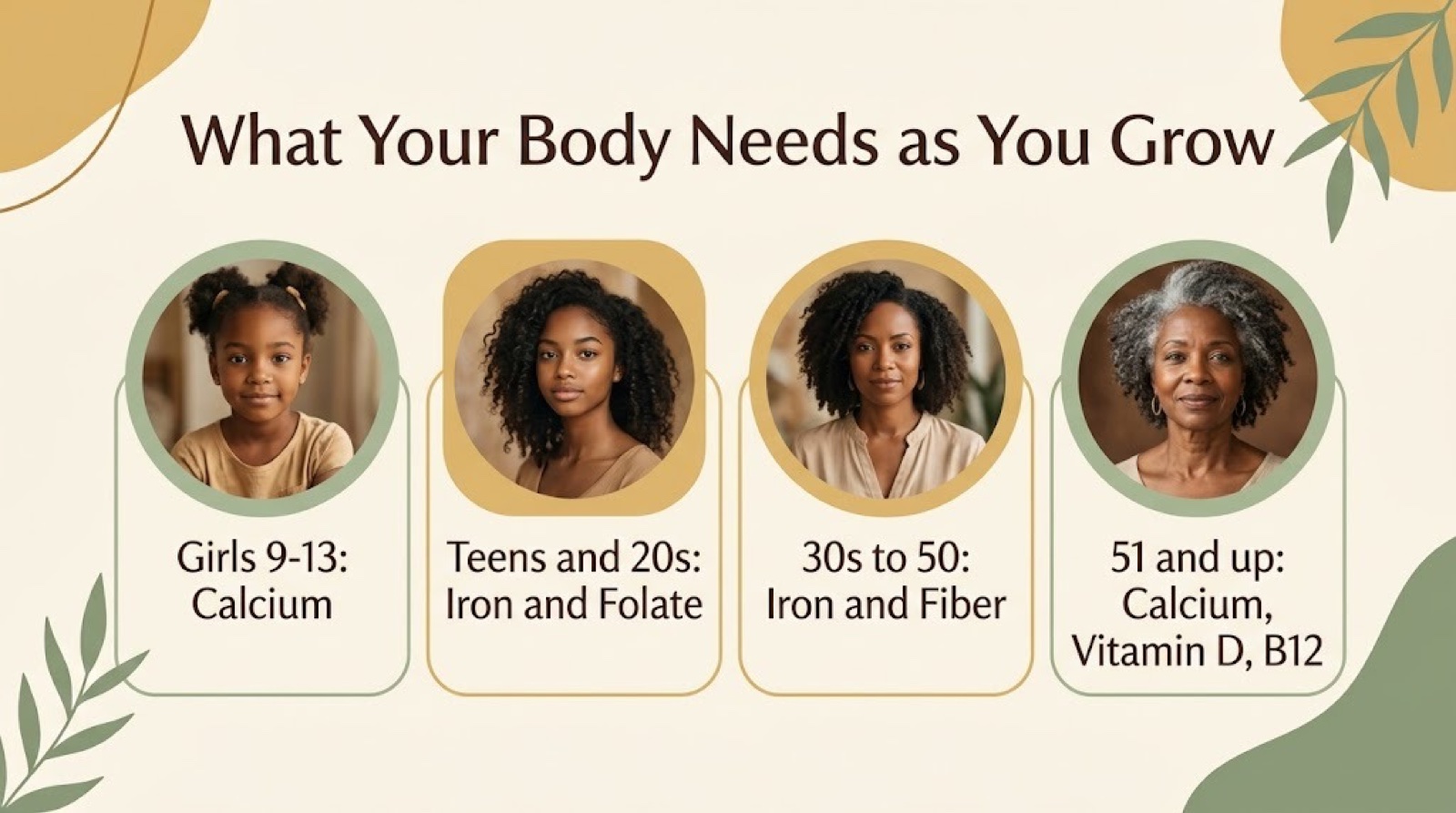
Key vitamins and minerals for girls and women, by age
Daily amounts from the NIH Office of Dietary Supplements (RDA, or AI where marked) and the Dietary Guidelines for fiber. These are food targets, not a reason to buy pills. Your doctor may advise more or less.



| Nutrient | Girls 9–13 | Teens 14–18 | Women 19–30 | Women 31–50 | Women 51–70 | Women 71+ | Pregnancy (19+) | Good food sources |
|---|---|---|---|---|---|---|---|---|
| Calcium | 1,300 mg | 1,300 mg | 1,000 mg | 1,000 mg | 1,200 mg | 1,200 mg | 1,000 mg | Milk, yogurt, fortified soy milk, collards, sardines with bones, calcium tofu |
| Vitamin D | 600 IU | 600 IU | 600 IU | 600 IU | 600 IU | 800 IU | 600 IU | Salmon, sardines, eggs, fortified milk, UV mushrooms |
| Iron | 8 mg | 15 mg | 18 mg | 18 mg | 8 mg | 8 mg | 27 mg | Beans, greens, lean meat, sardines, pumpkin seeds, fortified cereal |
| Folate (DFE) | 300 mcg | 400 mcg | 400 mcg | 400 mcg | 400 mcg | 400 mcg | 600 mcg | Black-eyed peas, lentils, greens, oranges, fortified grains |
| Vitamin B12 | 1.8 mcg | 2.4 mcg | 2.4 mcg | 2.4 mcg | 2.4 mcg* | 2.4 mcg* | 2.6 mcg | Fish, eggs, dairy, fortified cereal (*after 50, fortified foods absorb best) |
| Zinc | 8 mg | 9 mg | 8 mg | 8 mg | 8 mg | 8 mg | 11 mg | Oysters, beef, crab, pumpkin seeds, beans |
| Vitamin C | 45 mg | 65 mg | 75 mg | 75 mg | 75 mg | 75 mg | 85 mg | Citrus, peppers, guava, strawberries, tomatoes |
| Vitamin A (RAE) | 600 mcg | 700 mcg | 700 mcg | 700 mcg | 700 mcg | 700 mcg | 770 mcg | Sweet potato, carrots, greens, mango (beta-carotene is safest) |
| Magnesium | 240 mg | 360 mg | 310 mg | 320 mg | 320 mg | 320 mg | 350–360 mg | Pumpkin seeds, almonds, beans, greens, whole grains |
| Potassium (AI) | 2,300 mg | 2,300 mg | 2,600 mg | 2,600 mg | 2,600 mg | 2,600 mg | 2,900 mg | Beans, bananas, sweet potatoes, greens, yogurt (kidney disease: ask) |
| Iodine | 120 mcg | 150 mcg | 150 mcg | 150 mcg | 150 mcg | 150 mcg | 220 mcg | Iodized salt (a little), dairy, eggs, fish |
| Protein | 34 g | 46 g | 46 g | 46 g | 46 g | 46 g | 71 g | Eggs, beans, fish, poultry, yogurt, tofu |
| Fiber | 22 g | 25 g | 28 g | 25 g | 22 g | 22 g | 28 g | Beans, whole grains, vegetables, fruit, seeds |
| Sodium (limit) | under 1,800 mg | under 2,300 mg | under 2,300 mg | under 2,300 mg | under 2,300 mg | under 2,300 mg | under 2,300 mg | AHA ideal for most adults: 1,500 mg |
Sources: NIH Office of Dietary Supplements fact sheets (calcium, vitamin D, iron, folate, B12, zinc, vitamins C and A, magnesium, potassium, iodine) · Dietary Reference Intakes · Dietary Guidelines for Americans (fiber, sodium) · NHANES vitamin D analysis
Know the risks
Things that raise risk
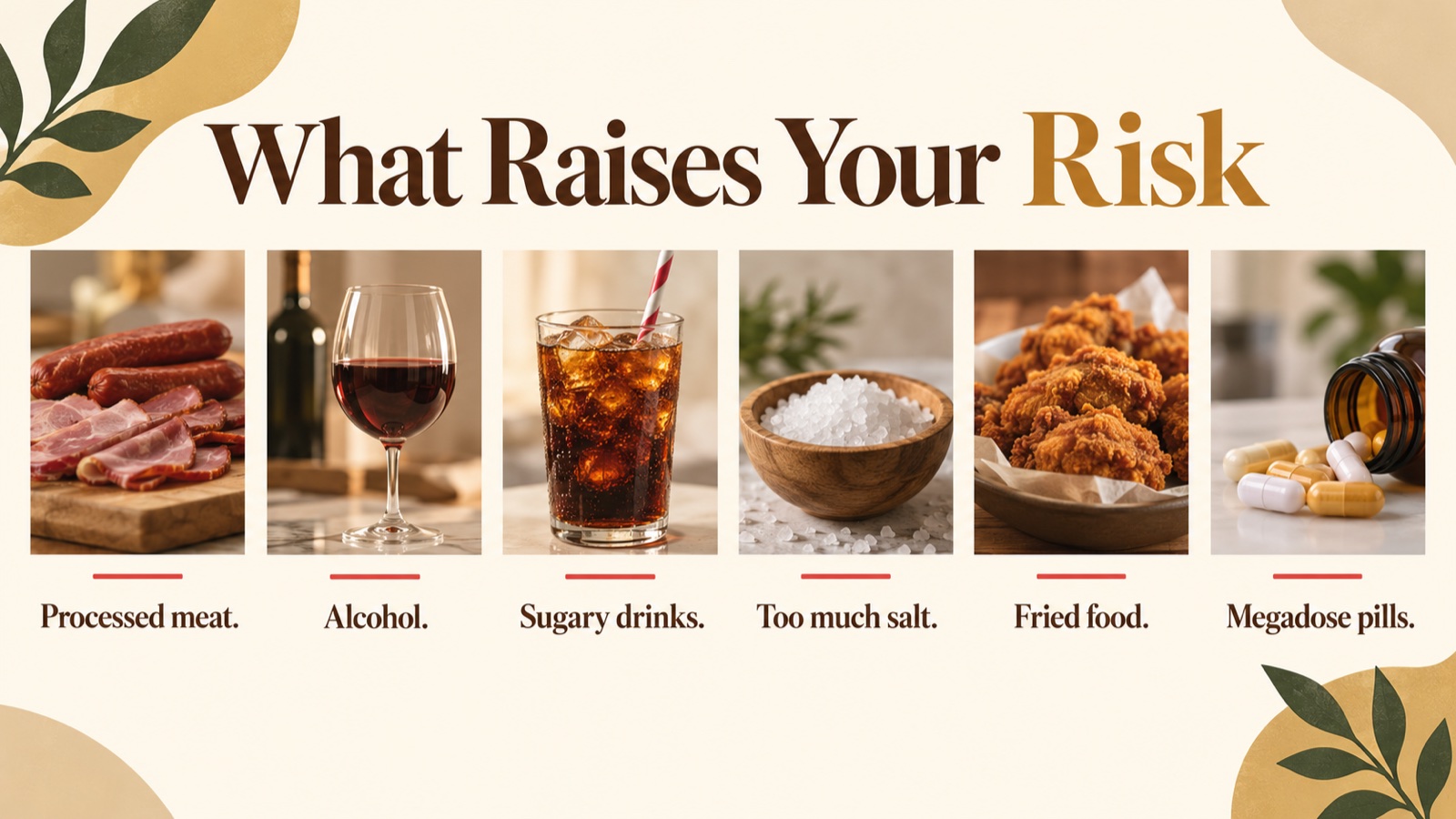
These have the clearest evidence for doing harm. "Group 1" means scientists are sure it causes cancer; it does not mean it's as dangerous as tobacco.
| Item | What the evidence says | Rating |
|---|---|---|
| Processed meat (bacon, sausage, hot dogs, deli meat, scrapple, ham, smoked pork) | IARC Group 1: causes colorectal cancer. Each 50 g a day (about one hot dog or a few deli slices) is linked to about 18% higher risk. WCRF: eat little, if any. | Strong |
| Red meat (beef, pork, lamb) | IARC Group 2A: probably causes cancer, mainly colorectal. WCRF: at most about 12–18 oz cooked a week. | Good |
| Alcohol, any amount | Causes at least 7 cancers, including breast. About 16.4% of US breast cancers are linked to alcohol; no safe level for cancer. | Strong |
| Sugary drinks (soda, sweet tea, juice drinks, sweetened coffee) | Linked to weight gain, type 2 diabetes and heart disease. | Strong |
| Fried foods | Frequent fried food is linked to more heart disease in big reviews; reused oil is worse. The acrylamide-cancer link in people is not consistent. | Some |
| High sodium | Raises BP, leading to stroke, heart and kidney disease. Salt-preserved foods probably raise stomach cancer risk. | Strong |
| Trans fats | Raise LDL and lower HDL. Removed from most US food; check imports. | Strong |
| Ultra-processed foods | In an NIH feeding study, people ate about 500 more calories a day on an ultra-processed diet and gained weight. Big studies link them to heart disease, diabetes and depression. | Good |
| Excess body fat | WCRF: a convincing cause of many cancers (postmenopausal breast, endometrial, colorectal, kidney, liver, pancreas), plus diabetes and heart disease. This is about metabolic health, not shame. | Strong |
| Megadose supplements (selenium, vitamin A, iron, zinc, biotin) | Hair loss, toxicity, wrong lab results. | Strong |
| Crash diets | Can trigger heavy shedding (telogen effluvium) 2–3 months later. | Good |
Sources: IARC red and processed meat · PAHO/IARC · Surgeon General alcohol · Fried food meta-analysis (Heart 2021) · NCI acrylamide · Hall 2019 NIH study · BMJ ultra-processed review · Cleveland Clinic telogen effluvium
Where our food comes from
Soul food: roots, changes, and the road back
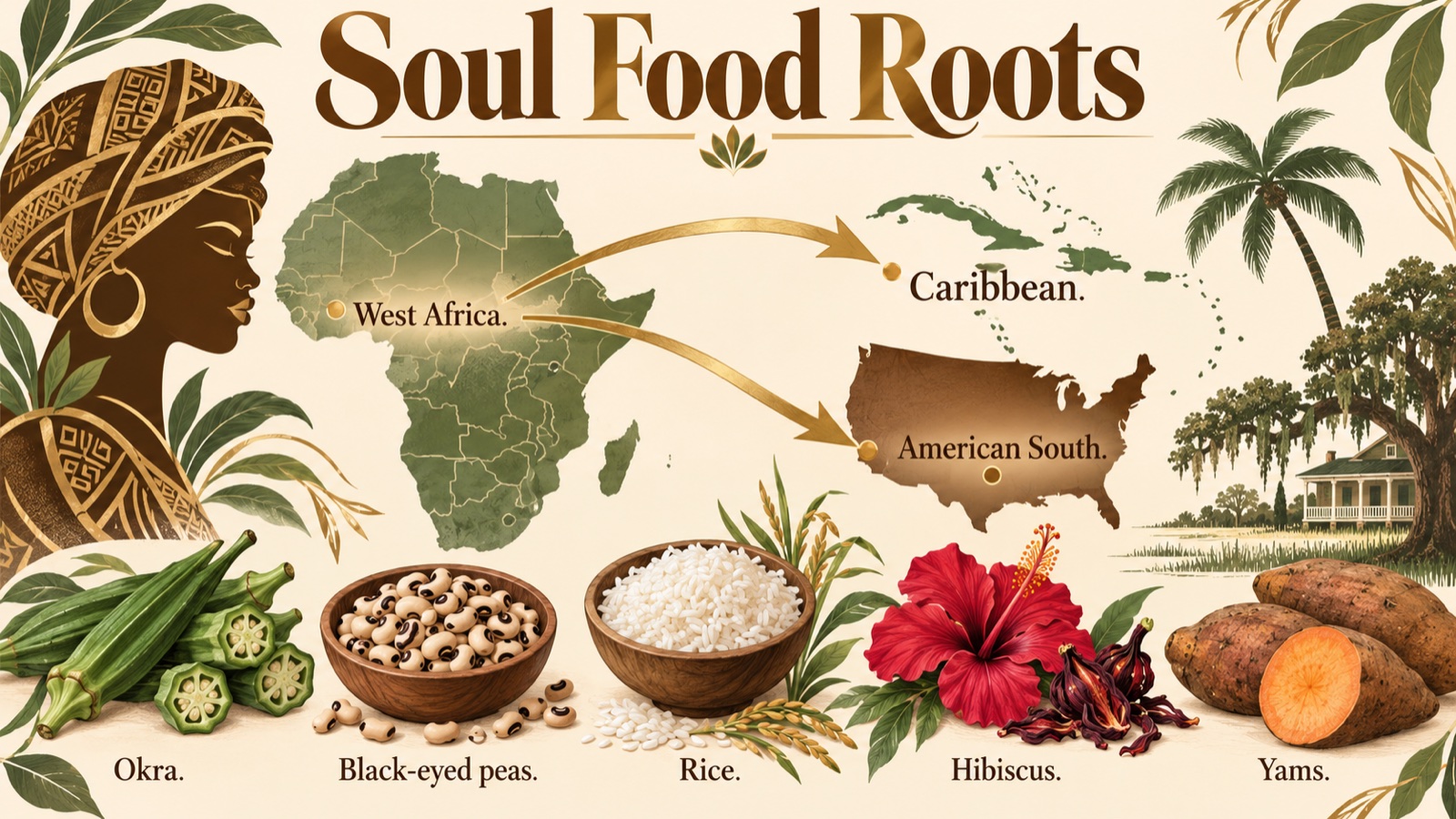
Soul food isn't the problem. The modern version, heavy on salt, sugar and frying, is a recent change. The original is greens, beans, grains and garden.
- West and Central AfricaWomen grow and cook rice, okra, yams, black-eyed peas, millet, sorghum, watermelon, sesame and leafy greens; one-pot stews and slow-cooked greens. [Documented]
- 1600s–1800s: provision gardensEnslaved Africans plant African seeds and know-how in small gardens across the Americas to feed their families (Carney & Rosomoff, In the Shadow of Slavery). Everyday meals are mostly vegetables, beans and grains, with meat used as seasoning. [Documented]
- Gullah Geechee coastFrom North Carolina to Florida, a rice-centered kitchen (red rice, okra soup, seafood, greens) keeps a direct line to West Africa. [Documented]
- Great Migration, 1910s–1970sSouthern dishes move north to Philadelphia, Chicago and Detroit. Celebration foods (fried chicken, mac and cheese, sweets, pork-seasoned everything) slowly become everyday foods.
- Mid-1960s: the name"Soul food" catches on with soul music and the Black Power movement.
- Late 1900sCheap processed ingredients, salt, sugar, frying fat and food deserts drive up high blood pressure and diabetes. Food historians stress this is a modern shift, not the original diet.
- 1969: Freedom FarmFannie Lou Hamer starts the Freedom Farm Cooperative in Mississippi, growing food to fight hunger as a health issue. [Documented]
- 2011 to today: back to the rootsDr. Jessica B. Harris traces the food from Africa in High on the Hog (a 2021 Netflix series); chef Bryant Terry's Afro-Vegan recasts African, Caribbean and Southern dishes around plants.
Making soul food healthier, the old way
| Instead of | Try |
|---|---|
| Ham hock or fatback in greens | Small smoked turkey wing, or smoked paprika plus onion, garlic and vinegar |
| Deep-fried chicken or fish | Cornmeal crust, oven at 425 °F or the air fryer |
| Mac and cheese with a pound of cheese | Sharp cheddar (half the amount, same flavor), whole-wheat pasta, hidden butternut or cauliflower |
| Candied yams with marshmallows | Roasted sweet potatoes with cinnamon and a little orange juice |
| White rice | Brown rice, or half brown and half white to start |
| Seasoning salt, bouillon cubes | Salt-free soul seasoning (in our Recipes) |
| Sweet tea by the pitcher | Sorrel or rooibos with one spoon of honey, or half sweet, half unsweet |
| Pound cake every Sunday | Fruit with lime and mint, and cake for real celebrations |
My great-grandmother didn't eat fried chicken every day. That was Sunday, maybe. Monday through Saturday it was greens, beans, cornbread and whatever came out of the garden. Going back to our roots means going back to that.
Sources: Carney & Rosomoff · NPS Gullah study · Soul food overview · Peabody, High on the Hog · Smithsonian Gardens, Freedom Farm · Bryant Terry
Read before you buy
How to read a food label in 60 seconds
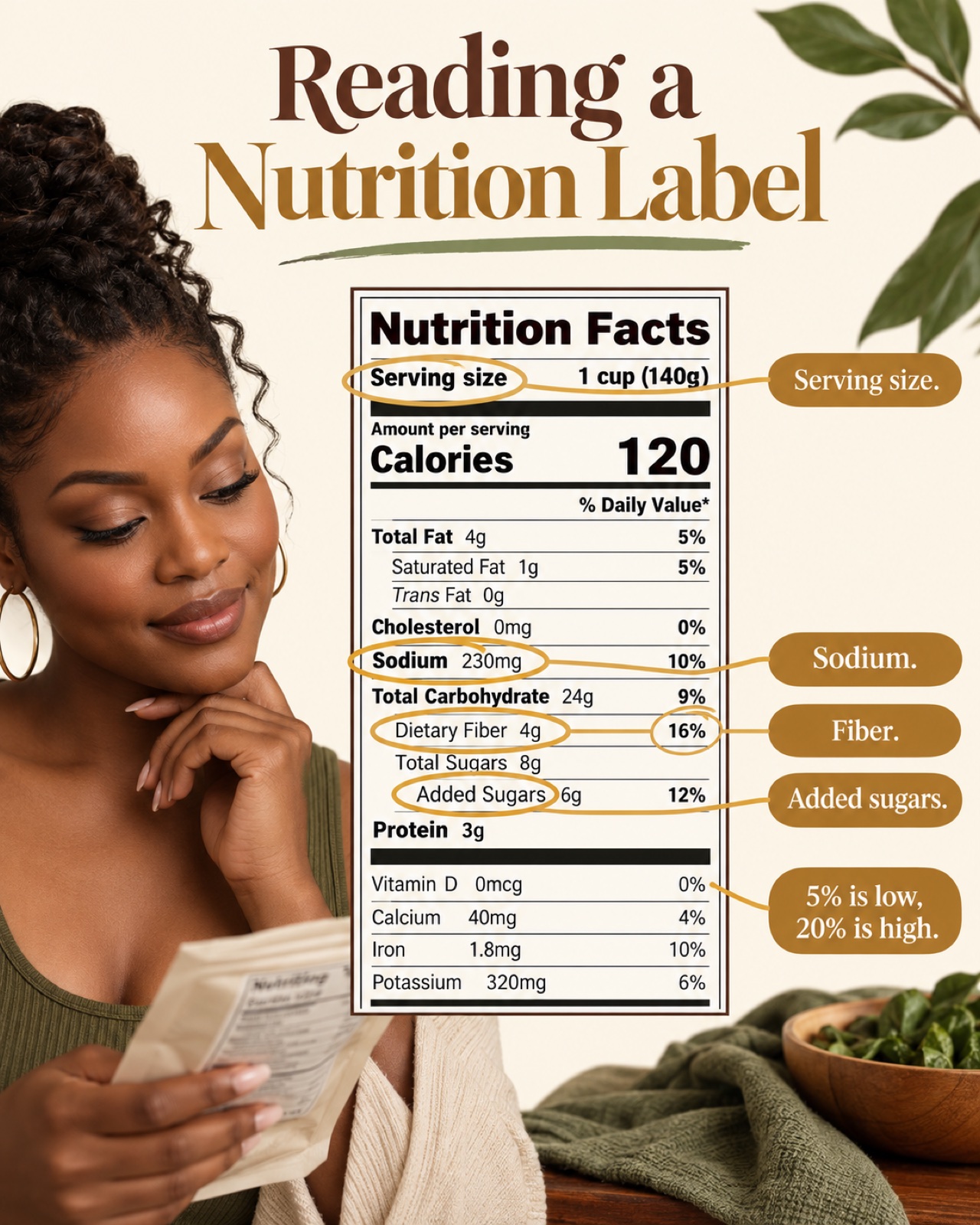
- Serving size first. All the numbers are for one serving. If you eat the whole bag, multiply.
- Use the % Daily Value. The FDA's rule of thumb: 5% or less is low, 20% or more is high. Aim low for sodium, saturated fat and added sugars; high for fiber, calcium, iron, potassium and vitamin D.
- Sodium. Compare brands; the same soup can differ by hundreds of milligrams.
- Added sugars. The AHA suggests women keep added sugar to about 25 g (6 teaspoons) a day.
- Fiber. Look for 3 g or more per serving in bread and cereal.
- Ingredients are listed by weight, most to least. If sugar or salt is near the top, it's a big part of the food. "Whole wheat" or "whole grain" should be the first word for bread.
- Watch for "partially hydrogenated" (trans fat).
Sodium words on the front
- Salt/sodium-free: under 5 mg per serving
- Very low sodium: 35 mg or less
- Low sodium: 140 mg or less
- Reduced sodium: at least 25% less than the regular version (can still be high)
- No salt added: none added, but the food may have its own sodium
Hidden salt names
- Monosodium glutamate (MSG)
- Sodium nitrite / nitrate (cured meats)
- Baking soda, baking powder
- Disodium phosphate
- Sodium benzoate
- Seasoning salt, bouillon, soy sauce
Hidden sugar names
- High-fructose corn syrup, corn syrup
- Cane sugar, brown sugar, raw sugar
- Words ending in "-ose" (dextrose, maltose, sucrose)
- Honey, agave, molasses, syrup
- Fruit juice concentrate
- Evaporated cane juice
Sources: FDA: How to understand the Nutrition Facts label · FDA sodium in your diet · AHA added sugars · AHA sodium and salt
Small trades, big difference
Sodium and sugar swaps
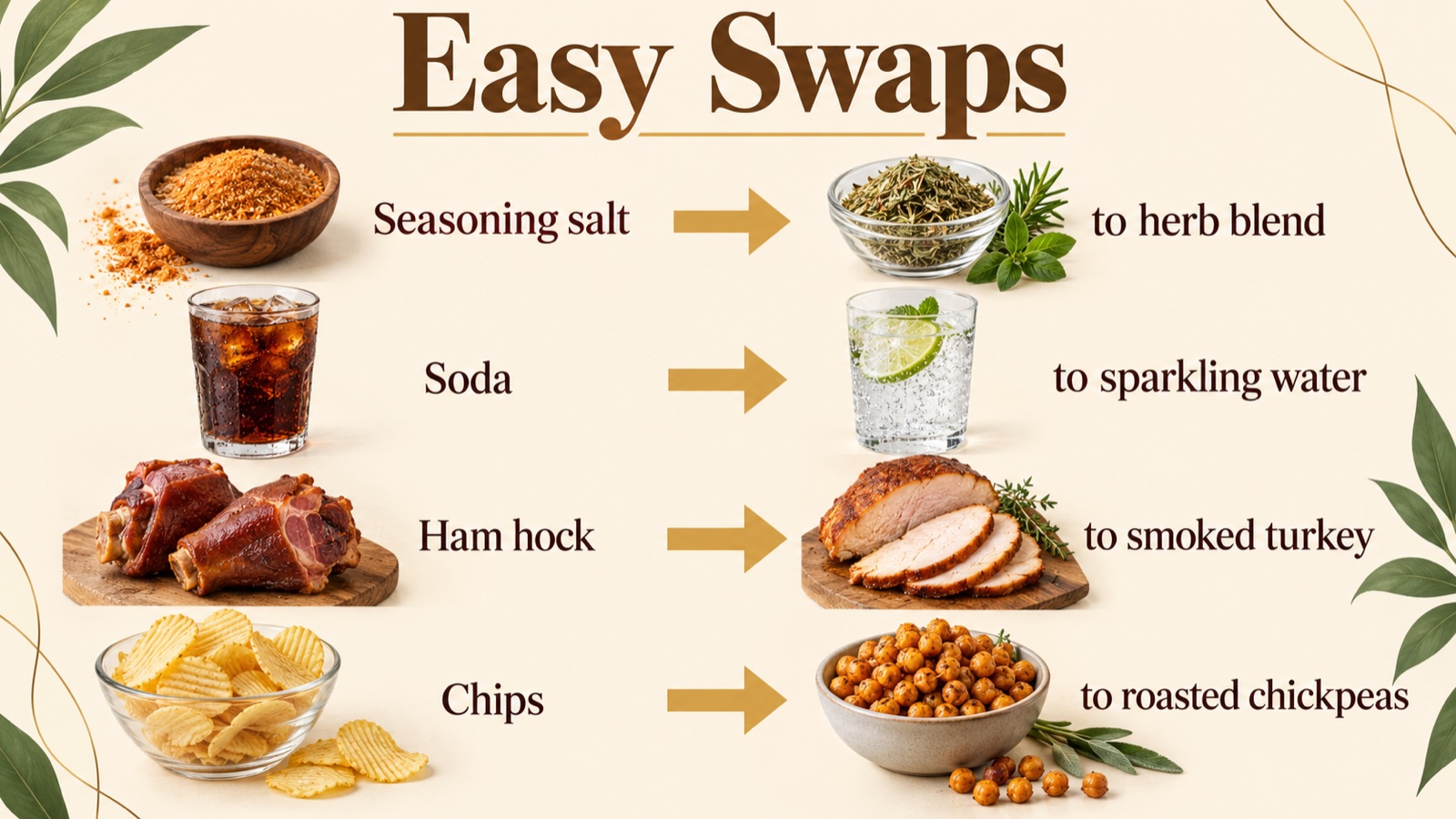
Most of our salt is hiding in packaged and restaurant food, not the shaker. Taste buds adjust to less salt and sugar in a few weeks, so go slow and keep going.
Sodium swaps
| Swap out | Swap in |
|---|---|
| Seasoning salt, bouillon cubes | Salt-free blend: smoked paprika, garlic and onion powder, thyme, black pepper, allspice |
| Canned soup | Homemade lentil or black-eyed pea soup; or low-sodium cans |
| Deli meat, hot dogs, scrapple | Home-roasted chicken or turkey, sliced; tuna or salmon salad |
| Regular canned beans and vegetables | "No salt added" cans, rinsed (rinsing removes some sodium) |
| Chips and salted snacks | Roasted chickpeas, unsalted nuts, air-popped popcorn |
| Soy sauce, hot sauce by the bottle | Low-sodium soy sauce; lime, vinegar, fresh hot peppers |
| Takeout several nights a week | A Sunday prep pot and leftovers |
Sugar swaps
| Swap out | Swap in |
|---|---|
| Soda (a 12-oz can has about 10 teaspoons of sugar) | Sparkling water with lime, or a splash of 100% juice |
| Sweet tea | Half sweet, half unsweet, then less; or sorrel or rooibos with one spoon of honey |
| Fruit punch and "juice drinks" | Water with sliced fruit; a small glass of real juice with a meal |
| Flavored oatmeal packets | Plain oats with fruit, cinnamon and a teaspoon of maple |
| Flavored yogurt | Plain yogurt plus berries |
| Sugary coffee creamer | Milk and cinnamon or vanilla |
| Dessert every night | Fruit most nights; dessert on special days |
Sources: AHA sodium · FDA sodium · Harvard sugary drinks · AHA added sugars
Eat well on a budget
Healthy food doesn't have to cost more
The cheapest healthy foods are the ones our grandmothers bought: dried beans, rice, oats, cabbage, carrots, sweet potatoes, greens in season, eggs and canned fish.
- Plan the week and shop with a list (see our printable grocery list).
- Buy dried beans and big bags of brown rice and oats; they cost far less per serving than canned or instant.
- Frozen fruits and vegetables are just as nutritious and never spoil in the drawer.
- Canned fish (sardines, salmon, tuna in water) is the cheapest omega-3 and calcium.
- Check the unit price on the shelf tag, and try the store brand.
- Buy in season (see our produce calendar). Collards in fall, peaches in August.
- Cook once, eat twice. A pot of soup or chili is lunch for three days.
- Grow a little: herbs, collards, peppers and okra grow in pots on a Philly stoop.
SNAP at the market
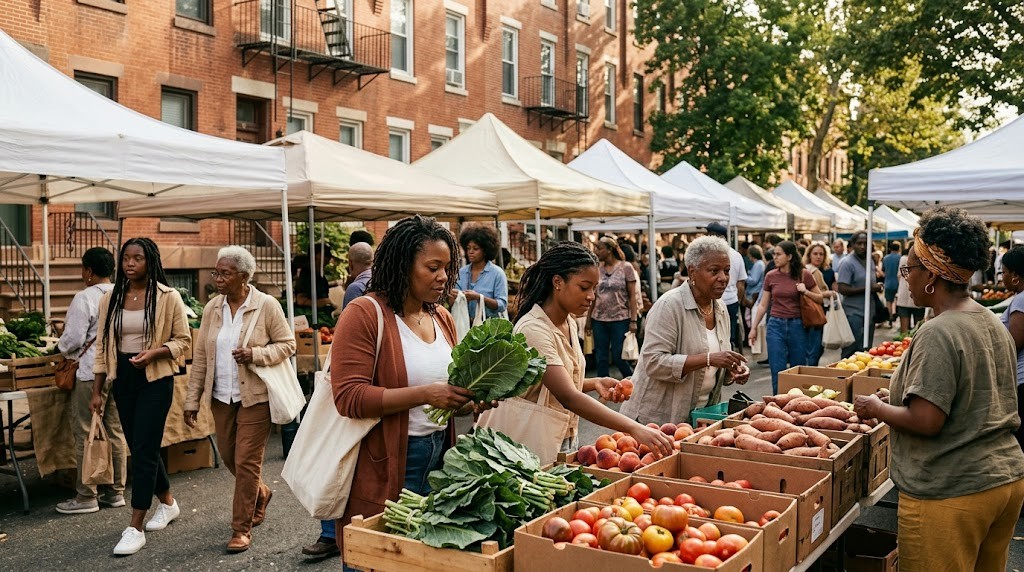
Many Philadelphia farmers markets run by The Food Trust accept SNAP (EBT). Ask about Philly Food Bucks, which give you extra coupons for fruits and vegetables when you use SNAP.
WIC for moms and kids
Pregnant and breastfeeding women and children under 5 may get WIC food benefits, plus seasonal farmers-market checks. Call the Pennsylvania WIC office or ask your clinic.
Food banks and pantries
Philabundance and neighborhood pantries share free groceries, often with fresh produce. See our Philly Guide for places near you.
A one-pound bag of dried black-eyed peas feeds my whole house twice. Don't let anybody tell you eating right is only for rich folks. Beans, greens and a pot: that's how we always did it.
Sources: USDA MyPlate: Healthy Eating on a Budget · The Food Trust (SNAP and Philly Food Bucks) · USDA WIC · Philabundance · PA Preferred
Ready to cook?
Every food on this page shows up in a recipe, from sorrel to salmon and collards to my family's Sunday cornbread.
Go to Recipes & RemediesSee the Wellness Calendar