Womanhood · The Change
Perimenopause & menopause
Hot flashes that last for years, sleep that disappears, a brain that misplaces words, periods that go wild before they stop. You are not crazy and you are not alone. Here's what's happening, what helps, and what Black women need to know.

Start here
Not "the end." A turning.
Our mothers and grandmothers often called it "the change," and too many of them went through it quietly, fanning themselves in the church pew and never saying a word. We can do better. Menopause is a normal stage of life, but its symptoms are real, they can last a long time, and there is real treatment.
It's also a turning point for your long-term health. After menopause, the risk of heart disease and bone loss rises. What you eat, how you move and which checkups you get in your 40s and 50s set you up for your 70s and 80s.
- Name it: tell your doctor "I think I'm in perimenopause."
- Track it: use the tracker at the bottom of this page.
- Treat it: hormones are safe and helpful for many women; non-hormone options exist too.
- Protect your future: strength training, calcium, blood pressure, cholesterol, bone scans.
The first time I had a hot flash in front of my class, I thought the radiator had gone haywire. Nobody had ever told me. So I'm telling you. And I'm telling you something else: you can feel good again.
The basics
Three words, three stages
Perimenopause
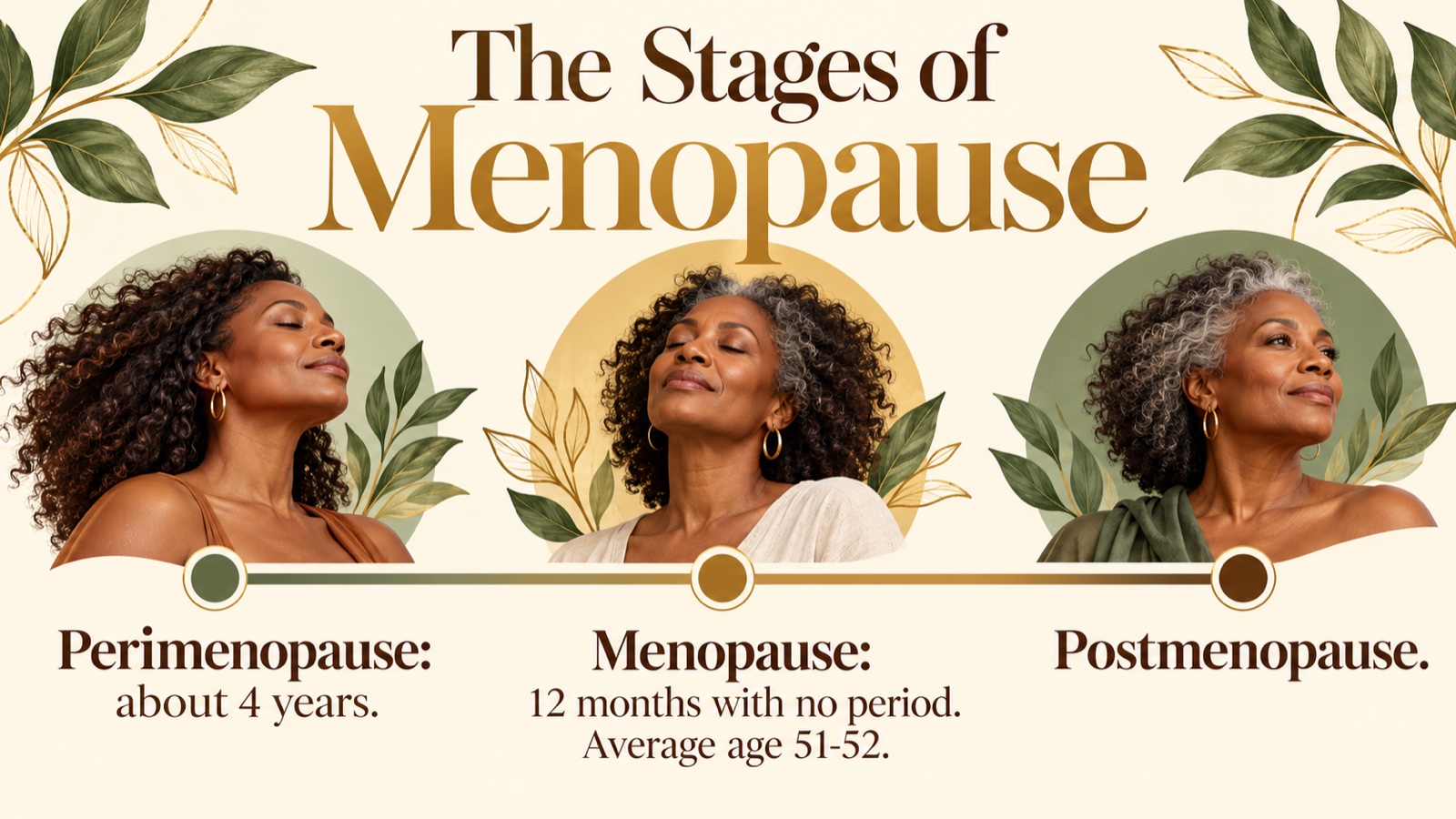
The years of transition before your last period. Hormones rise and fall unevenly. Periods get irregular, heavier or lighter, closer together or farther apart. Hot flashes and sleep trouble often start here. It usually begins between ages 45 and 55 and lasts about four years on average, though it can be a few months or eight years or more.
Menopause
One point in time: when you have gone 12 months in a row with no period (and no other cause like pregnancy or a medicine). In the U.S. this happens around age 51 to 52 on average. You only know it looking back.
Postmenopause
Every year after that point. Some symptoms, like hot flashes, can keep going for years. Others, like vaginal dryness, can show up or grow later. Bone and heart protection become the big jobs.
Sources: NIA, What Is Menopause? · NIH Office of Research on Women's Health · Cleveland Clinic, Perimenopause · Gold et al., SWAN age at menopause (2013)
Research about us
What the SWAN study found about Black women
The Study of Women's Health Across the Nation (SWAN) has followed more than 3,000 women of five racial and ethnic groups, including Black women, through midlife since 1996. It changed what doctors know about menopause.
Black women had the longest hot flashes
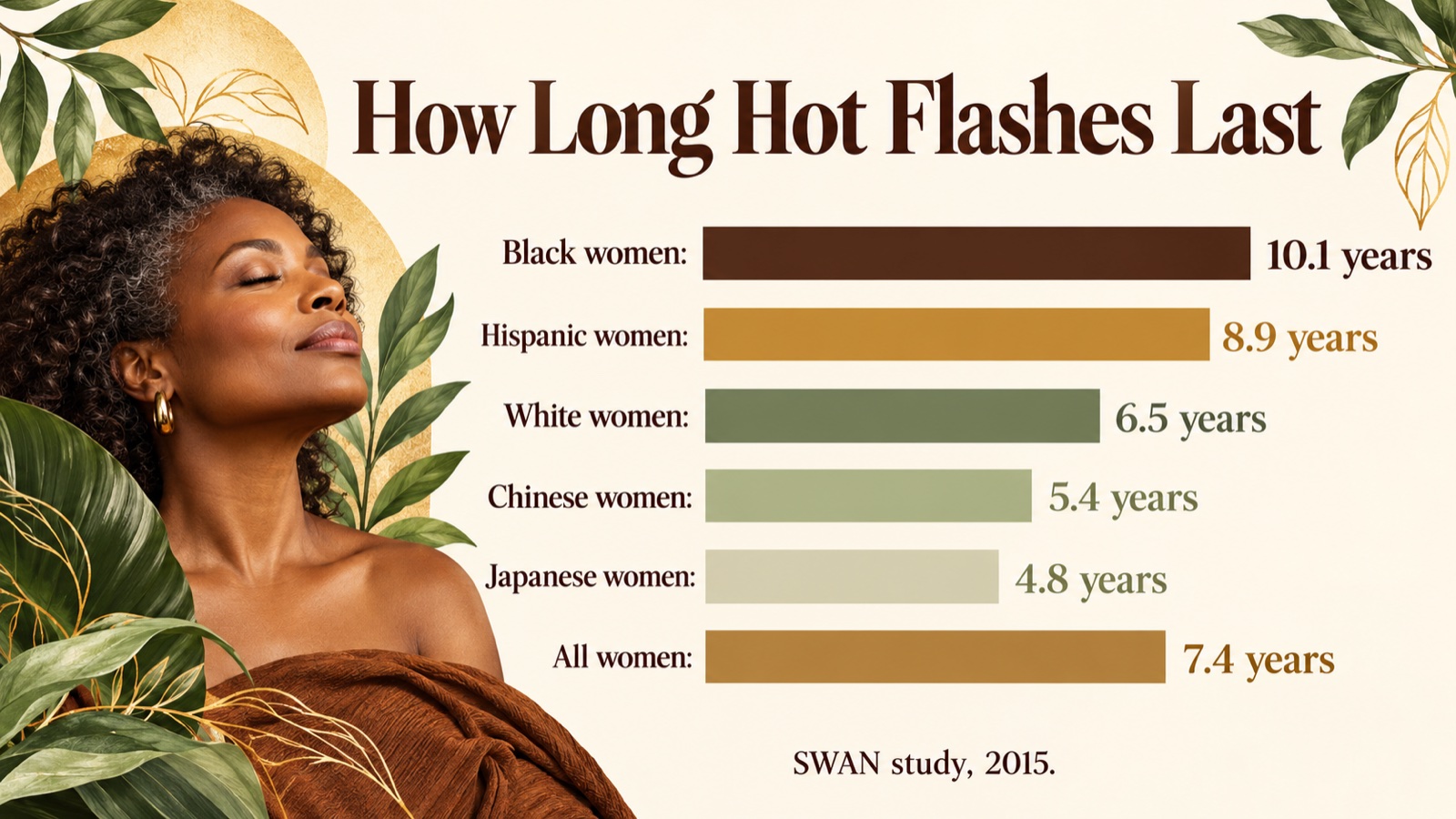
Among SWAN women with frequent hot flashes and night sweats, the typical (median) total length was 7.4 years. For Black women it was 10.1 years, the longest of any group (Hispanic 8.9, white 6.5, Chinese 5.4, Japanese 4.8).
Symptoms started earlier
Women whose hot flashes began while their periods were still regular, or early in perimenopause, had the longest duration of all: a median of more than 11.8 years. Black women were more likely to report hot flashes early in the transition.
Menopause may come earlier
SWAN's first analysis (2013) found no racial difference in age at menopause after adjustment. But SWAN only enrolled women who were still having periods, which left out many Black women who'd had hysterectomies. A 2023 re-analysis that corrected for this found Black women reached menopause (natural and surgical) about 1.2 years earlier than white women overall.
| Group in SWAN | Median years of frequent hot flashes / night sweats |
|---|---|
| Black women | 10.1 |
| Hispanic women | 8.9 |
| White women | 6.5 |
| Chinese women | 5.4 |
| Japanese women | 4.8 |
| All women with frequent symptoms | 7.4 |
What it means for you: if a doctor says "it'll pass in a year or two," you can answer, "Research shows Black women often have hot flashes for ten years. I'd like to talk about treatment." Long-lasting symptoms are a reason to treat, not to tough it out.
Sources: Avis et al., JAMA Internal Medicine 2015 · Wake Forest release · 2023 selection-bias-corrected SWAN analysis · SWAN exclusion analysis (PMC) · Gold et al. 2013 · SWAN study
Symptoms
What the change can feel like
Every woman's change is different. Some breeze through. Many have several of these. Use the filters to look by area.
Hot flashes & night sweats
A sudden wave of heat over the chest, neck and face, often with sweating, a red face and a pounding heart, then chills. At night they soak the sheets. The most common symptom.
Sleep trouble
Waking at 3 a.m., trouble falling back asleep, often from night sweats. Poor sleep makes every other symptom worse.
Mood changes
Irritability, anxiety, sadness, a short fuse. The risk of depression rises during perimenopause, especially if you've had depression before.
Brain fog
Forgetting words or names, losing your train of thought. It's common in perimenopause and, for most women, improves after the transition.
Vaginal dryness and painful sex
Lower estrogen thins and dries vaginal tissue. Doctors call this genitourinary syndrome of menopause. Unlike hot flashes, it often gets worse over time without treatment.
Bladder changes
Needing to go more often or urgently, leaking, more urinary tract infections.
Joint aches
Stiff, achy joints and muscles are commonly reported in midlife. Movement and strength training help; see a doctor for swelling or a hot, red joint.
Weight shifts
Weight tends to move to the belly, and muscle is lost more easily. Belly fat raises heart and diabetes risk, which is why strength training matters so much now.
Irregular periods
Closer together, farther apart, skipped, lighter, or much heavier. Some irregularity is normal in perimenopause. Some is not (see below).
Heart racing, headaches
Palpitations and headaches can come with hormone swings. New chest pain or shortness of breath is never "just menopause." Get checked.
Lower sex drive
Common, and has many causes: dryness, poor sleep, stress, medicines, relationship strain. It's worth bringing up.
Sources: NIA · Cleveland Clinic, Perimenopause · Menopause Society 2020 GSM statement · SWAN
Know the red flags
Bleeding: when to see a doctor
Black women have high rates of fibroids, which can cause heavy bleeding, and abnormal bleeding can also be an early sign of uterine cancer. Don't let anyone, including yourself, wave off abnormal bleeding as "just the change."
During perimenopause, call your doctor if
- You soak through a pad or tampon every 1 to 2 hours
- Your period comes more often than every 3 weeks
- Bleeding lasts more than 7 days
- You bleed between periods or after sex
- You pass large clots
- You feel dizzy, very tired, short of breath or your heart races (signs of anemia)
Testing may include a pelvic ultrasound and a blood count. Heavy bleeding can often be treated with medicine or a procedure.
After menopause: any bleeding at all
If you've gone 12 months with no period and then see any blood, even a little spotting, even once, get checked as soon as you can.
Most of the time the cause is harmless: thin vaginal tissue, a polyp or a fibroid. But bleeding after menopause is the most common early sign of uterine (endometrial) cancer, and caught early it's very treatable. The check usually involves an ultrasound and sometimes a small sample of the uterine lining.
Sources: Mayo Clinic, bleeding after menopause · Harvard Health · Cleveland Clinic, when to see a doctor · Bupa, bleeding in perimenopause · NICHD, uterine fibroids
Treatment
Hormone therapy, explained plainly
Many women were scared off hormones after a big 2002 study. Since then, researchers have learned much more about who benefits and when. Here's where expert guidance stands today.
What The Menopause Society says (2022)
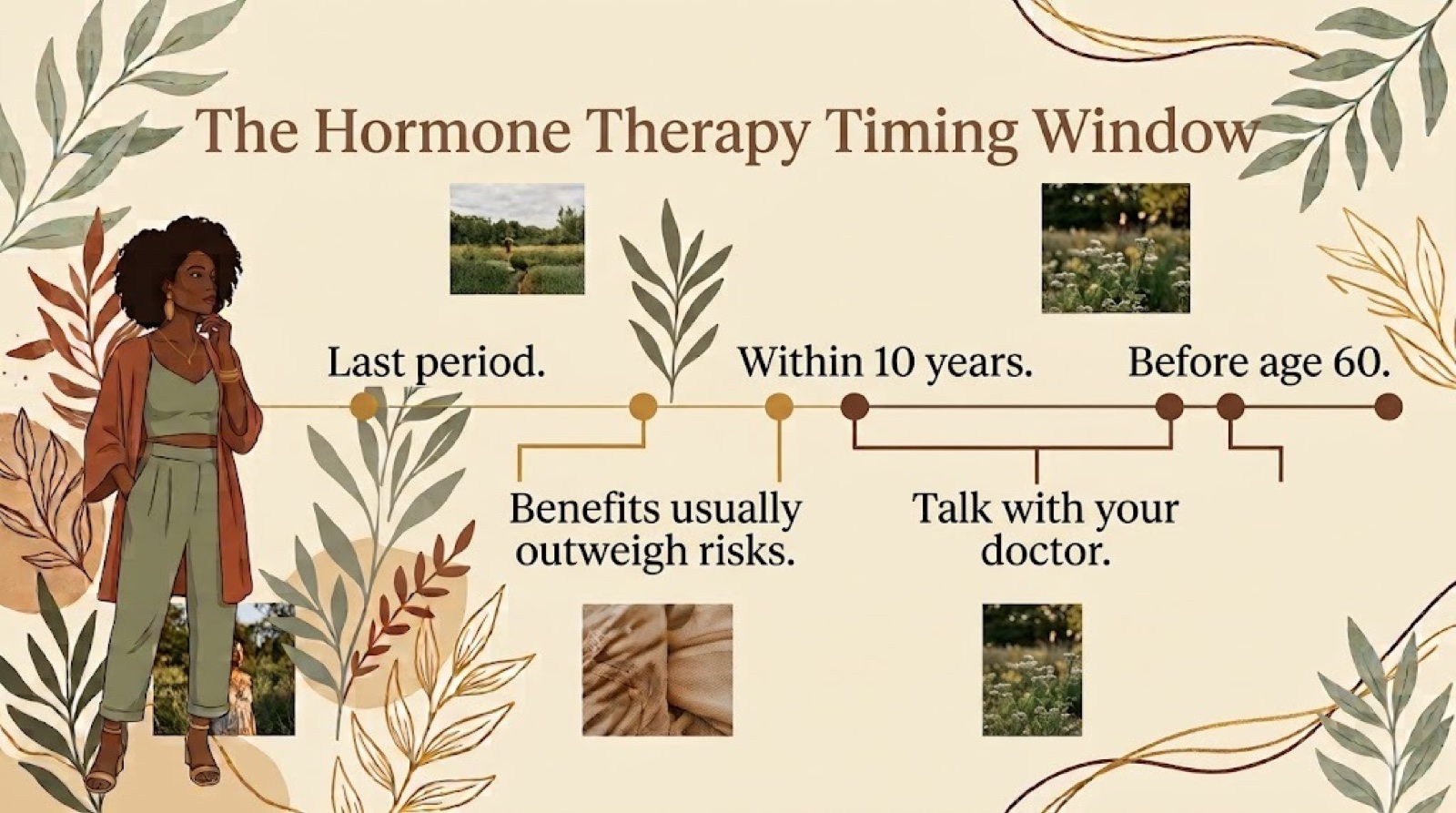
For healthy women with bothersome symptoms who are under 60, or within 10 years of their last period, and who have no reason they shouldn't take it, the benefits of hormone therapy generally outweigh the risks. It is the most effective treatment for hot flashes and night sweats, and it prevents bone loss.
The balance is less favorable when hormones are started after age 60 or more than 10 years after menopause, because the risks of heart disease, stroke, blood clots and dementia are higher then.
The basics
- Estrogen treats the symptoms. It comes as pills, skin patches, gels or sprays.
- If you still have a uterus, you also need a progestogen to protect the uterine lining from cancer.
- Patches and gels (through the skin) and lower doses may carry a lower risk of blood clots and stroke than pills.
- Risk depends on type, dose, how long you take it, how it's taken, and when you start.
- There's no automatic cutoff date; longer use can be fine for good reasons, with a yearly check-in.
Usually not for you if you've had
- Breast cancer or uterine cancer
- A blood clot in a leg or lung
- A stroke or heart attack
- Active liver disease
- Unexplained vaginal bleeding (get that checked first)
The 2025 label change
In November 2025, the FDA announced it was removing the "black box" warnings about heart disease, breast cancer and probable dementia from menopause hormone therapy labels, and adding language about starting within 10 years of menopause or before 60. The warning about uterine cancer stays for estrogen taken without a progestogen. Labels are being updated product by product.
"Bioidentical" and compounded hormones
FDA-approved estradiol patches and gels, and micronized progesterone, are already "bioidentical." Custom-mixed (compounded) hormones from specialty pharmacies are not FDA-approved, are not tested for purity or dose, and are not recommended by The Menopause Society when an approved product will work.
My mother suffered for twelve years because she was told hormones would give her cancer. The science has grown up since then. You don't have to take them, but you deserve a real conversation, not a "no" before you finish your sentence.
Sources: The 2022 hormone therapy position statement of The North American Menopause Society (now The Menopause Society) · Full statement (PDF) · Axios on FDA label change, Nov 2025 · Commentary on removal of the boxed warning · The Menopause Society patient education
Other options
Non-hormone treatments that work
For women who can't or don't want to take hormones, such as breast cancer survivors, there are proven options. The Menopause Society's 2023 statement graded them.
| Option | What it is | Evidence for hot flashes | Good to know |
|---|---|---|---|
| Fezolinetant (Veozah) | Daily pill approved by the FDA in May 2023; blocks a brain signal (neurokinin-3) that sets off hot flashes | Recommended | In December 2024 the FDA added a boxed warning for rare but serious liver injury. Liver blood tests are needed before starting and repeated during the first 9 months, as the label directs. Stop and call if you get yellow skin or eyes, dark urine, belly pain or unusual tiredness. |
| Elinzanetant (Lynkuet) | Once-nightly capsule approved by the FDA in October 2025; blocks two brain signals (NK1 and NK3) | Approved | Newer; ask your doctor about side effects and cost. |
| SSRIs and SNRIs (for example, low-dose paroxetine, escitalopram, venlafaxine) | Antidepressant medicines that also cut hot flashes | Recommended | Low-dose paroxetine is FDA-approved for hot flashes. Paroxetine can interfere with tamoxifen, so tell your doctor if you take it. Can also help mood. |
| Gabapentin | Nerve medicine | Recommended | Can cause drowsiness, so it's often taken at bedtime and may help night sweats and sleep. |
| Cognitive behavioral therapy (CBT) | Short-term talk therapy with practical skills | Recommended | Makes hot flashes less bothersome and improves sleep and mood. |
| Clinical hypnosis | Guided relaxation with a trained clinician | Recommended | Reduced hot flashes in trials. |
| Weight loss; stellate ganglion block (a nerve injection) | Some evidence | ||
| Paced breathing, yoga, exercise, acupuncture, cooling gadgets, avoiding triggers | Not proven for hot flashes | Still great for overall health, stress and sleep. Just don't expect them alone to stop hot flashes. | |
| Herbs and supplements (black cohosh, red clover, evening primrose, dong quai, wild yam) | Not recommended | See the supplements section below. |
Vaginal dryness and bladder symptoms
Moisturizers and lubricants
Over-the-counter vaginal moisturizers (used a few times a week) and lubricants (used during sex) are enough for many women with mild symptoms. Choose water- or silicone-based, fragrance-free.
Low-dose vaginal estrogen
A cream, small tablet or ring placed in the vagina. It works where you need it, and blood estrogen levels stay in the normal postmenopausal range. The Menopause Society says a progestogen is not needed with it. If you've had breast cancer, decide together with your oncologist.
Other prescriptions
Vaginal DHEA inserts and an oral pill called ospemifene also treat painful sex from menopause. Pelvic floor physical therapy helps leaking and pain.
Sources: The 2023 nonhormone therapy position statement (Menopause, 2023) · Healio summary · FDA approval of fezolinetant (2023) · Veozah label with FDA boxed warning, Dec 2024 (DailyMed) · AJMC, elinzanetant approval · 2020 GSM position statement
Food for the change
Eating for bones, heart and comfort
No food "cures" menopause. But the right plate protects the two things menopause puts at risk, your bones and your heart, and may ease some symptoms.
| Nutrient | Daily target for women 51+ | Why now | Soul-food and African-root sources | Evidence |
|---|---|---|---|---|
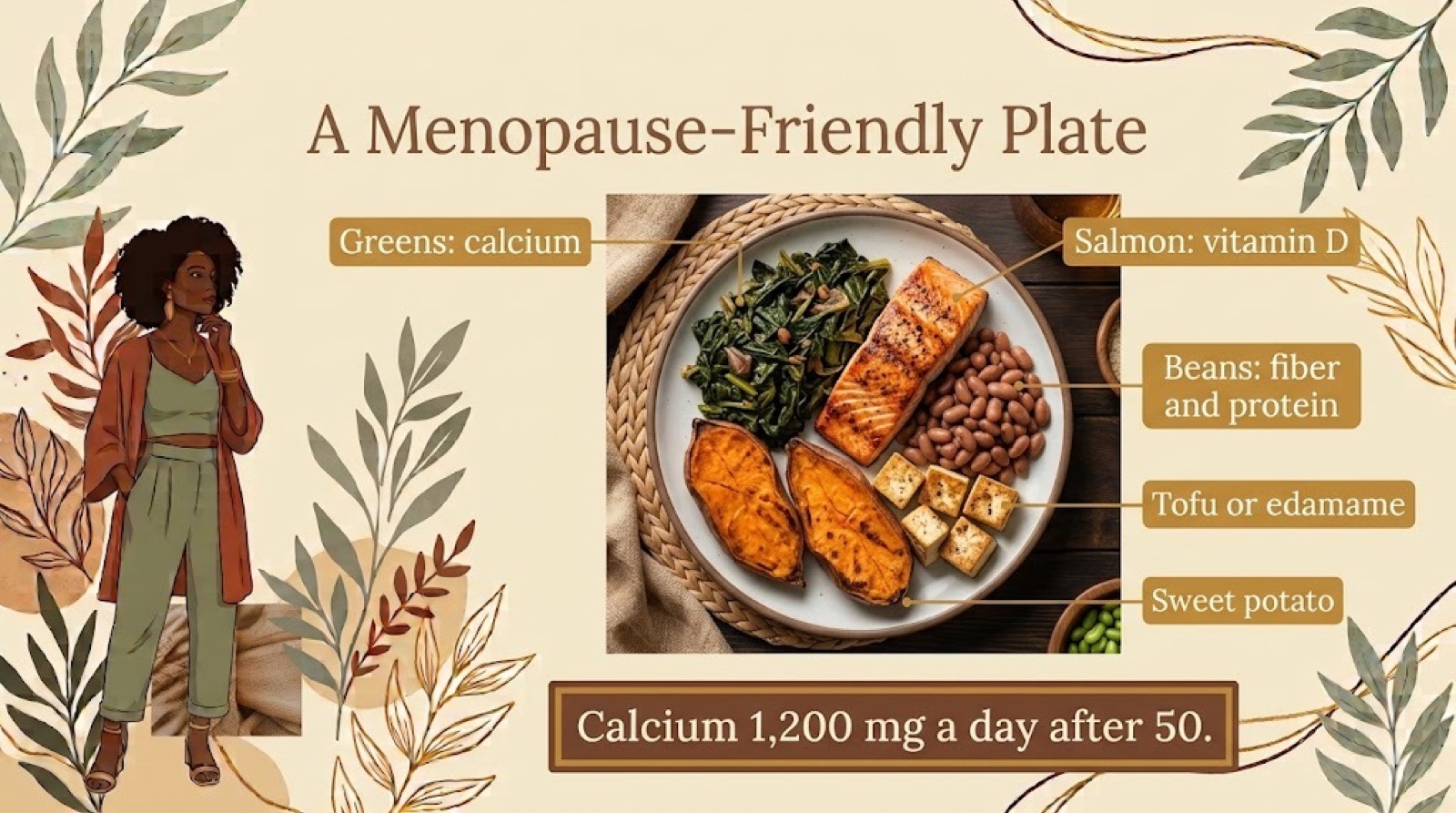
| Calcium | 1,200 mg (1,000 mg until 50) | Bone loss speeds up as estrogen falls | Milk, yogurt, fortified plant milk, collards and turnip greens, canned salmon or sardines with bones, calcium-set tofu, okra | Strong |
| Vitamin D | 600 IU to age 70; 800 IU at 71+ (upper limit 4,000 IU) | Needed to absorb calcium; many Black women run low | Salmon, sardines, eggs, fortified milk and cereal. Ask for a blood level before taking big doses. | Strong |
| Protein | Some at every meal | Keeps muscle, which you lose faster now | Fish, chicken, eggs, beans and black-eyed peas, peanuts, Greek yogurt | Strong |
| Fiber | Lots: whole grains, beans, fruit, vegetables | Lowers LDL cholesterol, steadies blood sugar, helps weight | Oats, brown rice, fonio, beans, greens, sweet potatoes, fruit | Strong |
| Healthy fats | Fish twice a week; nuts and seeds | Heart protection | Salmon, sardines, catfish, peanuts, sesame (benne), avocado, olive oil | Strong |
| Soy foods | As food: tofu, edamame, soy milk | May slightly ease hot flashes | Tofu stir-fry, edamame snack, soy milk in oatmeal | Some / mixed |
| Less salt | Under 2,300 mg sodium | Blood pressure rises with age | Season with herbs, garlic, onion, pepper, smoked turkey instead of ham hock | Strong |
What about soy?
A 2012 review of 17 trials found that soy isoflavone supplements (about 54 mg a day, for 6 weeks to a year) cut hot flash frequency by about 21% and severity by about 26% compared with a placebo, with a lot of variation between studies. The Menopause Society does not recommend supplements for hot flashes. Soy as food is healthy, and the American Cancer Society says soy foods are safe for most breast cancer survivors. Ask before taking soy pills if you've had breast cancer.
Hot flash triggers
Mayo Clinic lists spicy foods, hot drinks, caffeine, alcohol and smoking as common triggers. A Mayo study of 1,806 women linked caffeine with more bothersome hot flashes after menopause, but the authors called it preliminary. The Menopause Society says avoiding triggers has not been proven to reduce hot flashes overall.
Our advice: use the tracker. If your hot flashes come after your pepper sauce, coffee or wine, cut back and see. If they don't, enjoy your food.

Greens daily
Collards, turnip and mustard greens: calcium, folate, fiber.
Okra
An African domesticate; the word comes from Igbo. Fiber and some calcium. Great in stew.
Fonio
An ancient West African grain; cooks in minutes like couscous. Whole-grain fiber.
Benne (sesame)
Came to the American South with enslaved Africans. Sesame seeds and tahini add calcium and healthy fats.
Find recipes on our Recipes page: salmon with collards, red lentil soup, okra and tomato stew, and stuffed sweet potatoes all fit the menopause plate.
Sources: NIH ODS calcium · NIH ODS vitamin D · NIH Osteoporosis and Related Bone Diseases · Taku et al., soy isoflavones meta-analysis (Menopause 2012) · American Cancer Society on soy · Mayo Clinic caffeine study · Menopause Society 2023 · Our African Roots page
Movement
Lift, walk, balance
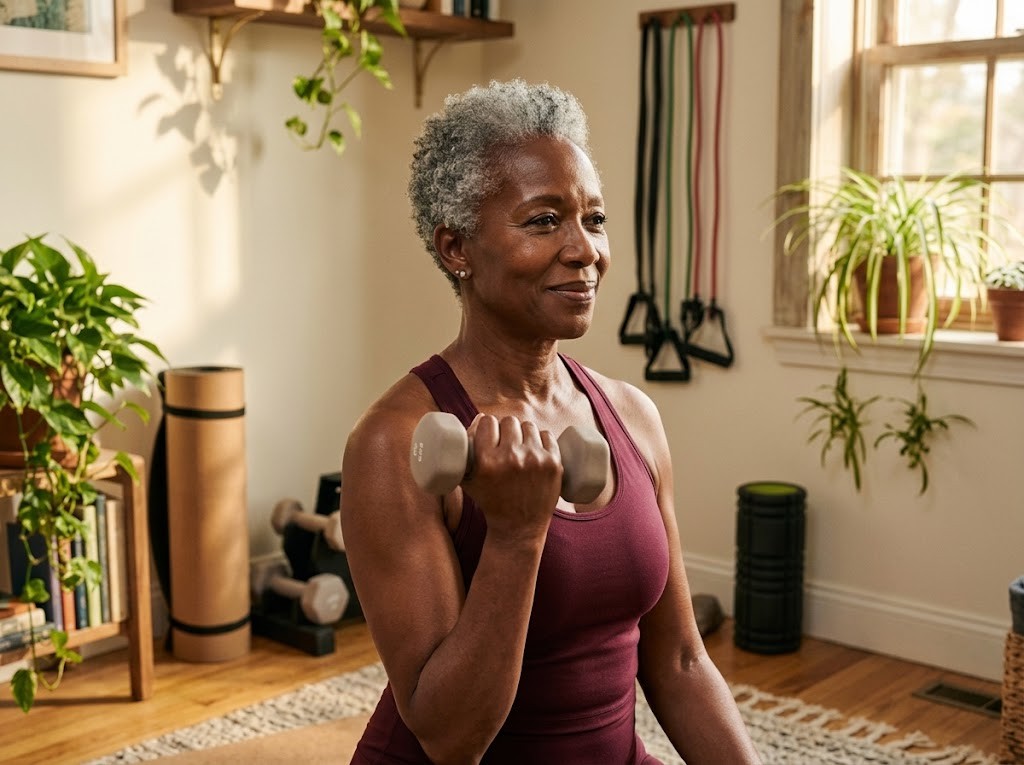
Muscle and bone both respond to work. After menopause, strength training is no longer optional; it's medicine.
| Type | How much | Why |
|---|---|---|
| Strength training | 2 or more days a week, all major muscle groups | Builds muscle, supports bone, burns more calories at rest, helps blood sugar |
| Weight-bearing cardio | 150 minutes a week (brisk walking, dancing, stair climbing) | Heart, bones, mood, sleep |
| Balance | A few minutes most days (stand on one foot by the counter, tai chi) | Prevents falls, which is how weak bones break |
| Stretching / yoga | As you like | Stiff joints, stress, flexibility |
Start light: wall push-ups, chair squats, a gallon jug of water as a weight. See the 4-week walking plan and strength moves on our Body page.
Sources: CDC adult activity guidelines · CDC older adults · NIH bone health
Your future self
Bones and heart after the change
Bones
Bone loss speeds up in the years around menopause as estrogen drops. Black women, on average, have higher bone density than white women, but that does not mean we can't get osteoporosis, and studies of older women on Medicare found that Black women had higher death rates after a major osteoporosis fracture. Research also shows Black women are less likely to be offered a bone scan. Don't let anyone skip yours.
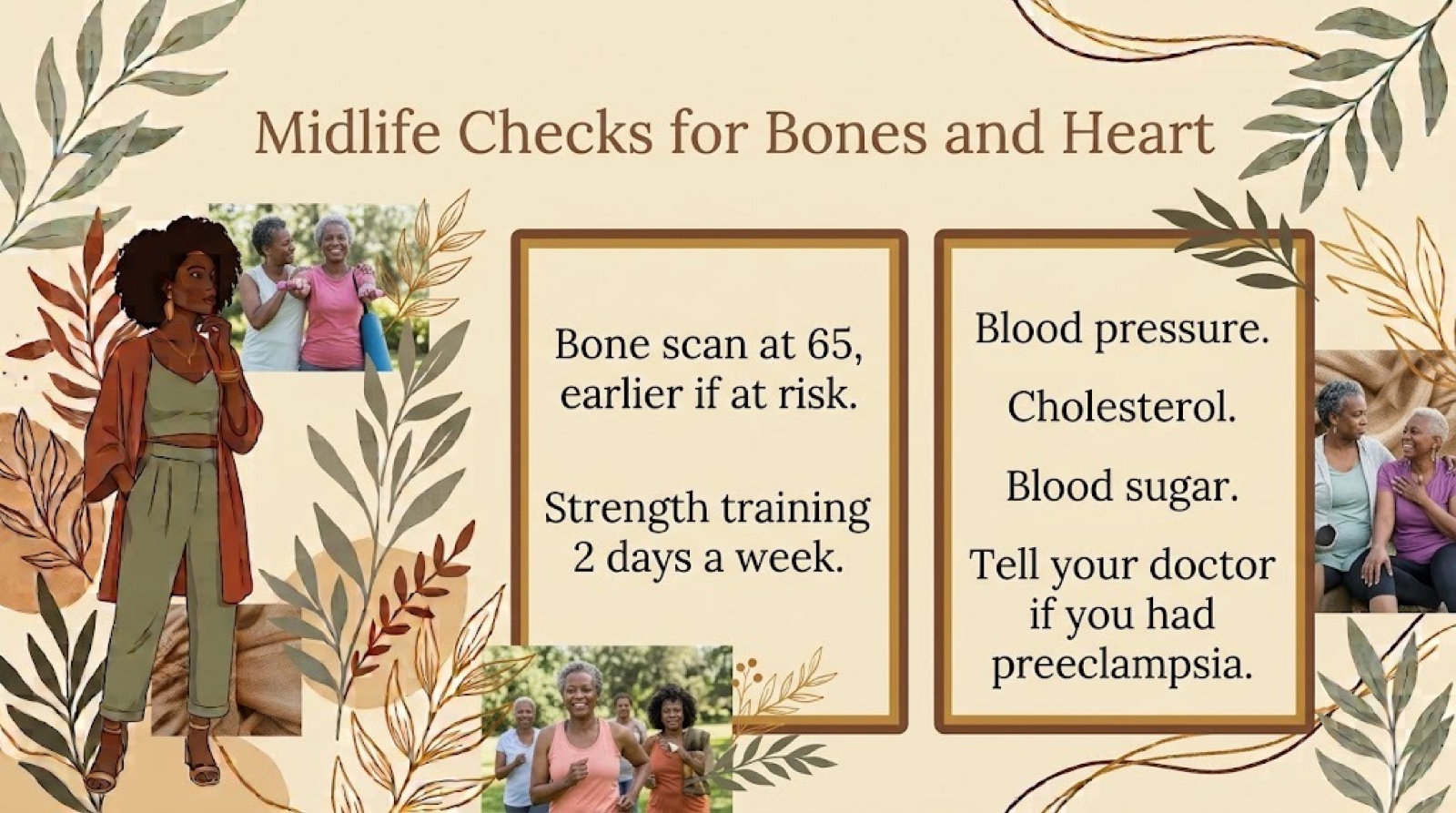
- Bone density scan (DXA) at 65 for all women, says the U.S. Preventive Services Task Force (2025).
- Earlier if you're past menopause and at higher risk: early menopause, a broken bone from a minor fall, long-term steroid medicines, low body weight, smoking, heavy drinking, a parent who broke a hip, rheumatoid arthritis.
- Calcium, vitamin D, strength training and not smoking are your foundation. Medicines are available if your bones are thin.
Heart
Heart disease is the leading cause of death for women. The American Heart Association (2020) says the menopause transition itself is linked to rising heart risk: LDL ("bad") cholesterol goes up, fat moves to the belly, and blood vessels stiffen. Midlife is the time to act.
- Know your blood pressure, cholesterol, blood sugar and waist size.
- Tell your doctor if you ever had preeclampsia, high blood pressure in pregnancy, gestational diabetes or a preterm birth. These raise later heart risk.
- Chest pressure, jaw or arm pain, shortness of breath, cold sweat or sudden tiredness can be a heart attack in women. Call 911.
- In SWAN, women whose frequent hot flashes kept going over many years had a higher risk of later heart disease events. Researchers now see long-lasting hot flashes as a possible heart warning sign. Another reason to talk to your doctor.
Sources: USPSTF Osteoporosis Screening (2025) · NIH bone health · AHA scientific statement: Menopause Transition and Cardiovascular Disease Risk (2020) · ACC summary · Thurston et al., SWAN hot flashes and heart events (JAHA 2021) · Medicare fracture outcomes study (ASBMR 2019)
Mind, rest and intimacy
Sleep, mood and sexual health
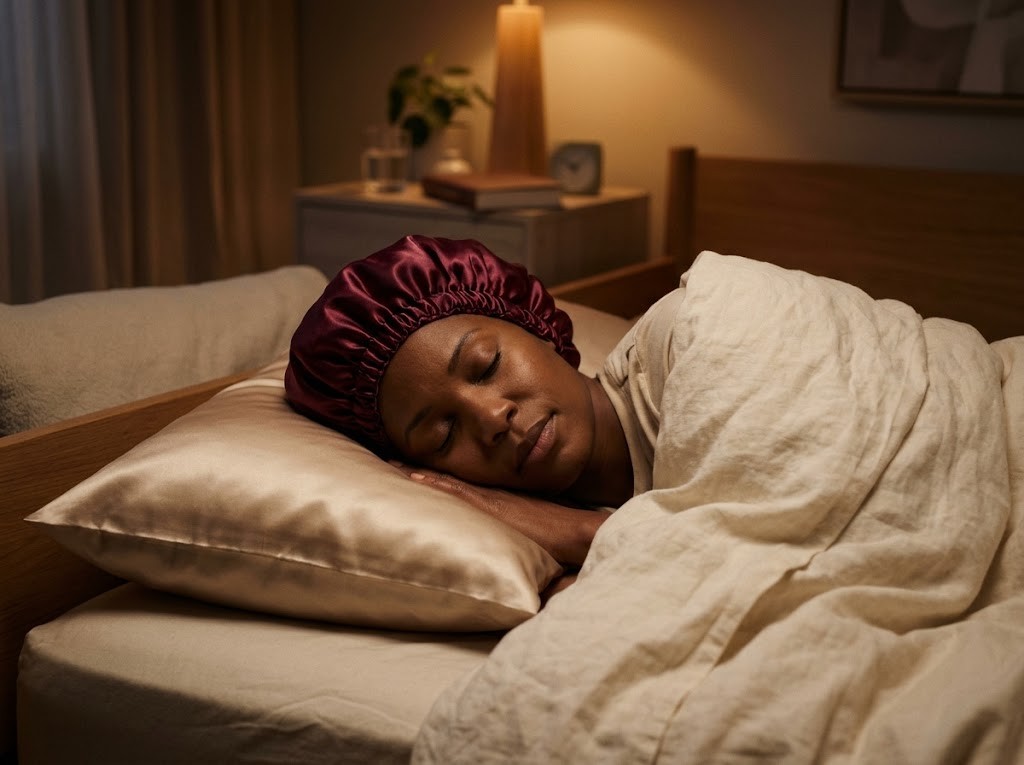
Sleep
- Cool, dark bedroom; a fan by the bed
- Layered, breathable bedding; moisture-wicking sleepwear
- Same wake-up time every day
- No alcohol close to bedtime
- CBT for insomnia (CBT-I) works and is recommended
- Ask about snoring or gasping: sleep apnea becomes more common after menopause
Mood
The years around menopause carry a higher risk of depression, especially for women who had depression before, postpartum depression or bad PMS. Add caring for parents, raising teens and work stress, and it's a lot.
- Low mood or loss of interest for more than 2 weeks: tell your doctor.
- Therapy, exercise, sister circles and, if needed, medicine all help.
- Thoughts of self-harm: call or text 988.
See our Mind & Sleep page.
Sexual health
- Painful sex is common and treatable. Lubricants, moisturizers and vaginal estrogen help.
- You can still get pregnant in perimenopause: use birth control until 12 months with no period (or as your doctor advises).
- Sexually transmitted infections don't retire. Use condoms with new partners and get tested.
- Pelvic floor exercises and physical therapy help leaking and pain.
Sources: Menopause Society 2023 (CBT) · Sleep Foundation, menopause and sleep · Menopause Society 2020 GSM · NIA · SWAN (depression findings)
Herbs and supplements
What the bottles promise, and what the science says
Store shelves are full of "menopause support" pills. Supplements don't need FDA approval before they're sold, and tests have found some contain the wrong plant. The Menopause Society does not recommend herbal supplements for hot flashes.
| Product | Claim | Evidence | Safety notes |
|---|---|---|---|
| Black cohosh | Hot flashes | Weak / mixed ACOG says the data don't show it works. | Liver warning: dozens of cases of liver damage reported worldwide (cause not proven; some products were contaminated or mislabeled). Stop and see a doctor for dark urine, yellow skin or eyes, or unusual tiredness. Avoid with liver disease, in pregnancy, and ask if you've had breast cancer. |
| Soy isoflavone pills | Hot flashes | Some modest effect in a meta-analysis | Food soy is preferred. Ask first if you've had breast cancer or take thyroid medicine. |
| Red clover | Hot flashes | Weak | May act like a weak estrogen; may affect blood thinners. |
| Evening primrose oil | Hot flashes | Weak | May raise bleeding risk with blood thinners. |
| Dong quai | "Female tonic" | Weak | Can increase bleeding with warfarin; makes skin sun-sensitive. |
| Wild yam cream | "Natural progesterone" | Weak | Your body cannot turn wild yam into progesterone. It won't protect the uterus. |
| Hibiscus, ginger, chamomile teas | Comfort, relaxation | Traditional use | A warm (or iced) cup can be a calming ritual. Hibiscus may lower blood pressure; ask if you take blood pressure medicine. Chamomile: skip if allergic to ragweed. Drink iced if hot drinks trigger flashes. |
| Calcium and vitamin D pills | Bones | Strong when you can't get enough from food | Food first. Don't go over your needs; too much calcium from pills may raise kidney stone risk. |
| Magnesium, melatonin | Sleep | Limited | Ask your pharmacist about interactions, especially with blood pressure and diabetes medicines. |
Sources: NCCIH, Black Cohosh · NIH LiverTox, black cohosh · Black cohosh and liver toxicity review · NCCIH, menopausal symptoms and complementary practices · Menopause Society 2023 · NIH ODS calcium · Our Herbs & Teas page
At the appointment
How to get heard
If your doctor isn't comfortable treating menopause, ask for a referral, or search The Menopause Society's directory of certified menopause practitioners at menopause.org.
Mrs. Revell's tips for the change
- Dress like an onion. Layers you can peel off: a cardigan over a sleeveless top.
- Keep a fan in your purse and a cold water bottle on your desk. No shame.
- Cotton or bamboo sheets and a spare nightgown by the bed.
- Iced hibiscus or ginger water instead of hot coffee in the evening (if hibiscus is OK with your meds).
- Lift something heavy twice a week. Groceries count, but dumbbells count more.
- Greens every day, fish twice a week, beans most days.
- Find your circle. Talk to your sisters, cousins and church friends. Half of them are going through it too.
- Laugh. When a hot flash hits mid-sentence, just say, "Excuse me, I'm having a personal summer."
My grandmother called her fifties "the freedom years." No more babies, no more monthly mess, and finally some time for herself. Once I got my hot flashes under control, I understood exactly what she meant.
Sources: The Menopause Society · Mayo Clinic self-care tips
Printable
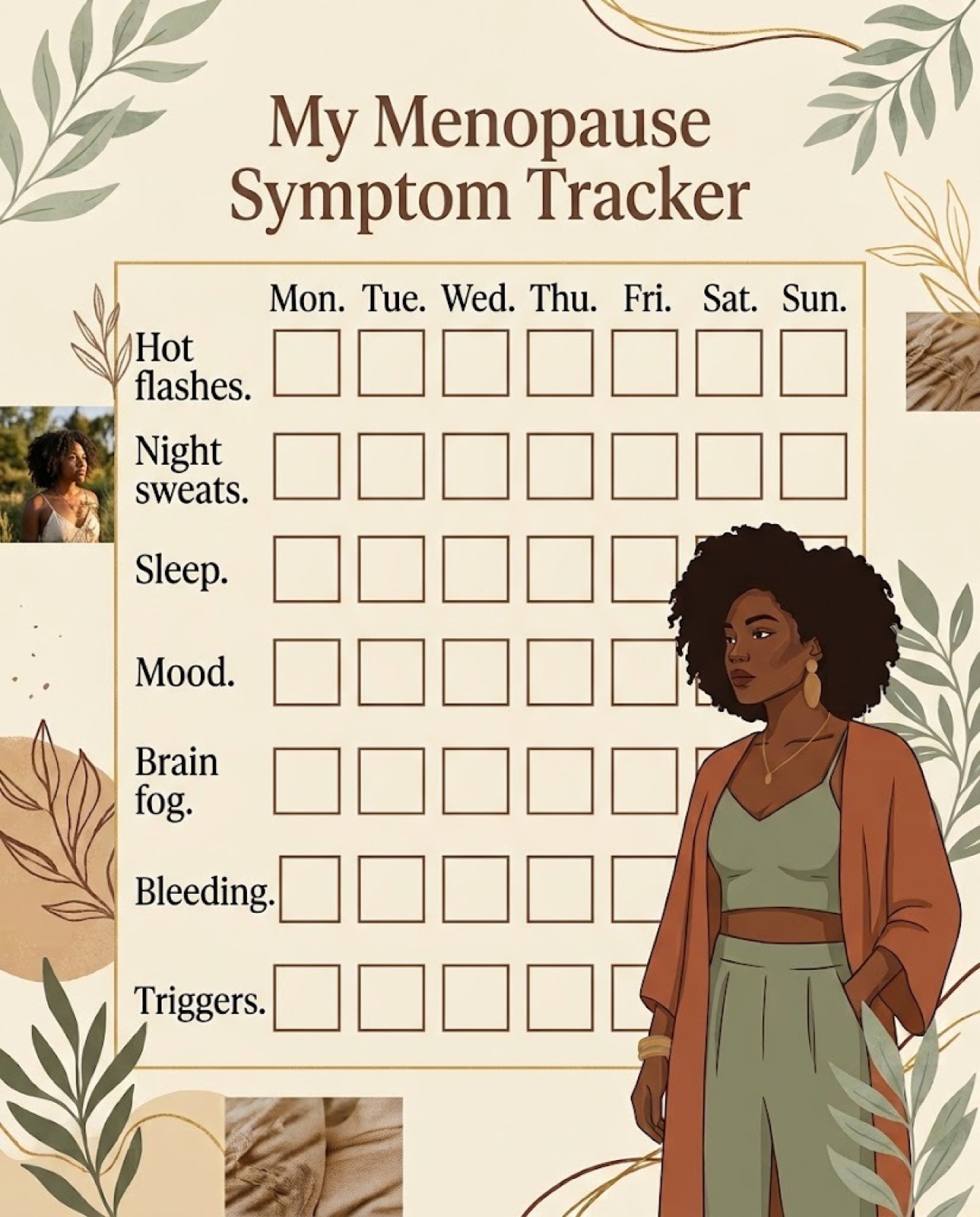
My symptom tracker
Fill in one row a day for 2 to 4 weeks, then bring it to your doctor. Rate each from 0 (none) to 3 (severe). Note what you ate or drank before a hot flash.
| Day | Hot flashes (how many) | Night sweats (0–3) | Sleep hours | Mood (0–3) | Brain fog (0–3) | Joint aches (0–3) | Bleeding (none / spot / light / heavy) | Possible triggers (spicy, coffee, wine, stress) |
|---|---|---|---|---|---|---|---|---|
| Mon | ||||||||
| Tue | ||||||||
| Wed | ||||||||
| Thu | ||||||||
| Fri | ||||||||
| Sat | ||||||||
| Sun |
Date of last period: ____________ Medicines and supplements: ______________________________ Questions for my doctor: ______________________________