
Womanhood · Pregnancy & After Baby
Carrying life, and carrying yourself
Everything from the vitamin you take before you ever see a plus sign, through nine months of good food and checkups, to the whole first year after the baby comes. Plain talk, real numbers, and the warning signs every Black mother and every person who loves her should know by heart.

Start here
You deserve care that listens
Pregnancy is a normal, beautiful part of life for many women. It is also a time when your body is working harder than it ever has. Your blood volume rises. Your heart pumps more. Your needs for certain vitamins jump.
For Black women in America, the stakes are higher. Black mothers die from maternal causes at about three times the rate of white mothers (44.8 vs. 14.2 per 100,000 live births, CDC 2024), and that gap is not about our bodies being "weaker." It is about care that comes late, signs that get brushed off, and stress that sits on us for generations. Most of these deaths can be prevented. That is why this page is long. Knowledge is protection.
- Before: folic acid every day if you could get pregnant.
- During: a good prenatal vitamin, good food, early and regular checkups.
- After: your checkups and your warning signs continue for a full year.
- Always: bring someone with you, and speak up.

When I was carrying my babies, my grandmother told me, "Your job right now is to grow that child and to take care of the house it lives in." Baby, you are the house. Take care of the house.
Preconception
Before the plus sign
The most important vitamin for a baby's spine and brain does its work in the first few weeks, often before a woman even knows she is pregnant. About half of U.S. pregnancies are not planned. So the advice is for every woman who could become pregnant, not just women who are trying.
Folic acid: 400 mcg every day
The CDC says all women who could become pregnant should get 400 micrograms (mcg) of folic acid every day. It helps prevent neural tube defects, serious birth defects of the baby's brain and spine. The U.S. Preventive Services Task Force gives it its top grade and says 400 to 800 mcg a day.
Most multivitamins sold in the U.S. already have 400 mcg. Read the label.
Had a baby with a neural tube defect before?
Women who have had a pregnancy affected by a neural tube defect need a much higher dose, prescribed by their provider. Do not guess at this dose on your own. Call before you start trying again.
A pre-pregnancy checkup
- Blood pressure and blood sugar checked and under control
- Review every medicine and supplement you take
- Vaccines up to date
- Know your sickle cell trait status (and your partner's)
- Stop smoking, alcohol and other drugs
Sources: CDC, About Folic Acid · USPSTF folic acid · CDC folic acid fact sheet · CDC sickle cell
Prenatal vitamins
What your prenatal vitamin should cover
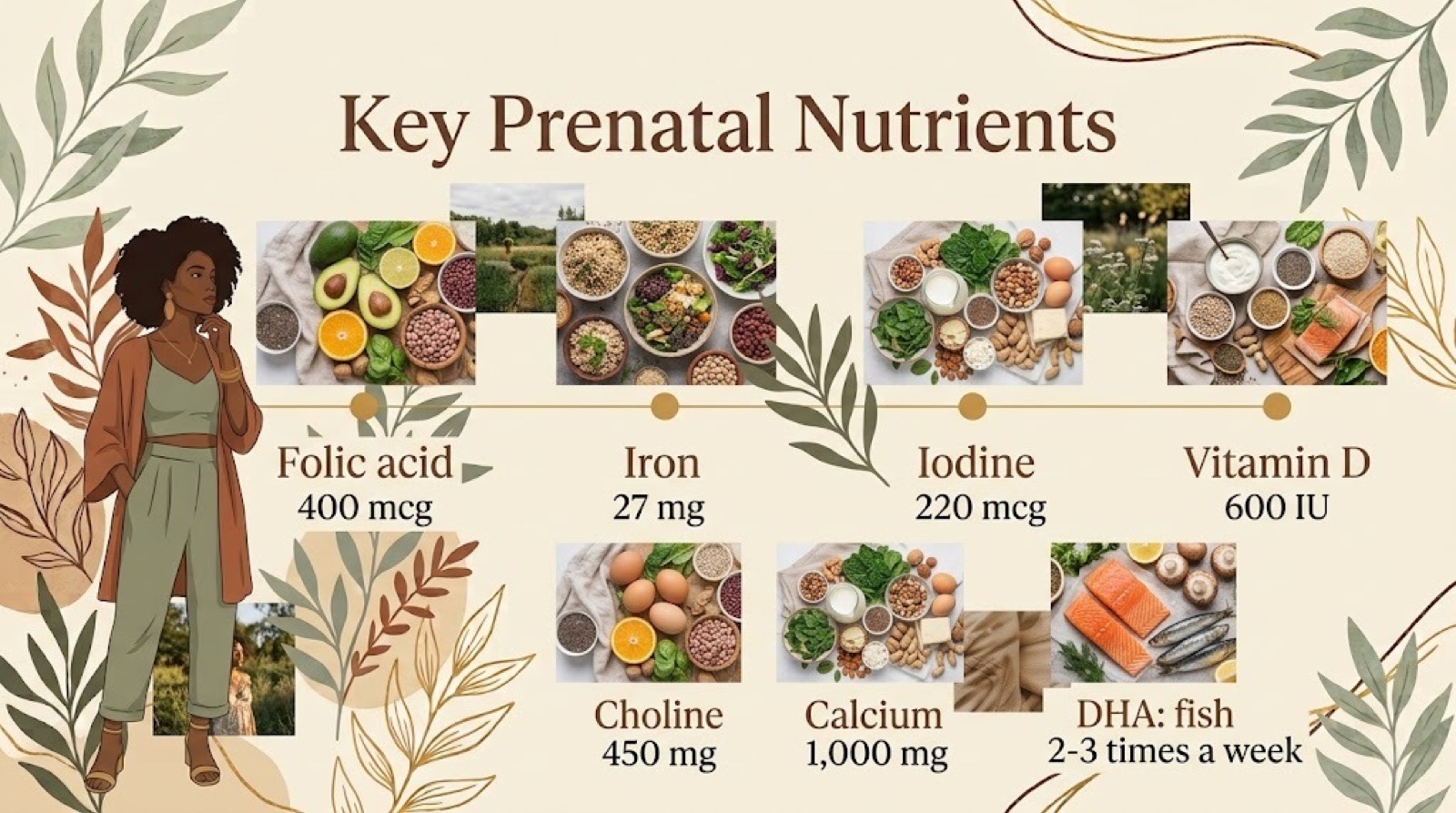
Not all prenatal vitamins are the same. The National Institutes of Health's Office of Dietary Supplements notes that some prenatal vitamins contain no iodine at all, and choline is often low or missing. Turn the bottle around and check.
| Nutrient | Daily need in pregnancy | While breastfeeding | Why it matters | Food sources |
|---|---|---|---|---|
| Folic acid / folate | 600 mcg DFE total from food and pills (including 400 mcg folic acid) | 500 mcg DFE | Baby's brain and spine; making new blood cells | Fortified cereal and bread, black-eyed peas, lentils, spinach, collards, oranges |
| Iron | 27 mg | 9 mg | Your blood volume grows a lot; prevents anemia and tiredness | Lean beef, chicken, sardines, beans, spinach, fortified cereal (eat with vitamin C foods) |
| Iodine | 220 mcg | 290 mcg | Baby's brain and your thyroid | Iodized salt (a little), dairy, eggs, fish. Check your vitamin label. |
| Choline | 450 mg | 550 mg | Baby's brain and spinal cord development | Eggs (one of the best), chicken, fish, beans, peanuts |
| Calcium | 1,000 mg (ages 19+) | 1,000 mg | Baby's bones and teeth; protects yours | Milk, yogurt, fortified plant milk, canned salmon with bones, collards, calcium-set tofu |
| Vitamin D | 600 IU | 600 IU | Helps you use calcium; bones | Fortified milk, salmon, eggs, sunlight; many Black women run low. Ask for a level check. |
| DHA (omega-3) | No official daily number has been set | Same | Baby's brain and eyes | Get it from 8 to 12 ounces a week of low-mercury fish (see below). Ask about a supplement if you eat no fish. |
Take it with care
- Iron can upset the stomach. Taking the pill with dinner or at bedtime helps some women.
- Calcium and iron block each other a little. Space them apart if your provider gives you separate pills.
- Gummy prenatals often have no iron. Check.
More is not better
Do not double up on vitamins. Too much vitamin A (from liver or retinol pills) can harm a baby, and iron has an upper limit of 45 mg a day unless your doctor prescribes more for anemia.
Can't afford vitamins?
WIC, the federal nutrition program for pregnant women, new moms and young children, can help with healthy food. Many Medicaid plans cover prenatal vitamins with a prescription. Ask at your first visit.
Sources: NIH ODS, Dietary Supplements and Pregnancy · NIH ODS calcium · IOM calcium and vitamin D · FDA/EPA fish advice · USDA WIC
Food
What to eat, trimester by trimester
You are not "eating for two" grown people. Early on you need about the same calories as before; later you need a little more. Focus on quality: color on the plate, protein at every meal, whole grains, and water all day.
First trimester
Baby's organs are forming. Nausea may make eating hard.
Lean on
- Folate foods: black-eyed peas, lentils, greens, oranges
- Small, frequent meals; crackers by the bed
- Ginger tea or ginger chews (ask your provider about amounts)
- Eggs for choline
- Plenty of water; sip if you are vomiting
Call if
- You can't keep any food or fluids down for a day
- You are losing weight or feel faint
Second trimester
Appetite usually comes back. Baby's bones and muscles are growing fast.
Lean on
- Calcium foods: yogurt, milk or fortified soy milk, collards, canned salmon
- Iron with vitamin C: beans plus tomatoes or peppers
- Low-mercury fish 2–3 times a week
- Fiber (oats, beans, fruit) for constipation
- A modest bump in food, about one extra healthy snack
Watch
- Sugary drinks and sweets; glucose test comes at 24–28 weeks
Third trimester
Baby is gaining weight and building the brain. Heartburn and swelling are common.
Lean on
- Protein at every meal: eggs, fish, chicken, beans, peanut butter
- DHA from salmon, sardines or other low-mercury fish
- Smaller meals; don't lie down right after eating
- Potassium foods: sweet potatoes, bananas, greens
- Less salt from packaged and fast food
Call now if
- Sudden swelling of face or hands, bad headache, or vision changes (possible preeclampsia)
A soul-food prenatal plate
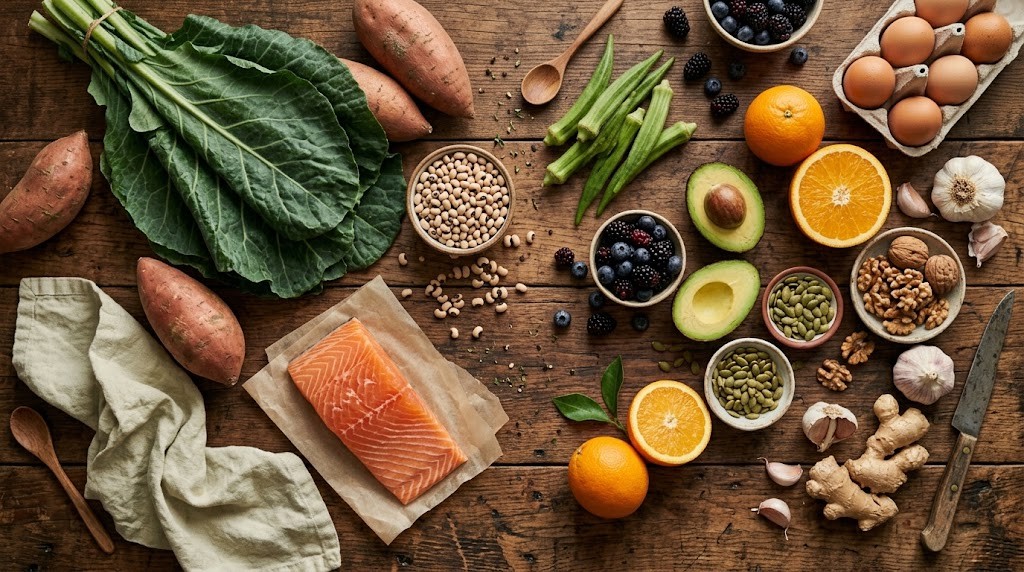
Half the plate greens and other vegetables, a quarter protein (baked fish, chicken, beans), a quarter whole grain or sweet potato.
Black-eyed peas
Food factFolate, iron, protein and fiber in one pot. Cowpeas are an African crop that came across the Atlantic with our ancestors.
Collard greens
Food factCalcium, folate and vitamin K. Cook them with smoked turkey instead of ham hock to cut the salt.
Eggs
Food factOne of the best choline foods. Cook until the yolk and white are firm.
Sources: NIH ODS pregnancy · Mayo Clinic pregnancy nutrition · NCCIH ginger · FDA/EPA fish advice · USDA MyPlate pregnancy
Food safety
What to skip or handle with care
Pregnancy changes your immune system, so some food germs hit harder. Listeria, a germ that can grow even in the refrigerator, can cause miscarriage or stillbirth. Mercury in some big fish can harm a baby's growing brain.
Skip completely
- Alcohol. The CDC says there is no known safe amount, no safe time and no safe type (wine, beer or liquor) during pregnancy or while trying to get pregnant. Stopping at any point helps the baby.
- High-mercury fish: king mackerel, marlin, orange roughy, shark, swordfish, tilefish from the Gulf of Mexico, bigeye tuna.
- Raw or undercooked meat, poultry, seafood (sushi, raw oysters, clams) and eggs (runny yolks, raw cookie dough, homemade eggnog, homemade Caesar dressing).
- Unpasteurized milk, cheese and juice. Check labels on queso fresco and other soft cheeses.
- Raw sprouts (alfalfa, bean, clover).
- Refrigerated smoked seafood (lox, "nova") unless cooked in a dish.
Only if handled right
- Deli meat, cold cuts, hot dogs: only when heated until steaming hot (165 °F).
- Caffeine: keep it under 200 mg a day. That is about one 12-ounce cup of brewed coffee. Remember tea, soda, energy drinks and chocolate count too. Skip energy drinks.
- Fish you or family catch: check Pennsylvania's local fish advisories. If there's no advice for those waters, eat only one meal of it that week and no other fish.
- Leftovers: eat within a few days; reheat until steaming.
- Wash fruits and vegetables; keep raw meat away from ready-to-eat food.
Fish: the good list
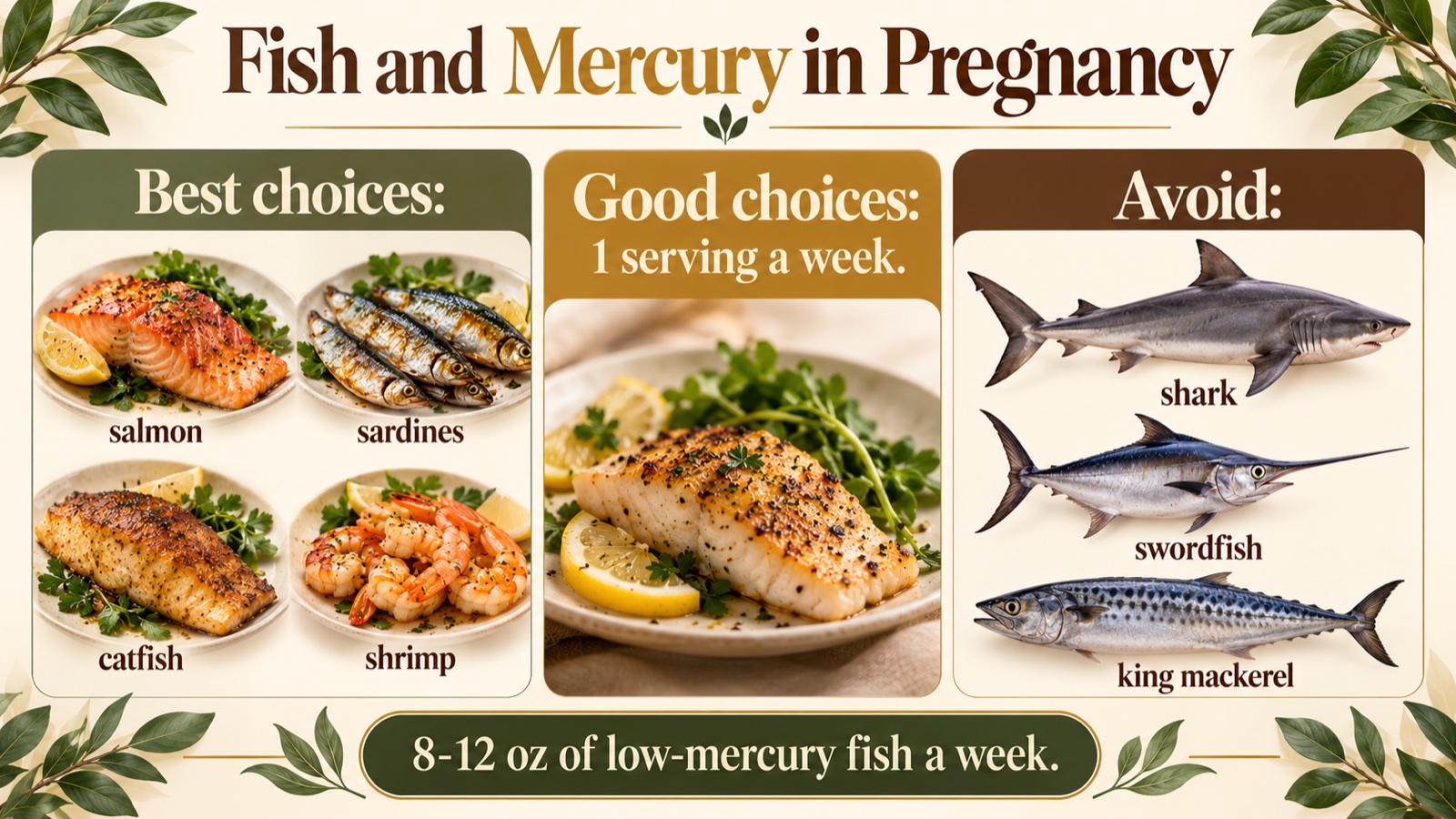
Fish is one of the best foods in pregnancy. FDA and EPA advise 2 to 3 servings a week (8 to 12 ounces total) from the "Best Choices" list. A serving is about the size of your palm.
| Best choices (2–3 servings a week) | Good choices (1 serving a week) | Avoid |
|---|---|---|
| Salmon, sardines, catfish, tilapia, whiting, cod, pollock, shrimp, crab, canned light tuna, trout, herring, flounder | Albacore (white) tuna, halibut, mahi mahi, snapper, striped bass (ocean), bluefish, grouper | King mackerel, marlin, orange roughy, shark, swordfish, tilefish (Gulf of Mexico), bigeye tuna |
Herbs and "natural" products to avoid in pregnancy
Plants are medicine, and that is exactly why some of them are not safe while you're carrying. Some cause the womb to contract; some are not tested at all in pregnancy. Supplements do not need FDA approval before they're sold, and labels don't always match what's in the bottle.
| Herb or product | Why to avoid in pregnancy | Evidence |
|---|---|---|
| Blue cohosh | Can stimulate the womb; reports of harm to babies | Avoid |
| Black cohosh | Not shown safe in pregnancy; liver injury reports | Avoid |
| Pennyroyal (tea or oil) | Toxic to the liver; has caused deaths | Avoid |
| Dong quai | May cause contractions; affects bleeding | Avoid |
| Goldenseal | Contains alkaloids not safe for a developing baby | Avoid |
| Mugwort, wormwood, rue, tansy | Traditional "bring on the period" herbs; can stimulate the womb | Avoid |
| Hibiscus (sorrel, bissap, zobo) as a daily tea | Not recommended in pregnancy; may affect hormones and blood pressure | Limited data, so skip |
| Moringa root or bark; black seed oil capsules; nettle tea | Moringa root/bark may cause contractions; others untested | Skip unless OB approves |
| Large amounts of licorice root, sage, rosemary or parsley as medicine | Fine as normal seasoning in food; not in concentrated amounts | Food amounts OK |
| Ginger | Commonly used for nausea | Some evidence; ask about amounts |
Sources: CDC alcohol and pregnancy · FDA/EPA Advice About Eating Fish · FDA food safety for pregnant women · CDC Listeria · Mayo Clinic (caffeine, deli meat) · UTEP herbal safety · NCCIH Herbs at a Glance
Weight gain
How much weight should you gain?
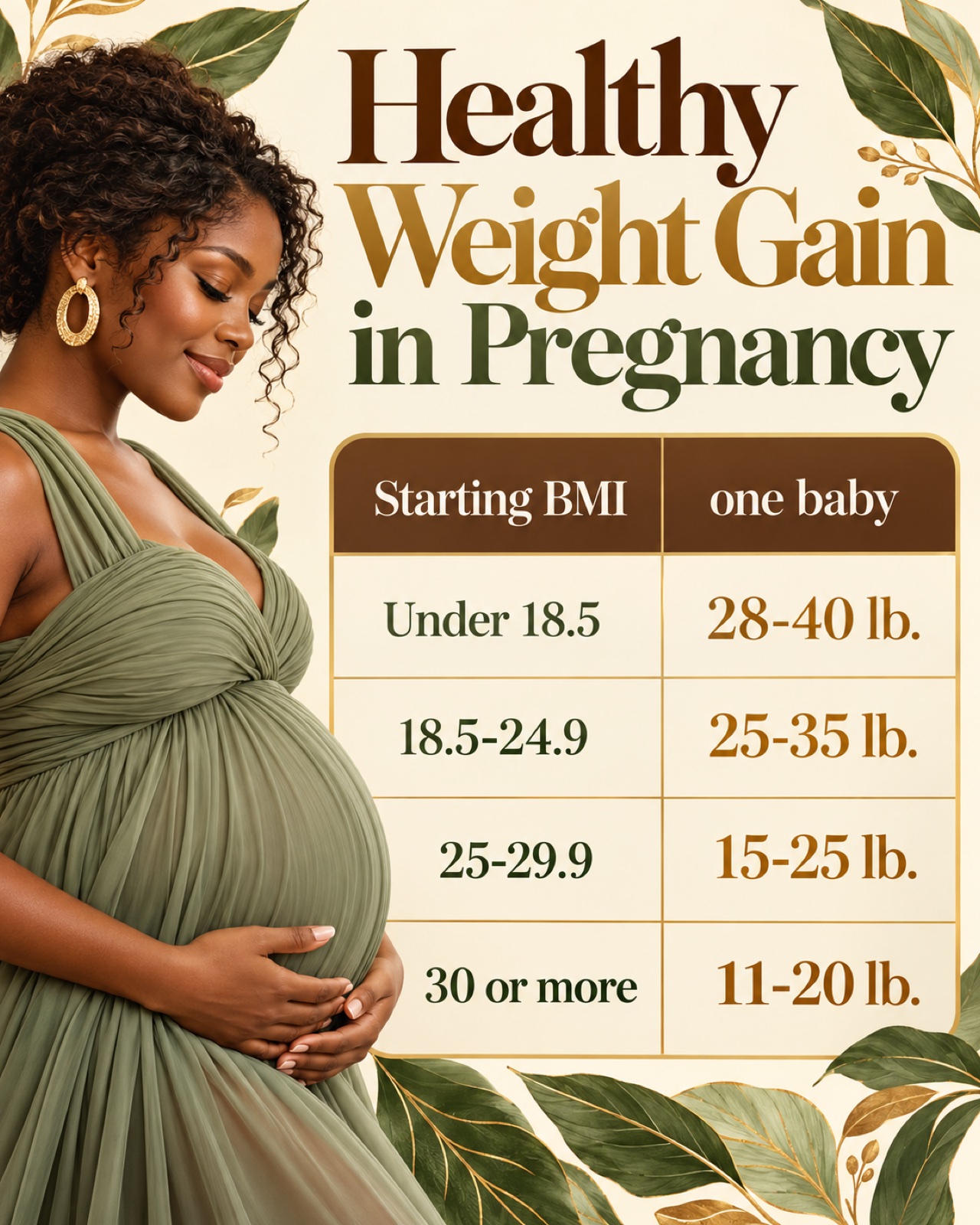
It depends on where you started. These ranges come from the Institute of Medicine (2009) and are used by ACOG, the doctors' group for OB-GYNs. Your provider may set a different goal for you. Never diet to lose weight during pregnancy unless your provider tells you to.
| Your BMI before pregnancy | One baby | Twins |
|---|---|---|
| Underweight (under 18.5) | 28–40 pounds | No range set |
| Healthy weight (18.5–24.9) | 25–35 pounds | 37–54 pounds |
| Overweight (25–29.9) | 15–25 pounds | 31–50 pounds |
| Obesity (30 or more) | 11–20 pounds | 25–42 pounds |
Most of the gain comes in the second and third trimesters. Gaining a lot more than the range raises the chance of gestational diabetes, high blood pressure and a cesarean birth; gaining too little raises the chance of a small or early baby.
Sources: Merck Manual table (adapted from IOM and ACOG Committee Opinion 548) · CDC weight gain during pregnancy
Movement
Safe exercise while you're expecting
ACOG says healthy pregnant and postpartum women should aim for at least 150 minutes a week of moderate activity, like 30 minutes, 5 days a week. Moving helps with sleep, mood, back pain, constipation and blood sugar. Check with your provider first, especially if you have a complication.
Good choices
- Brisk walking (the park, the mall, the block)
- Swimming and water aerobics
- Stationary bike
- Low-impact aerobics, line dancing
- Prenatal yoga and modified Pilates
- Light strength training
Not now
- Contact sports: boxing, basketball, soccer, hockey
- Activities with a high fall risk: horseback riding, off-road biking, skiing, gymnastics
- Scuba diving
- Skydiving
- Hot yoga or hot Pilates (overheating)
- Lying flat on your back for a long time later in pregnancy
Stop exercising if
- Vaginal bleeding or fluid leaking
- Regular, painful contractions
- Dizziness or feeling faint
- Chest pain or a racing heart
- Headache
- Short of breath before you even start
- Calf pain or swelling
Sources: ACOG, Exercise During Pregnancy · Lamaze summary of ACOG Committee Opinion 804 · NCBI StatPearls, exercise in pregnancy · CDC activity guidelines
Prenatal care
Your prenatal visits and tests
Start prenatal care as early as you can, ideally in the first trimester. For a healthy pregnancy, a common schedule is a visit about every 4 weeks until week 28, every 2 weeks from 28 to 36, then every week until the baby comes. High-risk pregnancies have more visits.
| When | What usually happens | Ask about |
|---|---|---|
| First visit (about 8–10 weeks) | Health and family history, blood type and Rh, blood count, tests for HIV, hepatitis B and syphilis, urine test, Pap test if due, dating ultrasound | Sickle cell and other genetic carrier tests; every medicine and supplement you take; blood pressure baseline |
| Every visit | Blood pressure, weight, urine check, baby's heartbeat, belly measurement later on | Write down your blood pressure each time and ask what it means |
| 10–13 weeks | Optional screening for chromosome conditions (blood test such as cell-free DNA); chorionic villus sampling if high risk | What the results can and can't tell you |
| After 12 weeks | If you are at high risk for preeclampsia, low-dose aspirin (81 mg a day) may be recommended | "Am I a candidate for low-dose aspirin?" Do not start it on your own. |
| 15–22 weeks | Quad screen blood test (if earlier screening not done) | |
| 18–22 weeks | Anatomy ultrasound: checks baby's organs, growth and placenta | Bring your support person |
| 24–28 weeks | Glucose test for gestational diabetes; repeat blood count | Diet tips if your number is high |
| About 28 weeks | Rh immune globulin shot if you are Rh-negative | |
| 27–36 weeks | Tdap vaccine (protects baby from whooping cough); flu and other vaccines in season | Which vaccines are right for this season |
| 36–37 weeks | Group B strep swab; check baby's position | Your birth plan, who will be with you, how to reach labor and delivery |
| After birth | A blood pressure check within the first 1–3 weeks if you had high blood pressure; full postpartum visit by 12 weeks; ongoing care up to a year | Depression screening, birth control and spacing, follow-up for any pregnancy complication |
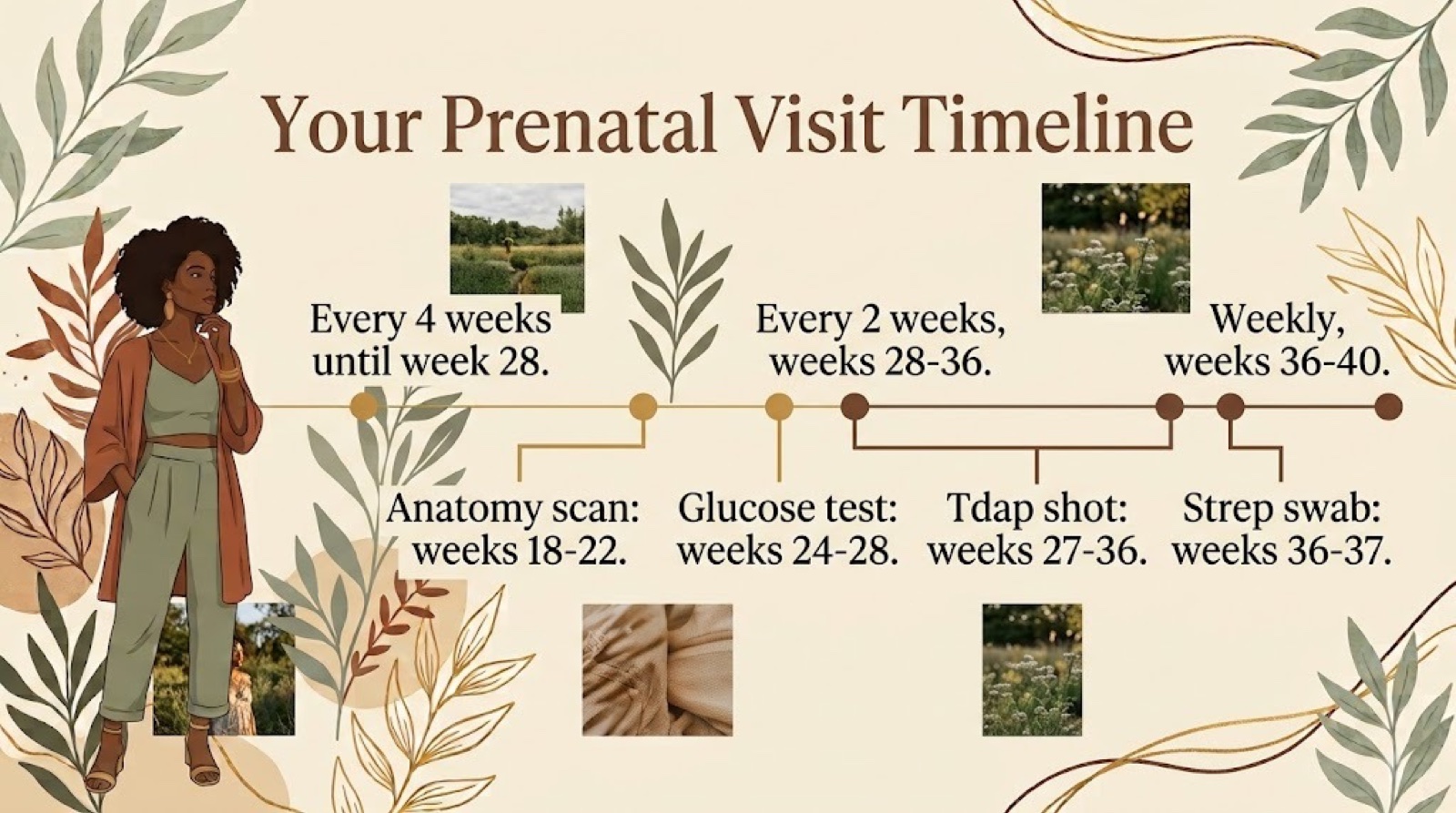
Sources: Cleveland Clinic prenatal appointment schedule · Cleveland Clinic prenatal testing · USPSTF aspirin for preeclampsia (2021) · CDC Tdap in pregnancy
Black maternal health
The numbers, and what they mean for you
These numbers are hard to read. They are here because knowing them is power. They are not a prediction for you. They are a reason to get early care, bring backup and speak up.
Black maternal deaths per 100,000 live births (2024)
Compared with 14.2 for white women, 18.1 for Asian women and 12.1 for Hispanic women. That is about three times the white rate. The rate was 50.3 in 2023; the change was not statistically significant.
of pregnancy-related deaths were preventable
That is what CDC-supported state review committees found when they studied 1,018 deaths from 2017 to 2019 in 36 states.
happened 7 days to 1 year after birth
In that same review, more than half of the deaths happened after the mother had gone home. Postpartum care is not a six-week thing. It is a full year.
What causes pregnancy-related deaths
Across all groups in the 2017–2019 review, the leading causes were mental health conditions (including suicide and overdose), severe bleeding, heart conditions, infection and blood clots. For Black women, the leading cause was heart and coronary conditions.
Preeclampsia and high blood pressure
Watch for headache, vision changes, swelling of face or hands, and chest pain. Can appear up to weeks after birth.
Hemorrhage (heavy bleeding)
Soaking a pad in an hour or passing big clots after birth is an emergency.
Cardiomyopathy
A weakening of the heart muscle in late pregnancy or the months after. Feels like getting winded lying down, swelling, a racing heart, extreme tiredness. Easy to brush off as "just new-mom tired." Don't.
Blood clots and infection
A swollen, red, painful leg; trouble breathing; fever of 100.4 °F or higher.
Remember Serena Williams. A world champion, famous and wealthy, and after her baby she had to push the staff to check her for blood clots she knew she had. She was right. If it happened to Serena, it can happen to you and me. That is why you never go to the hospital alone.
Sources: NCHS Maternal Mortality Rates in the U.S., 2024 (Health E-Stat 113) · NCHS 2023 · CDC: four in five pregnancy-related deaths preventable (MMRC 2017–2019) · CDC maternal mortality data · Serena Williams' account (Vogue, via GMA)
CDC Hear Her
Urgent maternal warning signs
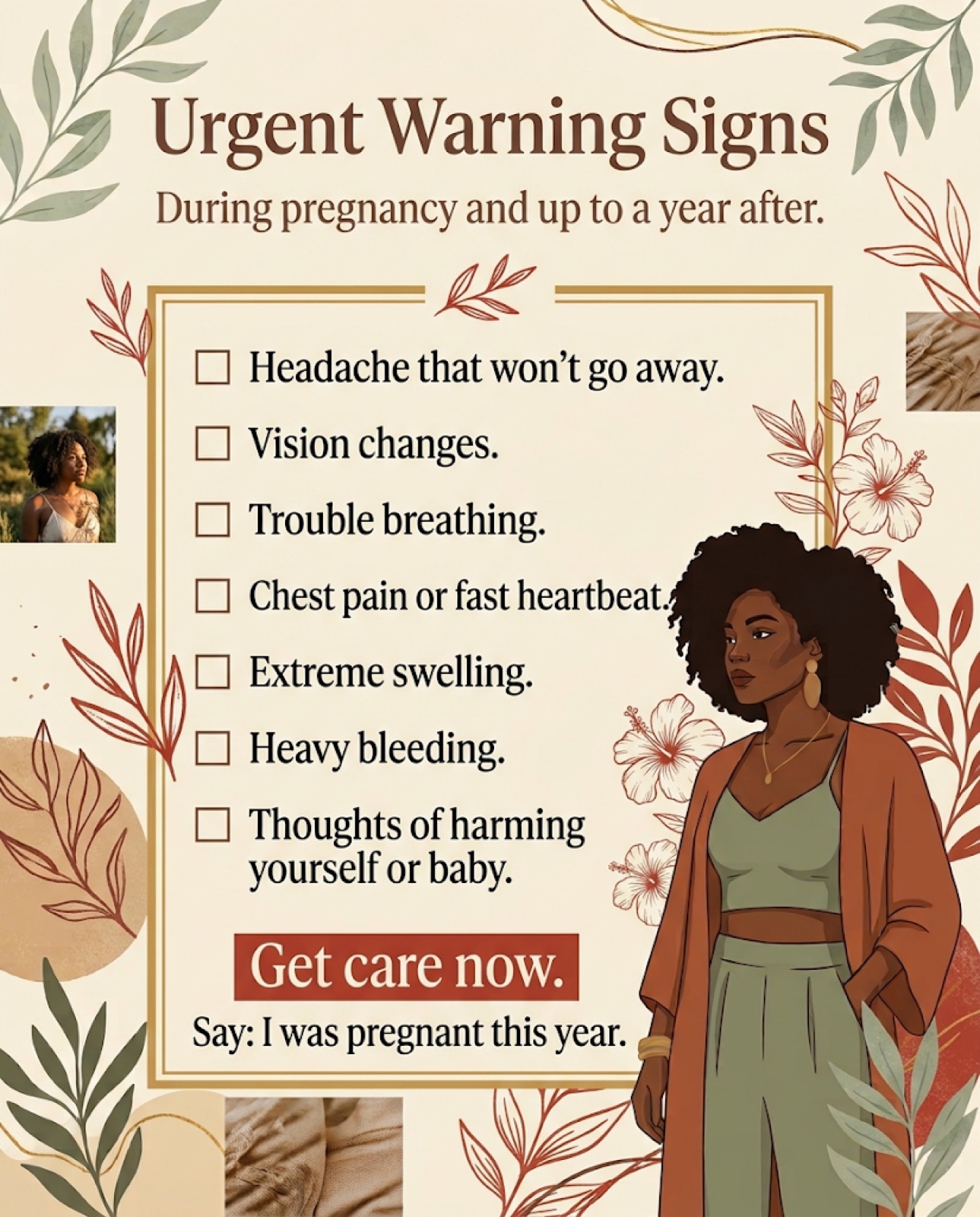
The CDC's Hear Her campaign lists these signs. They matter during pregnancy and for up to a year after. If you have any of them, get medical care right away. Call 911 if it feels like an emergency.
- Headache that won't go away or gets worse over time
- Dizziness or fainting
- Changes in your vision
- Fever of 100.4 °F or higher
- Extreme swelling of your hands or face
- Thoughts about harming yourself or your baby
- Trouble breathing
- Chest pain or fast-beating heart
- Severe nausea and throwing up
- Severe belly pain that doesn't go away
- Baby's movement stopping or slowing during pregnancy
- Vaginal bleeding or fluid leaking during pregnancy
- Vaginal bleeding or discharge after pregnancy
- Severe swelling, redness or pain of your leg or arm
- Overwhelming tiredness
What to say, word for word
Sources: CDC Hear Her, Urgent Maternal Warning Signs · CDC Hear Her campaign
Backup
Speak up, bring backup: doulas, midwives and Philly help
How to advocate
- Bring one support person to every big visit and to the birth.
- Keep a notebook or phone note: blood pressure readings, symptoms, questions.
- Ask "What else could this be?"
- Ask for a different provider if you feel dismissed.
- Get copies of your records and test results.
- Ask the hospital for a patient advocate if things go wrong.
Doulas
A doula is a trained, non-medical support person who helps before, during and after birth. A Cochrane review of 26 trials with nearly 16,000 women found that continuous one-on-one support during labor led to more spontaneous vaginal births, shorter labors, fewer cesareans and fewer babies with low Apgar scores. The benefits were greatest when the support came from a doula rather than hospital staff or family.
Midwives
Certified nurse-midwives are licensed to provide prenatal care, deliver babies and care for women after birth, often in hospitals and birth centers. They work with doctors when a pregnancy becomes high risk. Many women love the time and listening that midwifery care offers.
Rooted in our grandmothers' work
Into the early 1900s, most babies in the rural South were caught by midwives, and in Black communities these were usually older women called "granny midwives." They learned by apprenticeship, prayer and what they called "motherwit," and many stayed with a family for days after a birth. Through the 1900s, state laws and medical campaigns pushed them out. Alabama midwives like Onnie Lee Logan and Margaret Charles Smith, both licensed in 1949, were among the last.
Today's Black doulas and community midwives often call themselves heirs to these grandmothers. In Philadelphia, Dr. Helen Octavia Dickens, the first African American woman admitted to the American College of Surgeons (1950), led OB-GYN care at Mercy-Douglass Hospital and later opened a Penn clinic for pregnant teens in 1967.
Documented historySources: Encyclopedia of Alabama, Onnie Lee Logan · Alabama Women's Hall of Fame, Margaret Charles Smith · Nursing Clio · NLM, Helen Octavia Dickens
Help in Philadelphia and Pennsylvania
Maternity Care Coalition (MCC)
Phone 215-972-0700 · maternitycarecoalition.org
Free home visiting (MOMobile) for pregnant people and families with children up to age 3, Healthy Start, Early Head Start, Cribs for Kids, and the Community Doula and Lactation Program (North Philadelphia Breastfeeding & Community Doula Program) with culturally connected doulas and lactation counselors. Call for current eligibility.
Penn Medicine Heart Safe Motherhood
Penn Medicine hospitals; adopted by other Philly health systems
New mothers with high blood pressure in pregnancy go home with a blood pressure cuff and text their readings. The care team answers high readings fast. A Penn study found participants had fewer complications and hospital readmissions in the six months after birth (not a randomized trial). Ask your hospital if they offer this or something like it.
Pennsylvania Medicaid
Medical Assistance (PA DHS)
Since April 1, 2022, Pennsylvania Medicaid covers mothers for 12 months after birth, not just 60 days. Since February 2024, certified doulas can enroll as Medicaid providers, for support during pregnancy, birth and up to a year after. Ask your Medicaid plan for a list of in-network doulas.
WIC
Pennsylvania WIC · pawic.com
Healthy food, nutrition counseling and breastfeeding peer counselors for pregnant and new mothers and children under 5 who qualify.
PA 211
Dial 211 or visit pa211.org
Free, confidential help finding local services: housing, food, baby supplies, doulas, support groups.
911 · labor and delivery
Save your hospital's L&D number in your phone
For any Hear Her warning sign, go now. Say you are pregnant or were pregnant in the last year.
Sources: Bohren et al., Cochrane review of continuous labor support · PA 211, Maternity Care Coalition · Generocity, MCC doula and lactation program · PhillyVoice on MCC · Penn Medicine Heart Safe Motherhood · Penn study release · PHLP, 12-month postpartum Medicaid · PHLP, doulas in PA Medicaid · WHYY
The fourth trimester and beyond
After baby: the whole first year
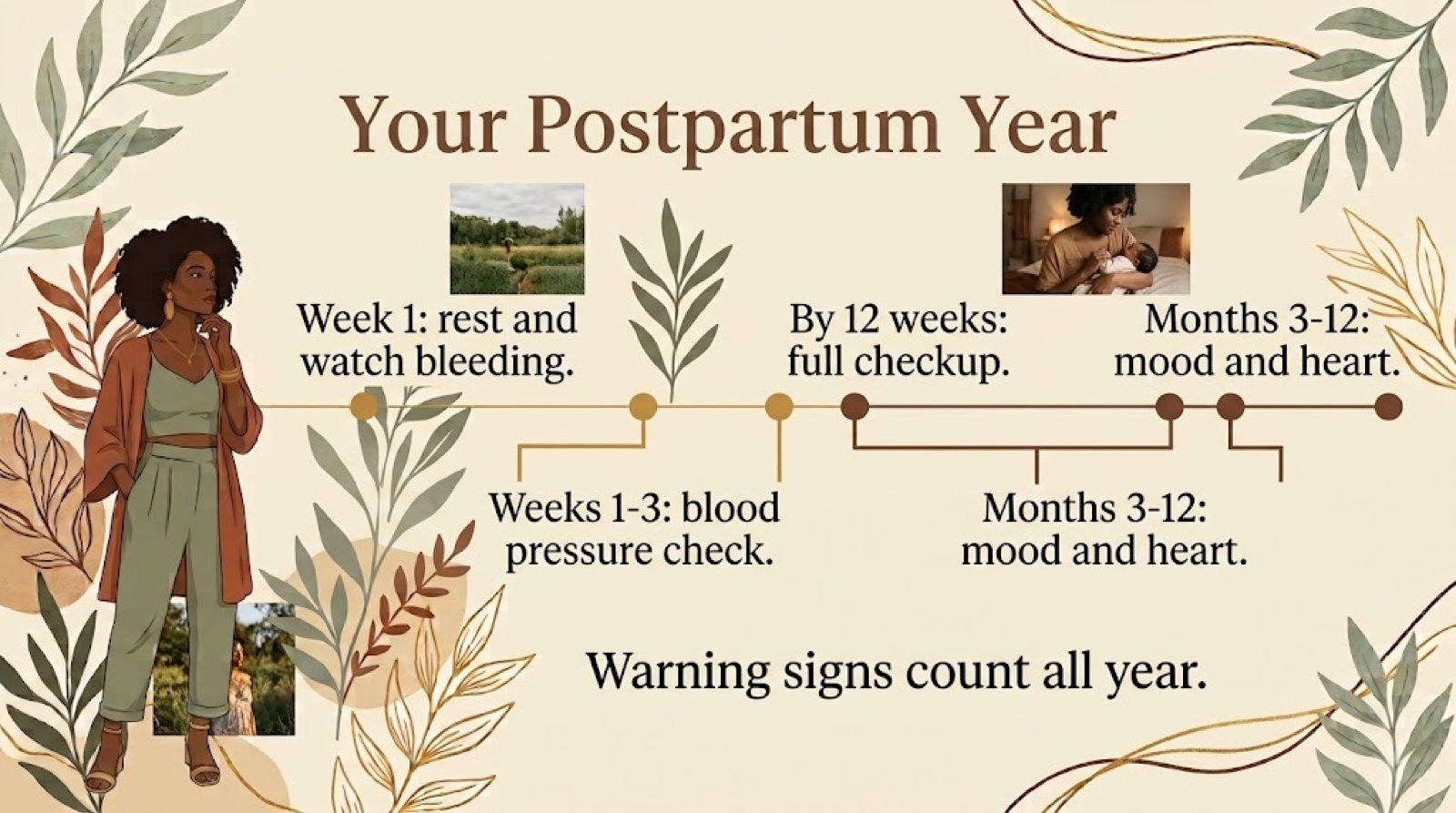
The six-week checkup is not the finish line. Your body, your heart, your hormones and your mind keep healing for months. Warning signs still count for a full year.
- First 24 hours to 1 weekBleeding (lochia) like a heavy period that slowly lightens. Rest, fluids, help with the baby. Watch for soaking a pad in an hour, fever, or a bad headache.
- Weeks 1–3If you had high blood pressure in pregnancy, get a blood pressure check now; dangerous spikes often happen in the first days to weeks. "Baby blues" (weepy, moody) usually ease within about two weeks.
- By 12 weeksA full postpartum visit: physical recovery, mood, sleep, feeding, birth control, follow-up for diabetes or blood pressure.
- Months 3–12Keep checking mood and blood pressure. Return to exercise slowly. Postpartum depression can begin any time in the first year. Cardiomyopathy and other heart problems can show up months later.
- LifelongPreeclampsia, gestational diabetes and preterm birth are early signs of higher heart and diabetes risk later. Tell every future doctor about them.
Postpartum depression and anxiety
About 1 in 8 women with a recent birth reported symptoms of postpartum depression in CDC survey data (PRAMS, 2018). It is a medical condition, not a weakness and not a sign you're a bad mother. It's treatable.
Signs to watch
- Feeling sad, empty or hopeless most of the day
- Crying a lot
- Anxiety, racing thoughts, panic
- Feeling angry or irritable
- Trouble bonding with the baby
- Pulling away from family and friends
- Can't sleep even when baby sleeps, or sleeping all the time
- Feeling worthless or guilty
- Thoughts of harming yourself or the baby
Blues or depression?
Baby blues are common in the first days: weepy, up and down, overwhelmed. They fade within about two weeks.
Depression lasts longer, feels heavier, and gets in the way of caring for yourself or the baby. It can start during pregnancy or any time in the first year. Partners can get it too.
Treatment can include talk therapy, support groups and medicines that are compatible with breastfeeding.
Call or text today
National Maternal Mental Health Hotline1-833-852-6262(1-833-TLC-MAMA) · free, confidential, 24/7, call or text, English and Spanish
Postpartum Support International HelpLine1-800-944-4773Call or text. Trained volunteers return messages and connect you to local help. Not a crisis line.
In crisis: call or text 988, or call 911.
In our families we're taught to be strong and keep it moving. But "strong" does not mean "silent." If you feel like you're drowning, telling somebody is the strongest thing you can do. And if you're the grandmother or the auntie, ask the new mama, "How are YOU doing?" and then wait for the real answer.
Sources: CDC MMWR, postpartum depressive symptoms (PRAMS 2018) · CDC depression during and after pregnancy · NIMH perinatal depression · HRSA National Maternal Mental Health Hotline · Postpartum Support International · NICHD Moms' Mental Health Matters · AHA 2020 statement (pregnancy complications and later heart risk)
Feeding and spacing
Breastfeeding, and giving your body time
Breastfeeding
The American Academy of Pediatrics (2022) recommends only breast milk for about the first 6 months, then continuing breastfeeding along with solid foods for 2 years or longer, as long as mother and child want.
- For baby: fewer ear infections, fewer serious stomach bugs with diarrhea, fewer lower respiratory infections.
- For you: lower rates of type 2 diabetes, high blood pressure, and breast and ovarian cancers.
- How to feed your baby is a family decision. Fed is cared for. If breastfeeding is not possible, formula is a safe choice.
Get help early
Ask for a lactation consultant in the hospital. WIC peer counselors and MCC lactation counselors are free. Pain, cracked nipples or a baby who isn't gaining are reasons to call, not to quit alone. While breastfeeding you need more iodine (290 mcg) and choline (550 mg); keep taking your prenatal, and the same fish advice applies.
Birth spacing
The CDC's National Center for Health Statistics reports that very short gaps (less than 18 months from one birth to the next pregnancy) and very long gaps (5 years or more) are both linked to higher risk of problems, such as preterm birth. Experts don't agree on one perfect gap, and research on cause and effect continues. Many providers advise waiting at least 18 months before getting pregnant again, especially after a cesarean.
- You can get pregnant again before your period comes back.
- Breastfeeding alone is not reliable birth control for most women.
- Talk about birth control options before you leave the hospital or at your postpartum visit.
Let your body refill the cupboard before you cook another feast. Your babies need a healthy mama for a long, long time.
Sources: AAP newborn and infant breastfeeding · AAP 2022 policy statement, Pediatrics · NIH ODS (lactation needs) · NCHS interpregnancy intervals report (2015)
African roots
Traditions of rest: how our people care for new mothers
Across Africa and the diaspora, families have long treated the weeks after birth as sacred time for the mother to rest, eat warm food and be waited on. Here is what is documented, and what science can and can't say about it.

Omugwo (Igbo, Nigeria)
After a birth, the new mother's own mother (or sometimes mother-in-law) comes to stay, often for about one to three months. She cooks, bathes and massages the baby and lets the new mother rest. The Yoruba practice is called ojojo omo; in Akwa Ibom it is umaan.
Pepper soup and pap
New mothers in Nigeria are traditionally served pepper soup made with fish or meat and local spices, and pap or akamu, a fermented corn porridge. Families believe these help clear the womb and bring in milk.
What science says: no studies have tested those claims. But a warm, protein-rich, homemade soup and plenty of fluids are good food for healing, and having someone else cook is real help.
Hot-water care and confinement
Hot-water compresses on the belly, hot baths and staying indoors with the baby are common. In one survey of 300 mothers in northern Nigeria, most practiced confinement (88%) and hot ritual baths (86%), and believed these made them stronger.
Safety: very hot water can burn healing skin, and overheated rooms are not safe for babies. Keep water warm, not scalding, and keep the baby's room at a comfortable temperature.
Forty days of rest
Many African American, Caribbean and Latin families keep a time of rest after birth, often called "forty days" (in Spanish-speaking families, la cuarentena). Church mothers bring soup; grandmothers take the night shift. These customs vary by family and are passed down by word of mouth.
The science agrees with the heart of it: rest, nourishing food, help with the baby and someone checking on mama's mood all support healing.
Bring the tradition, keep the checkups
- Let family cook, clean and hold the baby so you can sleep.
- Make a big pot of fish pepper soup, chicken and okra stew, or red lentil soup before the due date.
- Rest at home and go to every postpartum appointment.
- Teach your mother, aunties and partner the Hear Her warning signs.
- Skip "womb cleansing" herbs or teas unless your provider says they're safe, especially while breastfeeding.
When my daughter had her first baby, I moved into her guest room for six weeks. I made soup, I washed bottles, I sat with her at three in the morning. That's our tradition. But I also drove her to every checkup, and I watched her blood pressure like a hawk. Old love and new knowledge, together.
Sources: Hektoen International, Omugwo · The Guardian Nigeria, Omugwo · Journal of Obstetrics and Gynaecology, postpartum practices survey, northern Nigeria
Quick answers
Questions women ask
Can I keep my hair relaxer or color while pregnant?
Ask your provider. Many women choose to wait until after the first trimester or go natural for a while. Some studies have linked frequent straightener use to higher uterine cancer risk in general, so it's a good season to give your scalp a rest. See our Hair page.
Is it safe to have sex during pregnancy?
For most healthy pregnancies, yes. Your provider may advise against it if you have bleeding, placenta previa, leaking fluid or a risk of early labor.
Can I drink hibiscus (sorrel) at Christmas?
Hibiscus tea is not recommended in pregnancy. A small taste is unlikely to matter, but don't make it a daily drink. Try a ginger-lemon water or a splash of pomegranate juice in sparkling water instead.
What about sea moss?
Iodine levels in sea moss vary a lot and can push you over the safe upper limit, which affects both your thyroid and the baby's. Talk to your provider first. Your prenatal vitamin with iodine is the safer way to meet the 220 mcg need.
When should I go to the hospital in labor?
Follow your provider's plan. In general, go if your water breaks, you have bleeding, contractions are regular and strong, the baby is moving less, or you have any Hear Her warning sign.
I had preeclampsia. What now?
Keep checking your blood pressure after birth (ask about a home cuff). Tell every doctor for the rest of your life, because it raises your risk of heart disease later. In a future pregnancy, ask about low-dose aspirin after 12 weeks.
Sources: CDC Hear Her · NIH ODS · USPSTF aspirin · NIH, hair straighteners and uterine cancer (2022)