Womanhood · Ages 8 to 15
Growing Up: Puberty & Your First Period
For our girls, and for the mamas, aunties, grandmothers and big sisters walking beside them. What changes, when, what is normal, what to pack, and when to call the doctor. No shame, just facts and love.
Before we start
Your body is doing exactly what it was made to do
Puberty is the season when a girl's body starts turning into a woman's body. Hormones from the brain wake up the ovaries, and the ovaries start making estrogen. That one change sets off everything else: breasts, hair, height, curves, skin changes, moods and, in time, a period.
It does not happen overnight. Puberty takes about four years from the first sign to the end, and every girl moves at her own speed. Two cousins born the same month can be years apart, and both can be healthy.
- For girls: nothing here is gross or wrong. Every grown woman you love went through it.
- For grown folks: start talking before the first sign shows. Small talks, many times, beat one big talk.
- For everyone: the words are breasts, vulva, vagina, uterus, period. Using real words keeps girls safer and makes it easier to tell a doctor what is going on.

When I was a girl, my grandmother handed me a box of pads and said, "Don't tell your brothers." That was the whole talk. Baby, we can do better than that. Ask me anything. There is no question too silly in this house.
Sources: AAP HealthyChildren, Puberty · ACOG, Your Changing Body · MedlinePlus, Puberty in girls
Timing
When does puberty start?
For most girls, the first sign shows up somewhere between ages 8 and 13. The first period usually comes about two to three years after the first breast changes.
Start: 8 to 13
Breast changes can start as early as 8 or as late as 13 and still be normal, says the American College of Obstetricians and Gynecologists (ACOG).
First period: about 12
The average age of a first period in the U.S. is about 12 and a half, per ACOG. Most girls start between 10 and 15. Almost all have started by 15.
2 to 3 years after buds
Count from the first breast bud. The period usually arrives two to three years later. That is your best clue for "when will mine come?"
Black girls often start earlier, and that is backed by research
Moms, this one matters. Several large studies show Black girls in the U.S. tend to begin breast development and periods earlier than white girls. Earlier is not the same as "too early." It means our girls may need the talk, the bra and the period kit sooner than the school health class plans for.
| Study | Who | What it found | Evidence |
|---|---|---|---|
| Herman-Giddens et al., 1997 (AAP office-practice network) | About 17,000 U.S. girls seen by pediatricians | Black girls showed breast and pubic-hair development earlier than white girls. | Strong |
| Chumlea et al., 2003, Pediatrics (national NHANES III survey) | Nationally representative U.S. girls | Median age at first period about 12.4; non-Hispanic Black girls started significantly earlier than white girls. | Strong |
| Biro et al., 2013, Pediatrics (federally funded Breast Cancer and the Environment Research Program) | 1,239 girls in Cincinnati, New York City and the San Francisco Bay Area | Average age breasts began: Black girls 8.8, Hispanic 9.3, white and Asian about 9.7. Higher body weight was linked with earlier development. | Strong |
| Apple Women's Health Study, 2024, JAMA Network Open (Harvard Chan School with NIH's National Institute of Environmental Health Sciences) | About 71,000 people born 1950 to 2005 | Average first-period age dropped from about 12.5 to about 11.9. Periods before age 11 rose from 8.6% to 15.5%. The shift was strongest among Black, Hispanic, Asian, mixed-race and lower-income participants. Fewer girls had regular cycles within two years. | Strong trend · Some on causes |
Why earlier? Researchers are still working on it. Ideas include body weight, diet, stress and hard childhood experiences, and chemicals in the environment that act like hormones. None is proven to be the whole answer, so be wary of anyone selling a product that "stops early puberty."
Sources: ACOG, Top 3 questions parents ask · ACOG, Your Changing Body · Chumlea 2003, Pediatrics · Biro 2013, Pediatrics · Apple Women's Health Study 2024, JAMA Netw Open · Harvard Chan School summary
Step by step
The order of changes
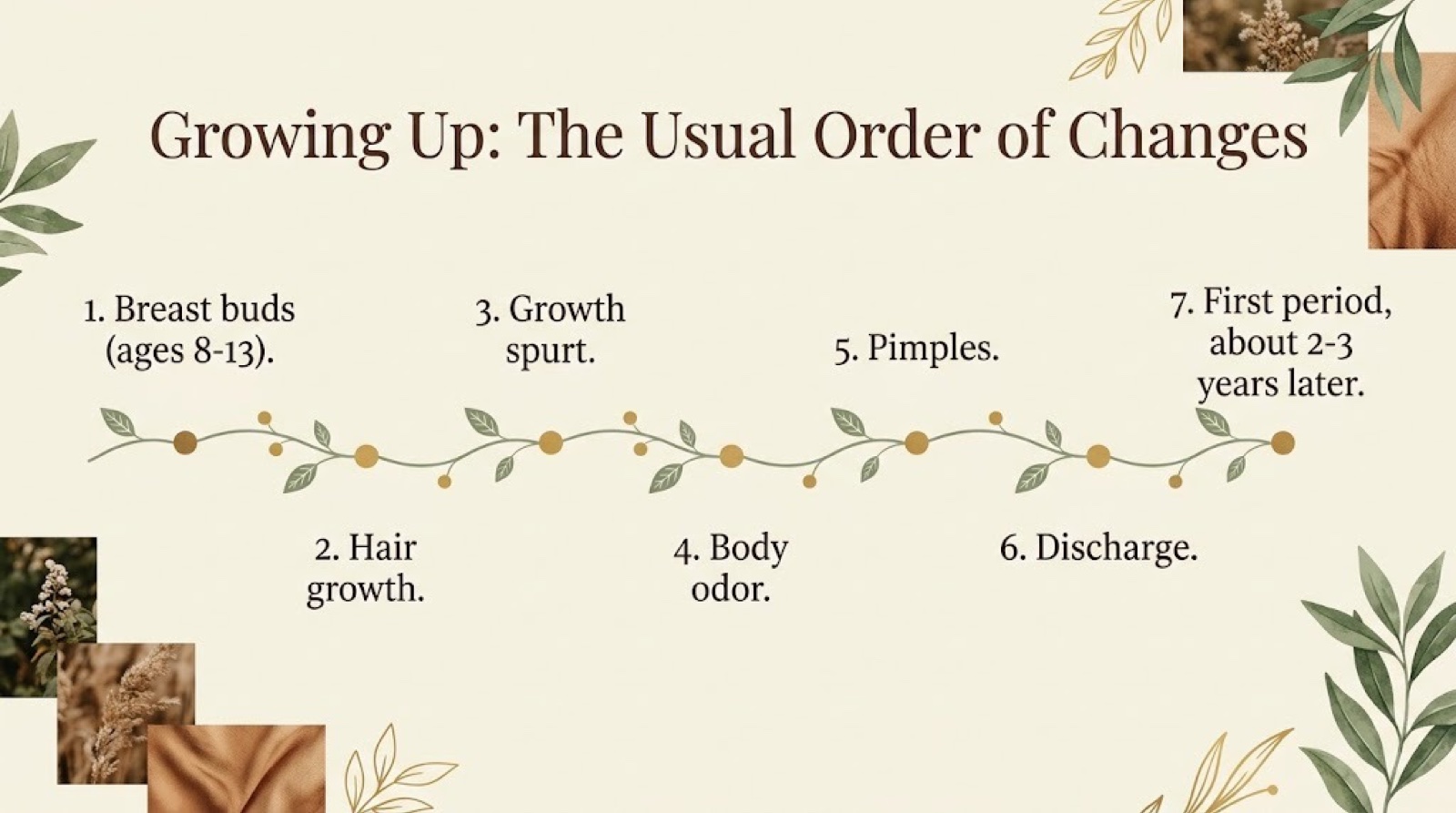
Most girls follow this path. Some steps overlap and a few girls switch the order. The step that matters most for planning is number one.
Breast buds
A small, firm bump under one or both nipples, about the size of a nickel. It may be tender. One side often starts first. That is normal and is not a lump to fear. This is the starting line for most girls.
Pubic hair
Soft hair starts on the vulva, then gets curlier and spreads. For a few girls, hair comes before breasts.
Growth spurt
Starts soon after breasts begin. She may outgrow shoes and pants every few months. Hips widen and the body gets curvier. Gaining weight now is healthy and expected.
Underarm hair, sweat and body odor
New sweat glands switch on. A daily wash and deodorant or antiperspirant become part of the routine.
Oily skin and pimples
Hormones make oil glands bigger. Bumps on the forehead, nose, chin, chest or back are common.
Discharge
About 6 to 12 months before the first period, many girls see a clear or white discharge in their underwear. It is the body's natural cleaner and a sign the period is coming.
First period
About two to three years after breast buds. Then the body keeps maturing for a couple more years.
Sources: AAP HealthyChildren, Physical development in girls · AAP HealthyChildren, Concerns girls have · Nemours KidsHealth, Discharge before your period · AAD, Acne causes
When to call the pediatrician
Too early, or running late?
Early (precocious) puberty
- Breast development, pubic hair or a big growth spurt before age 8
- A first period before about age 10
- Changes moving very fast, one on top of the other
- Go now, not later, if early changes come with bad headaches, vision changes or big behavior changes
The doctor may order blood tests for hormones and an X-ray of the hand to check "bone age." Treatment exists and works best when started early.
Good news: some girls get only body odor, a little hair or pimples early (called premature adrenarche). It is usually harmless, but let the doctor take a look.
Late (delayed) puberty
- No breast development by 13
- No period by 15
- No period within 3 years of breast buds
- Periods that came, then stopped for 3 months or more
Often it simply runs in the family and she will catch up. It can also come from very low body fat (dancers, gymnasts, runners), an eating disorder, thyroid problems or another illness. A check-up sorts it out.
Write it down. The month you notice breast buds, the month hair shows up, the day of the first period. Put it in your phone or on the calendar. When the doctor asks "when did this start?" you will have the answer, and that answer matters.
Sources: Nationwide Children's, Precocious puberty · Nemours KidsHealth, Precocious puberty · NICHD, Puberty · Columbia, Delayed puberty · ACOG/AAP, Menstruation as a vital sign
The big day
What to expect with a first period
A period is the lining of the uterus leaving the body through the vagina, because no pregnancy started that month. It is a sign of health. Doctors even call it a "vital sign," like blood pressure.
How it looks
The first one may be brown, rusty or pink spotting instead of bright red. Later periods may be red, darker or have small, soft clots on heavy days.
How much blood
Less than it looks. Most of a whole period adds up to only a few tablespoons. A pad can look full because blood spreads out.
How long
Usually 2 to 7 days. Bleeding longer than 7 days needs a call to the doctor.
How often
For teens, 21 to 45 days from the first day of one period to the first day of the next is normal. Grown women usually run 21 to 35.
Irregular is normal at first
The first one to two years can be all over the place, even skipping months. ACOG says it can take years to settle. But most girls still have a period at least every 3 months.
Other feelings
Cramps, a heavy feeling, sore breasts, a few pimples, bloating, tiredness or feeling teary. See our Period Care page for relief.
Normal teen periods at a glance
| Question | Normal for teens | Call the doctor if… |
|---|---|---|
| Age of first period | About 10 to 15 (average about 12 and a half) | Before about 10, or none by 15 |
| Days between periods | 21 to 45 days | More than 90 days apart, or less than 21 days apart again and again |
| Days of bleeding | 2 to 7 days | More than 7 days |
| Flow | Pads or tampons last a few hours, even on heavy days | Soaking a pad or tampon every 1 to 2 hours, or needing to change it overnight again and again |
| Clots | Small and soft now and then | Clots the size of a quarter or bigger, often |
| Pain | Cramps that a heating pad or an over-the-counter pain reliever helps | Pain that makes her miss school or activities, or gets worse every month |
Sources: ACOG, Your First Period · ACOG/AAP Committee Opinion 651 · CDC, Bleeding disorders in tweens and teens · CDC, Heavy menstrual bleeding
Pack it before she needs it
The first period kit
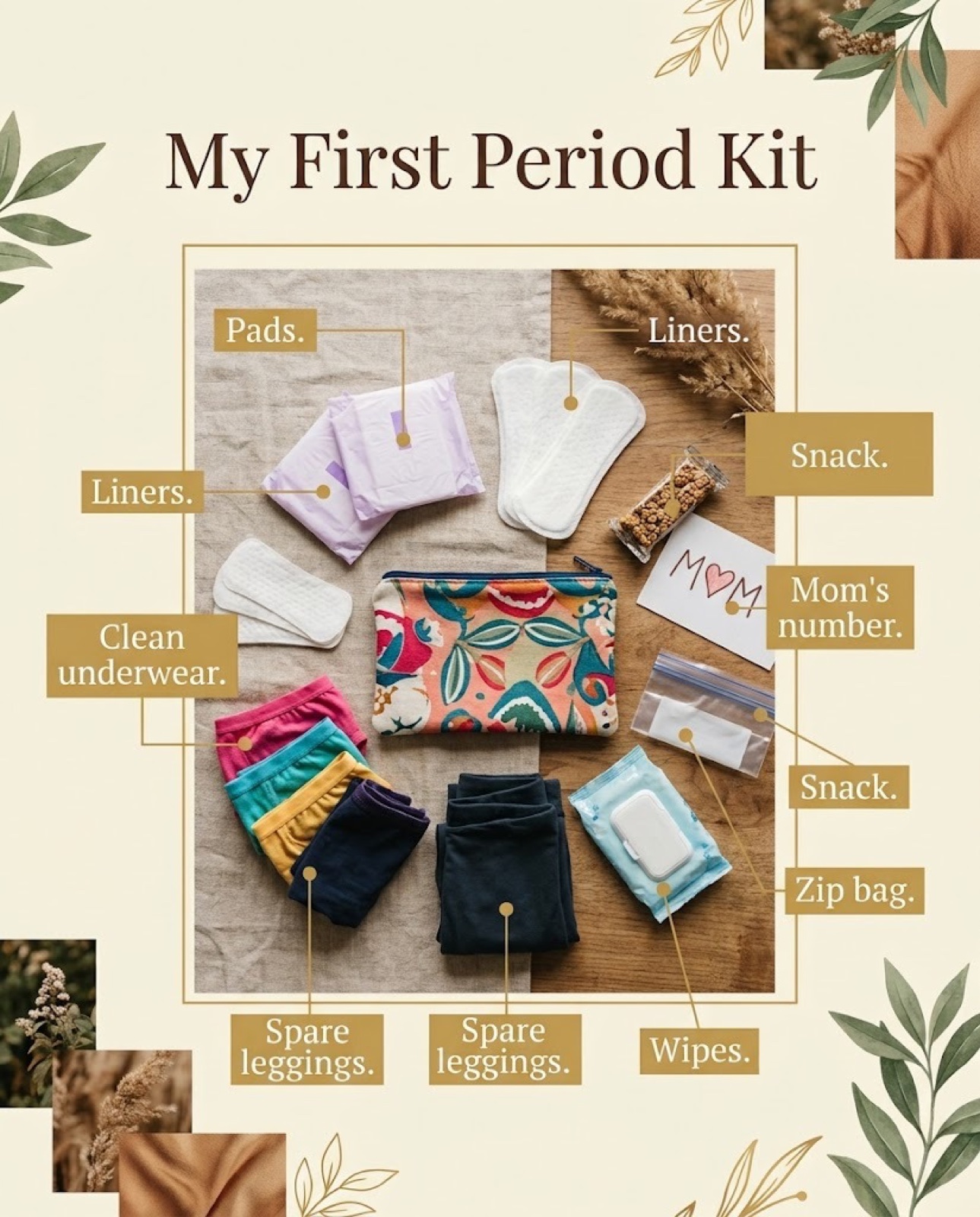
Make this together once breast buds show up. Keep one in her backpack and one in the bathroom. A first period at school is a lot less scary with a plan in a zipper pouch.
- 3 or 4 pads (regular and an overnight one)
- 2 panty liners for spotting days
- A clean pair of underwear
- A spare pair of dark leggings or shorts
- Unscented wipes for the outside only
- A small zip bag for a stained pair
- A wrapped snack and a water bottle
- A hand sanitizer
- A note with Mom's or Auntie's number
- Hair tie and lip balm (because, comfort)
- A sweater to tie around the waist
- Pain reliever only by school rules (most schools keep medicine with the nurse)
Choices
Pads, tampons, cups and period underwear
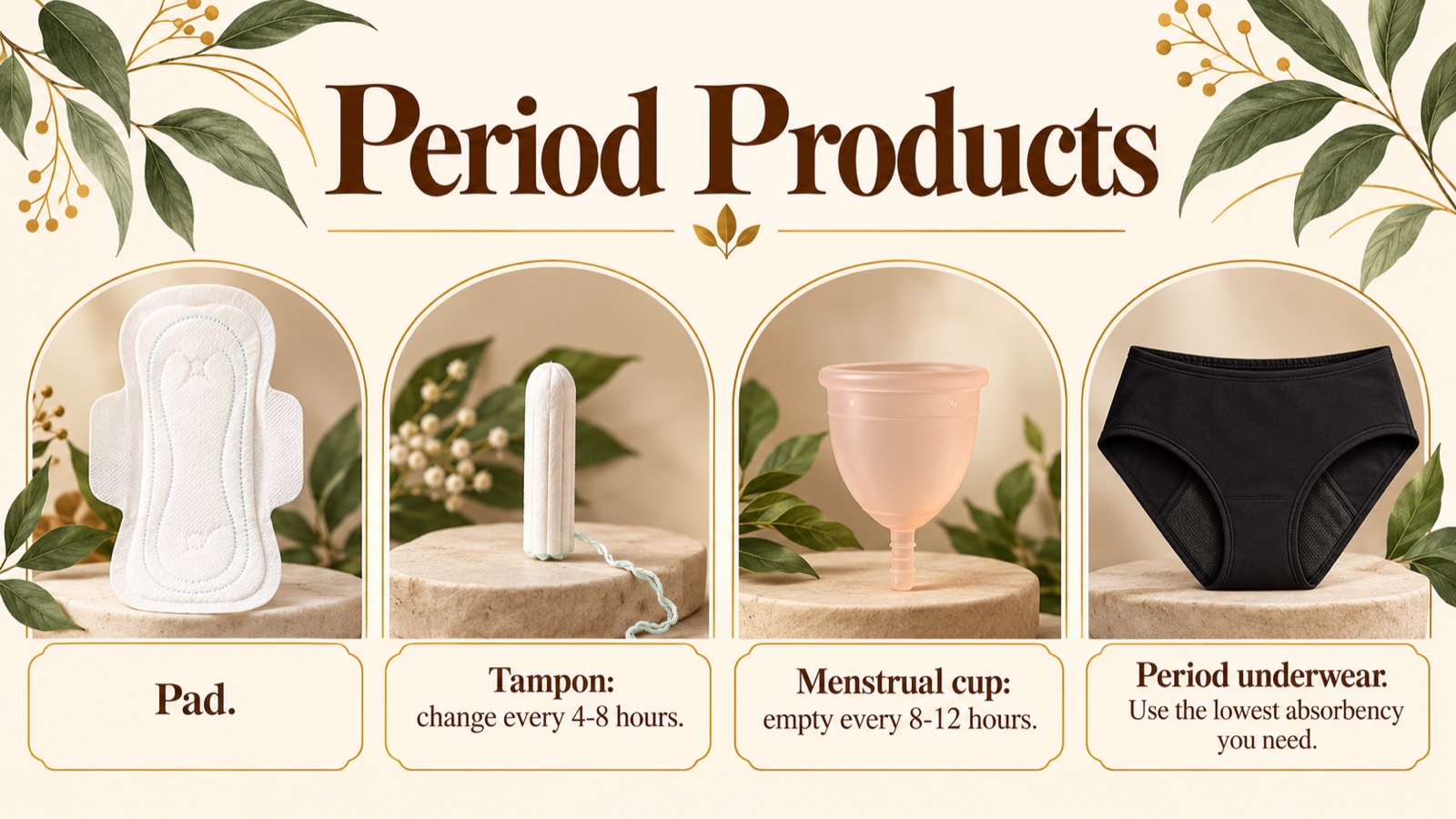
All four are regulated by the FDA as medical devices. Pads are the easiest place to start. Tampons and cups are safe for young girls too, and using one does not change anything about virginity.
Pads
Stick to the underwear. Come in liners, regular, super and overnight. Change every few hours, and whenever full. The FDA says toxic shock syndrome is not a concern with pads.
Tampons
Worn inside the vagina. FDA rules: change every 4 to 8 hours, never more than 8, even on light days. Use the lowest absorbency that works. If one lasts 8 hours dry, it is too absorbent.
Menstrual cups & discs
Soft silicone that collects blood. Wash hands, clean the cup as the maker says, and empty it usually every 8 to 12 hours. A large review found cups safe and no leakier than pads or tampons. Rare TSS has been reported.
Period underwear
Underwear with a built-in pad layer. Great backup on light days or overnight. Rinse cold, then wash as the label says.
Sources: FDA, Facts on tampons · FDA, Pads and liners · FDA, Menstrual cups · FDA, Menstrual product options · van Eijk 2019, menstrual cup review (Lancet Public Health)
Fresh, not perfumed
Keeping clean down there
The vagina cleans itself. That is what discharge is for. Our job is to keep the outside clean and leave the inside alone.
Do
- Wash the vulva (outside) with warm water, or a mild, unscented soap on the outer skin only.
- Wipe front to back.
- Wear cotton underwear and change it daily, more often on period days.
- Change pads and tampons on time.
- Shower after sports or sweaty days.
Don't
- Never douche. ACOG says douching washes away protective bacteria and may push germs up into the uterus. The Office on Women's Health notes women who douche weekly are about five times more likely to get bacterial vaginosis.
- Skip "feminine" sprays, perfumed wipes inside, glitter or scented washes. They irritate.
- No steaming, herbs, or "yoni" products placed inside.
- Don't sit in a wet swimsuit for hours.
Some of us were raised that a woman should douche to be "clean." Our mothers meant well. The doctors are clear now: it does more harm than good. Healthy has a light, natural smell. A strong fishy smell, itching or colored discharge means see the doctor, not buy a spray.
Sources: ACOG, Vulvovaginal health · ACOG, Pelvic inflammatory disease · Office on Women's Health, Douching
Bumps on the face
Acne in melanin-rich skin
Why it happens: puberty hormones called androgens make the skin's oil glands bigger. More oil plus dead skin cells clog pores, and bacteria join the party. That is a pimple. It is not because she is dirty.
Why our skin needs extra care: in brown and Black skin, a pimple often leaves a dark spot (post-inflammatory hyperpigmentation). The American Academy of Dermatology (AAD) notes those spots can last longer than the acne itself. So the goal is to treat acne early and gently, before marks pile up.
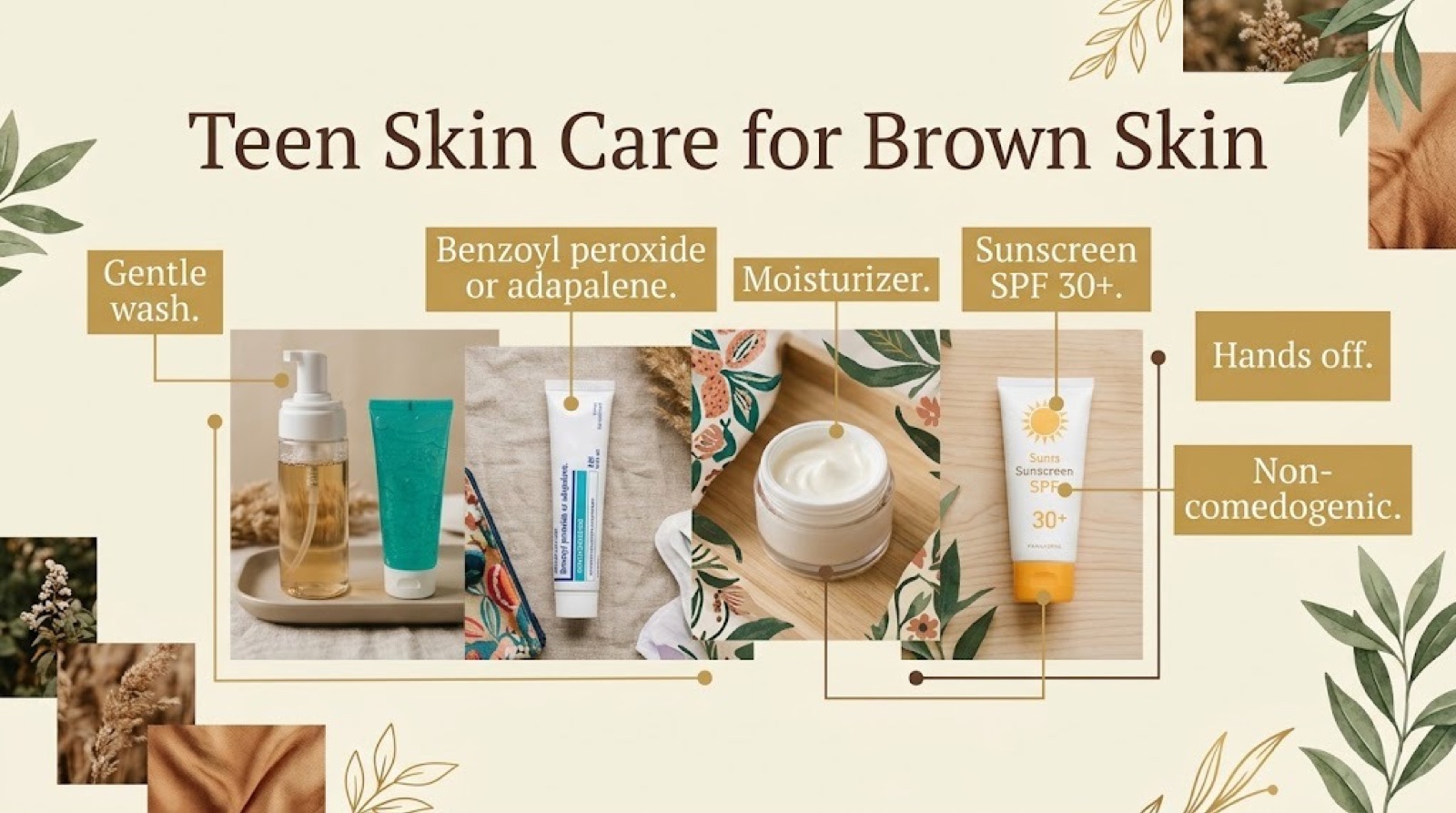
- Wash gently up to twice a day and after sweating, with fingertips. No rough washcloths or scrubs.
- Skip astringents and harsh toners. They dry and irritate, which can darken spots.
- Hands off. Picking and squeezing make scars and dark spots.
- Look for "non-comedogenic" on lotion, sunscreen and makeup.
- Sunscreen daily, broad-spectrum SPF 30 or higher. Sun darkens marks, and some acne medicines make skin burn easier.
- Over-the-counter help: benzoyl peroxide wash or gel; adapalene gel (a retinoid). AAD says a retinoid plus benzoyl peroxide works well in skin of color. Start every other night to avoid irritation.
"Pomade acne"
Bumps only along the hairline, forehead and temples are often from hair oils, edge control and greases. Keep oils off the hairline, try water- or glycerin-based products, and wash the face after styling.
Dark spots
Clear the acne first, then fade marks with daily sunscreen and products a dermatologist suggests. Never use bleach or skin-lighteners from beauty supply shelves; some contain mercury or steroids. See our Skin page.
When to go
Deep, painful bumps; acne leaving scars or many dark spots; no improvement after 6 to 8 weeks of over-the-counter care; or acne hurting her confidence. Darker skin scars and darkens more easily, so earlier is better.
Does food cause acne? The honest answer
| Food | What research shows | Evidence |
|---|---|---|
| High-glycemic foods (white bread, sugary drinks, chips, sweets) | Some studies link a low-glycemic diet to fewer breakouts; others find no link. AAD says more research is needed. | Some |
| Cow's milk (whole, low-fat and skim) | Observational studies link more milk with more acne. They show a connection, not proof of cause. No good evidence that yogurt or cheese cause acne. | Weak to Some |
| Chocolate | Small, mixed studies. | Weak |
| Greasy food | Grease on the skin (from hands, phones, hair oil) matters more than grease in the stomach. | Weak |
If a girl wants to test it, she can swap sugary drinks for water and cut back on milk for 8 to 12 weeks while keeping up calcium from other foods. Do not cut whole food groups without a doctor or dietitian. Growing bones need calcium.
Sources: AAD, 10 tips for clearing acne in darker skin tones · AAD, Hair products and breakouts · AAD, Fade dark spots · AAD, Can the right diet get rid of acne? · Aghasi 2019, dairy and acne meta-analysis · research/07-african-roots.md
Fresh all day
Body odor and sweat
Puberty switches on new sweat glands under the arms and in the groin. Sweat itself has little smell. Odor comes when sweat meets the bacteria that live on skin.
Wash daily
Soap and water on armpits, feet and groin (outside only). Daily showers if she plays sports or dances.
Antiperspirant vs deodorant
Antiperspirant lowers sweat. Deodorant covers smell. Many products do both. The AAD tip: put antiperspirant on clean, dry skin at night so it works by morning.
Clothes count
Fresh socks and underwear daily. Cotton breathes. Wash gym clothes after each use.
Rash?
If a product causes redness or itching, switch to a fragrance-free one.
Shaving is a choice
It does not make you cleaner. If she wants to, teach her: clean razor, shave gel, go with the grain, and never share razors. Bumps? Pause and let skin heal.
Too much sweat
Dripping sweat without heat or exercise may be hyperhidrosis, which often starts in the teen years. Prescription help exists.
Sources: AAD, Hyperhidrosis self-care · AAP HealthyChildren, Body odor in teens · Nemours KidsHealth, Deodorant use
Support
Breast development and bra basics
- Buds can be sore. Tenderness, one side bigger, a firm bump under one nipple: all common. ACOG says breasts often even out, though up to 1 in 4 girls keep some size difference. That is normal too.
- When to buy: AAP's advice is simple. When she asks, or when you see she could use one.
- First bra: a soft sports bra or a bralette is often best. No wires, no padding needed.
- Fit check: band snug but she can slide two fingers under it; straps don't dig; no gaps or spilling.
- Re-measure every few months during the growth spurt.
- Sports: a supportive sports bra for running and jumping protects comfort and confidence.
- Early bloomers may feel shy and want loose tops. Let her. Protect her from comments by grown folks, too.
Sources: AAP HealthyChildren, Concerns girls have about puberty · Nemours KidsHealth, Breasts and bras · ACOG, Your Changing Body
Inside matters too
Body image, moods and confidence
Hormones, a changing body, school, friends and social media all land at the same time. Big feelings are part of it. Feeling down for weeks is not.
Praise what she does
AAP's guidance: talk about strength, effort and skills, not looks or weight. "You ran so hard today" beats "You look skinny."
Weight gain is growth
Hips, thighs and a softer belly are a healthy part of puberty. Do not put a growing girl on a diet unless her doctor says so.
Filter the feed
Edited photos set impossible standards, the AAP warns. Follow accounts that show real Black girls and women of every shape and shade.
Hair, skin, shape
Our girls hear early about "good hair" and "too dark." Name it, push back, and fill the house with images of beauty that look like her.
Watch for
Skipping meals, making herself throw up, over-exercising, hiding food, sadness or irritability most days for two weeks, pulling away from friends.
Get help
Tell her pediatrician. In a crisis, call or text 988, any time. See our Mind & Sleep page.
Sources: AAP HealthyChildren, Puberty · AAP News, Social media and body image · AAP Bright Futures, Adolescence visits · 988 Lifeline
Two appointments to put on the calendar
The HPV vaccine and the first gynecology visit
HPV vaccine: ages 9 to 12
HPV is a very common virus that can cause cervical cancer and other cancers later in life. The vaccine works best when given long before any exposure.
- CDC: routinely at 11 to 12; can start as early as 9.
- Started before the 15th birthday: 2 doses, 6 to 12 months apart.
- Started at 15 or later, or with a weak immune system: 3 doses.
- Catch-up is recommended through age 26.
Getting it is not about sex. It is cancer prevention, like a seatbelt.
First gyn visit: ages 13 to 15
ACOG recommends a first reproductive-health visit between 13 and 15. Most of the time it is just a talk.
- Usually no pelvic exam unless there is a problem like heavy bleeding or pain.
- The doctor may check general health and the outside of the body.
- There is private time with the doctor. Moms, that is a good thing. It builds trust she will need later.
- She can bring Mom, Auntie or a nurse into the room for any part.
- Go sooner for no period by 15, very heavy or painful periods, or any worry.
Sources: CDC, HPV vaccination · CDC, Clinical overview of HPV · ACOG, Your first gynecologic visit · ACOG, The initial reproductive health visit · NLM, Helen Octavia Dickens
For moms, aunties and grandmothers
Talking with our daughters: scripts that work
The AAP says puberty is not a one-time talk. Start before the first changes, keep it short, use real words, and keep the door open. Car rides and kitchen chores are perfect, because nobody has to make eye contact.
- Start around age 8, earlier if changes begin.
- Answer only what she asks, then ask, "Does that make sense?"
- If you don't know, say "Let's look it up together" and use a trusted source.
- Keep her privacy. Don't announce her first period to the family group chat unless she says yes.
- Let a trusted auntie or big cousin help if she is shy with you. That is not a failure.
Ready for the bigger conversations about boundaries, crushes, online safety and sex? See The Talk, our age-by-age guide with scripts.
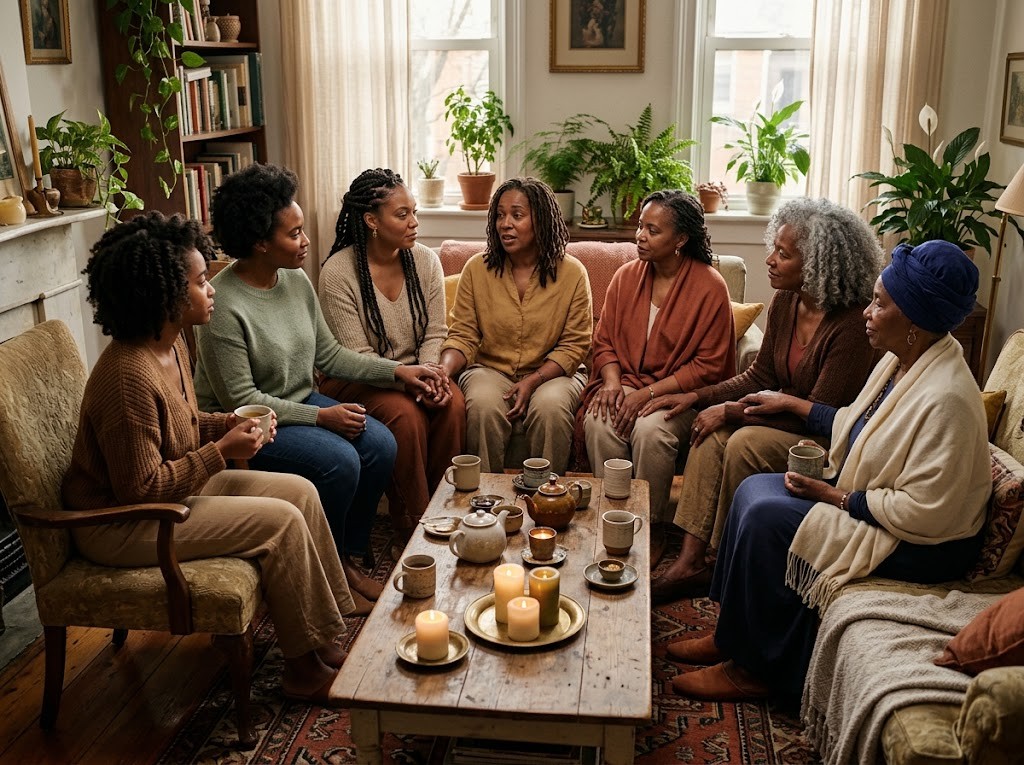
The first talk (age 8 or so)
You: "Your body is going to start changing in the next few years. You might grow breasts, get hair under your arms, and one day get a period. It happens to every girl, and it means your body is healthy. You can ask me anything, even if it feels embarrassing. I won't laugh and I won't be mad."
When breast buds show up
You: "I noticed your body is starting to change. That's the very first step. Do your chests feel sore? Want to go pick out a couple of comfy sports bras this weekend? And let's put a period kit in your backpack, just in case. It might be a while, but we'll be ready."
Explaining a period simply
You: "Every month the uterus, which is where a baby could grow someday, makes a soft lining. If there's no baby, the body lets that lining go. It comes out as blood from your vagina for a few days. It's not a cut and it's not dirty. It's a sign your body is working."
If it happens at school
You: "If you feel wet or see blood, go to the bathroom and use a pad from your kit. If you leaked, tie your sweater around your waist and go to the nurse. You can call me and I'll come or tell you what to do. Nothing about this is a disaster."
When she gets her first period
You: "Congratulations, baby. How are you feeling? Do you need anything right now, a heating pad, tea, a snack? Let's write today's date down so we can keep track. Do you want to celebrate, or keep it just between us?"
Body talk and safety
You: "Your body belongs to you. If anybody, even someone we know, touches you, makes comments about your body, or sends you pictures that feel wrong, tell me. You will never be in trouble for telling me."
For dads and uncles
You: "I might not know everything about periods, but I know where the pads are, and I'll buy whatever you need with no questions. You never have to be embarrassed to ask me."
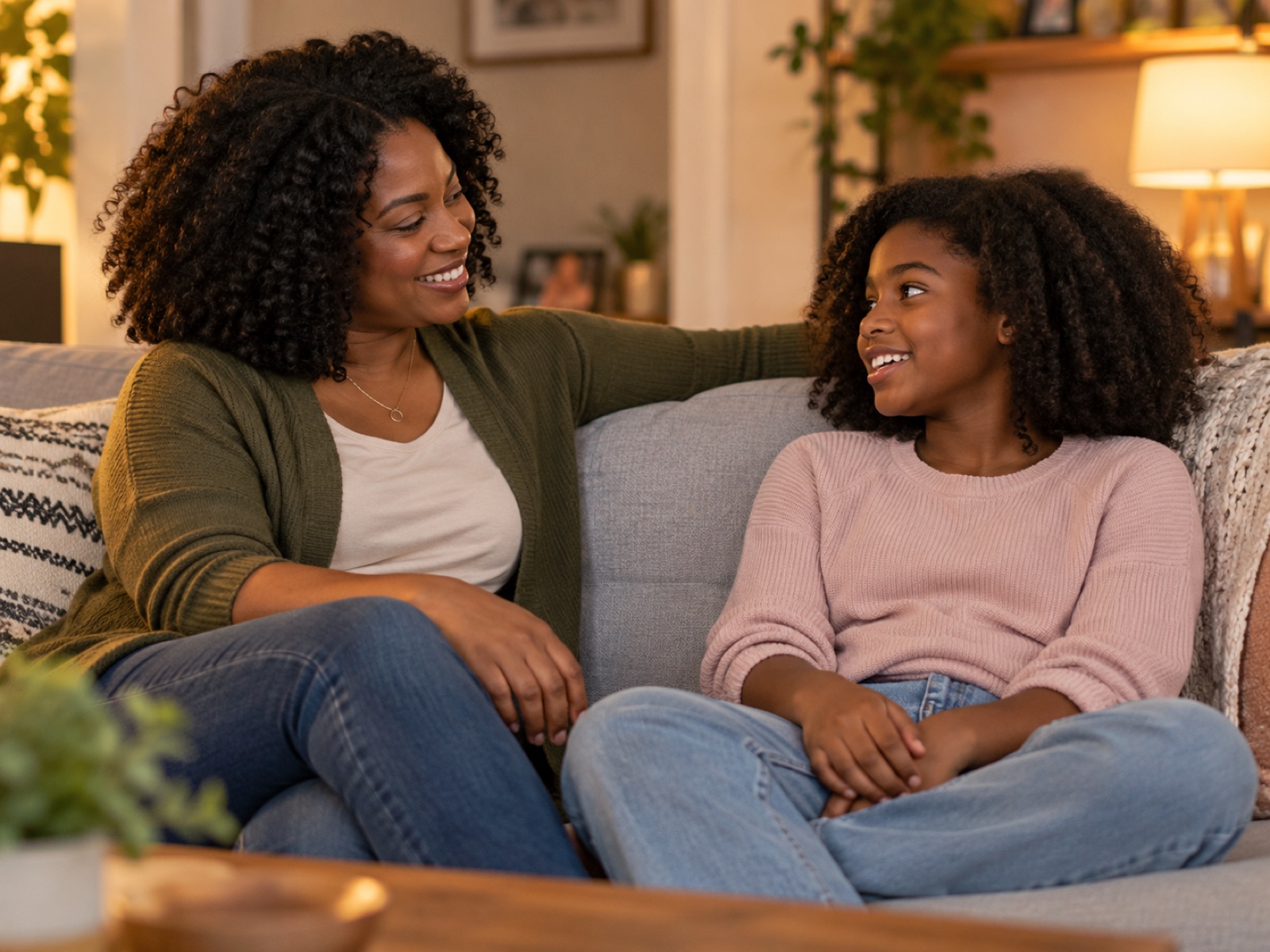
If you are a mom who never got the talk, you are not behind. You are breaking a cycle. Read this page with her. Let her see you learn too. That's how we raise women who aren't afraid of their own bodies.
Sources: AAP HealthyChildren podcast, How and when to talk about puberty · AAP HealthyChildren, Concerns girls have · ACOG, Should my teen see an ob-gyn?
Feeding a growing body
Iron, calcium and vitamin D for growing girls
The teen years build almost all of the bone a woman will ever have, and periods start pulling iron out of the body. Three nutrients deserve special attention.
| Nutrient | Ages 9–13 | Girls 14–18 | Women 19–50 | Why it matters | Foods that bring it |
|---|---|---|---|---|---|
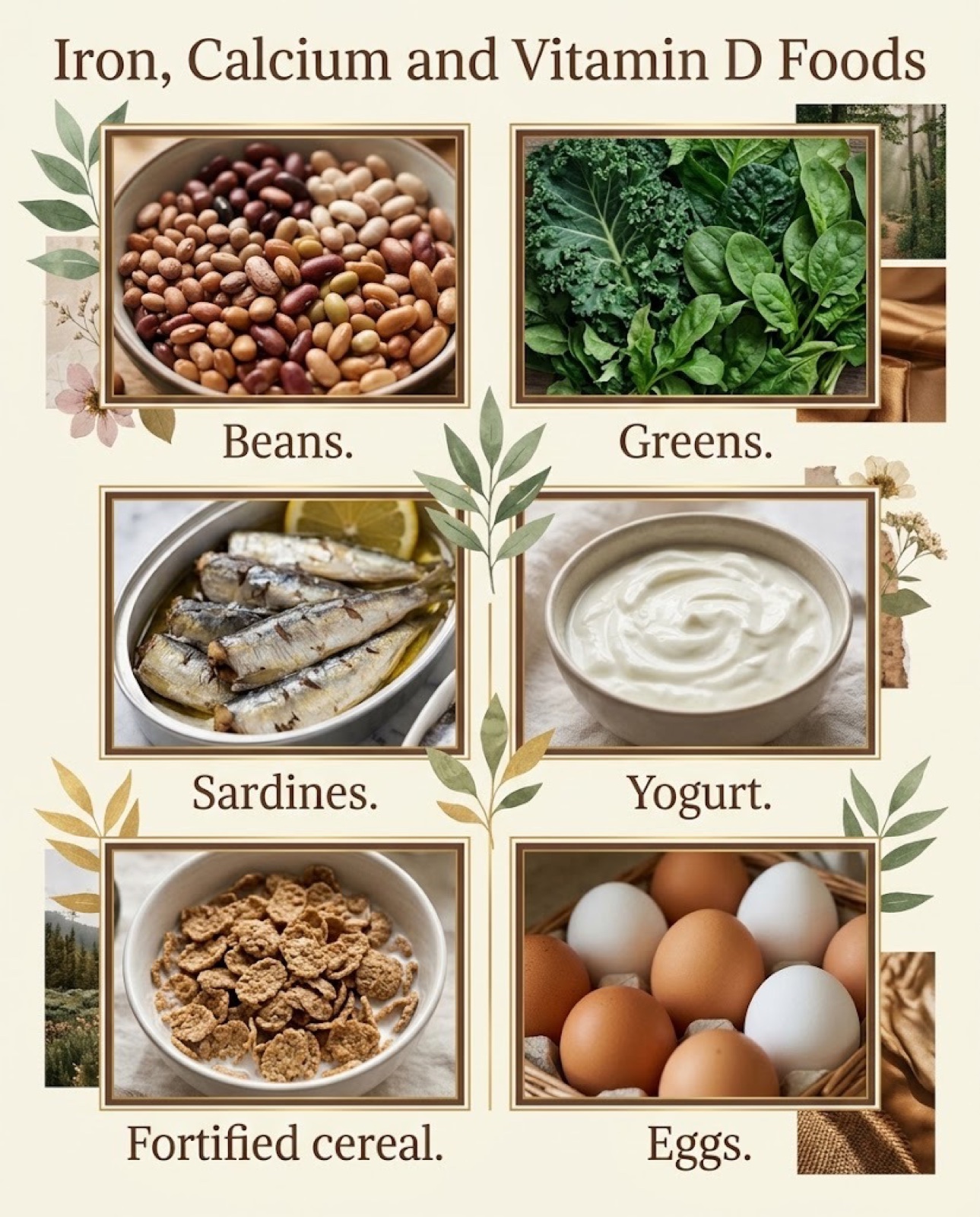
| Iron | 8 mg/day | 15 mg/day | 18 mg/day | Needs nearly double at 14 because periods begin. Heavy periods raise the risk of low iron (tiredness, pale skin, feeling cold, short of breath). | Beans, black-eyed peas, lentils, dark leafy greens, lean beef, chicken, sardines, iron-fortified cereal. Pair plant iron with vitamin C (oranges, peppers, tomatoes) to absorb more. |
| Calcium | 1,300 mg/day | 1,300 mg/day | 1,000 mg/day | Builds peak bone mass, which protects against broken bones decades later. | Yogurt, milk or fortified soy/plant milk, cheese, canned sardines or salmon with bones, collard and turnip greens, fortified orange juice, tofu made with calcium. |
| Vitamin D | 15 mcg (600 IU)/day | 15 mcg (600 IU)/day | 15 mcg (600 IU)/day | Helps the body use calcium. More melanin means skin makes less vitamin D from the same sunshine. | Salmon, sardines, trout, eggs, fortified milk and plant milks, fortified cereal, UV-exposed mushrooms. Ask the doctor about a blood test or supplement. |
Breakfast
Fortified cereal or oatmeal with milk or soy milk and an orange. Or eggs, toast and a cup of yogurt.
Lunch
Black-eyed pea salad with peppers and tomatoes, or a turkey and cheese sandwich with baby spinach and a fruit.
Dinner
Salmon or baked chicken, collard greens, brown rice. Bean chili with cheese on top. See our Recipes.
Sources: NIH ODS, Iron · NIH ODS, Calcium · NIH ODS, Vitamin D · research/07-african-roots.md (cowpea, okra, baobab)
Honoring womanhood
African and diaspora coming-of-age traditions
Long before school health class, African communities marked a girl's passage into womanhood with teaching, song and celebration by the women around her. Here are a few, labeled honestly.
Dipo · Krobo people, Ghana
A puberty rite in Ghana's Eastern Region where girls are taught by elder women about womanhood, home skills and Krobo identity, then presented to the community in beads and cloth. Scholars have studied it in detail. Some Christian families today choose not to take part, and the rite has changed over time. One small study found initiates reported less psychological distress, though it was a preliminary study.
Umemulo · Zulu people, South Africa
A celebration that a young woman has come of age, often held around 21. Family gives thanks to the ancestors, friends practise songs and the ukusina dance for days, and guests bring gifts. Practices vary by family and region.
Sande (Bondo) · Mende and neighbors, Sierra Leone & Liberia
A women's society where elders teach girls songs, dance, herbal knowledge and conduct. Its sowei helmet masks are among the only African masquerades worn by women. Honest note: Sande initiation has historically included female genital cutting. That practice causes lasting harm and is opposed by the World Health Organization. We honor the circle of women teaching girls, not the cutting.
African American rites of passage
From the late 1970s, Black communities in the U.S. built Africa-inspired programs for girls. One early example, Kwandulukwa Ntu at Boston University, was written up by scholars. Programs such as Ifetayo in Brooklyn have guided girls ages 8 to 19 through history, culture, health and self-worth, ending in a ceremony with elders.
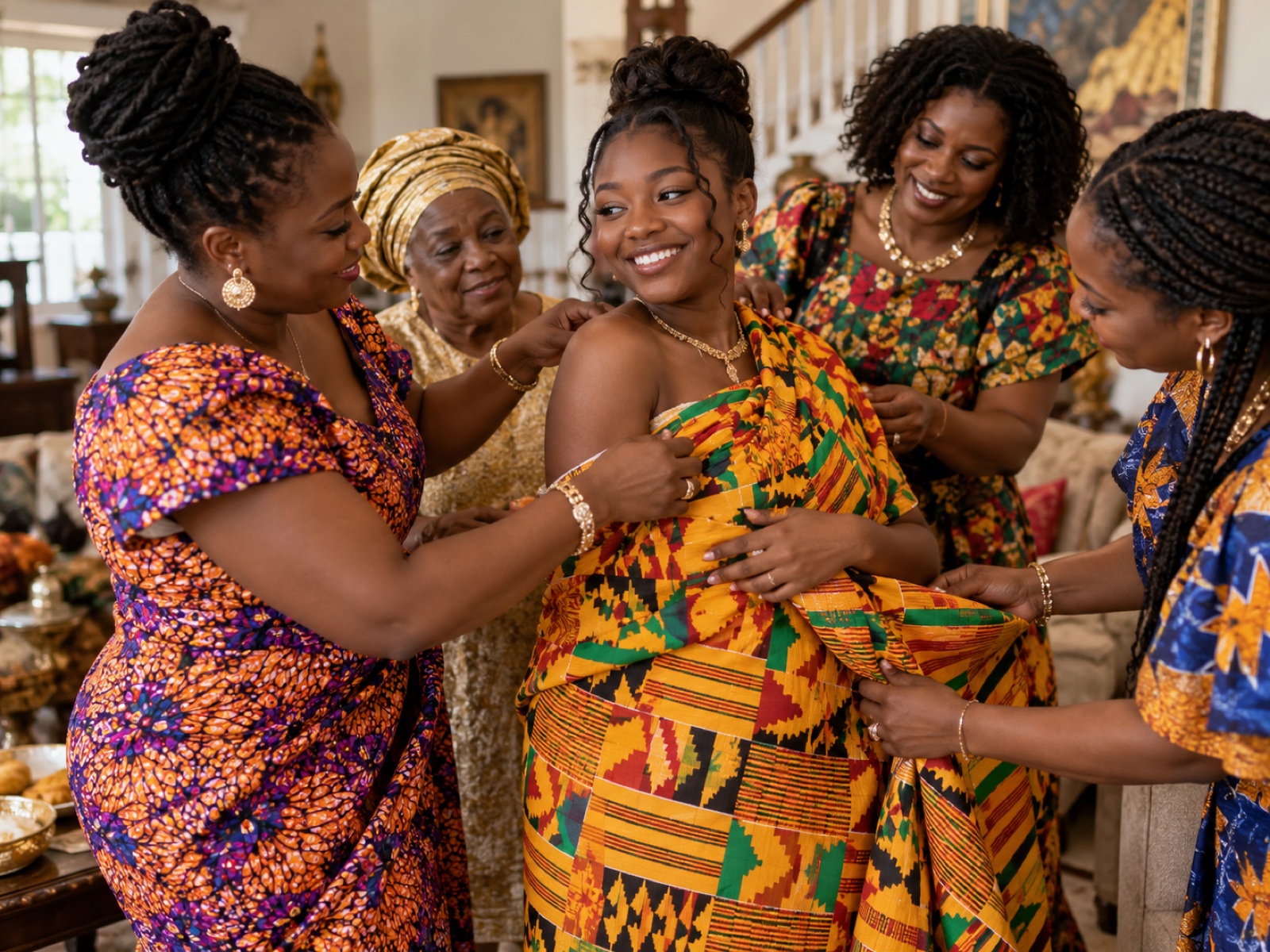
Start a tradition of your own
- A "becoming" dinner with the women in the family. Each woman shares one thing she wishes she had known at 12.
- A gift that lasts: a journal, a piece of jewelry, a head wrap, her first good bra, or a letter from Grandma.
- A teaching day: cook a family recipe together, learn to braid, plant something.
- Her choice: some girls want a party, some want it private. Both honor her.
When my daughter started, her aunties came over with a pot of jollof, a satin bonnet and a card each. No speeches. Just love in the kitchen. She is grown now and still talks about that night.
Sources: Boakye 2010, Dipo: a rite of passage among the Krobos (UiT thesis) · University of Ghana, Dipo and psychological well-being · Wits Vuvuzela, Umemulo in modern times · Smarthistory, Sowei helmet mask · Sierra Leone Heritage, Sande · WHO, Female genital mutilation · Journal of Ritual Studies, Kwandulukwa Ntu · Women's eNews, Africa-inspired rites
Keep going
Next: taking care of every period
Cramps, bloating, foods that help, safe use of over-the-counter medicine, heavy-period red flags and free products in Philly.
Period Care: Cramps, Bloating & Your Cycle The Talk Skin & Nails