
Family · Every age from toddler to 19
Talking With Your Children About Bodies, Puberty & Sex
Not one big, scary talk. Many small, loving ones, starting early and lasting all through the teen years. What the research says, what to say at every age, word-for-word scripts, how to keep children safe, and how to share your faith and values without leaving out the facts.
Before we start
You are your child's first and best teacher
Somebody is going to teach your child about bodies, love and sex. It will be you, or it will be the playground, the group chat, a music video or a stranger online. Every big health group agrees: it should be you.
A lot of us grew up with silence. Maybe the whole talk was "keep your legs closed" or "don't come home pregnant." Maybe nobody said anything at all. That does not make you a bad parent now. It just means you get to do it differently.
- Start early. Real body-part names in the toddler years. Simple facts as questions come.
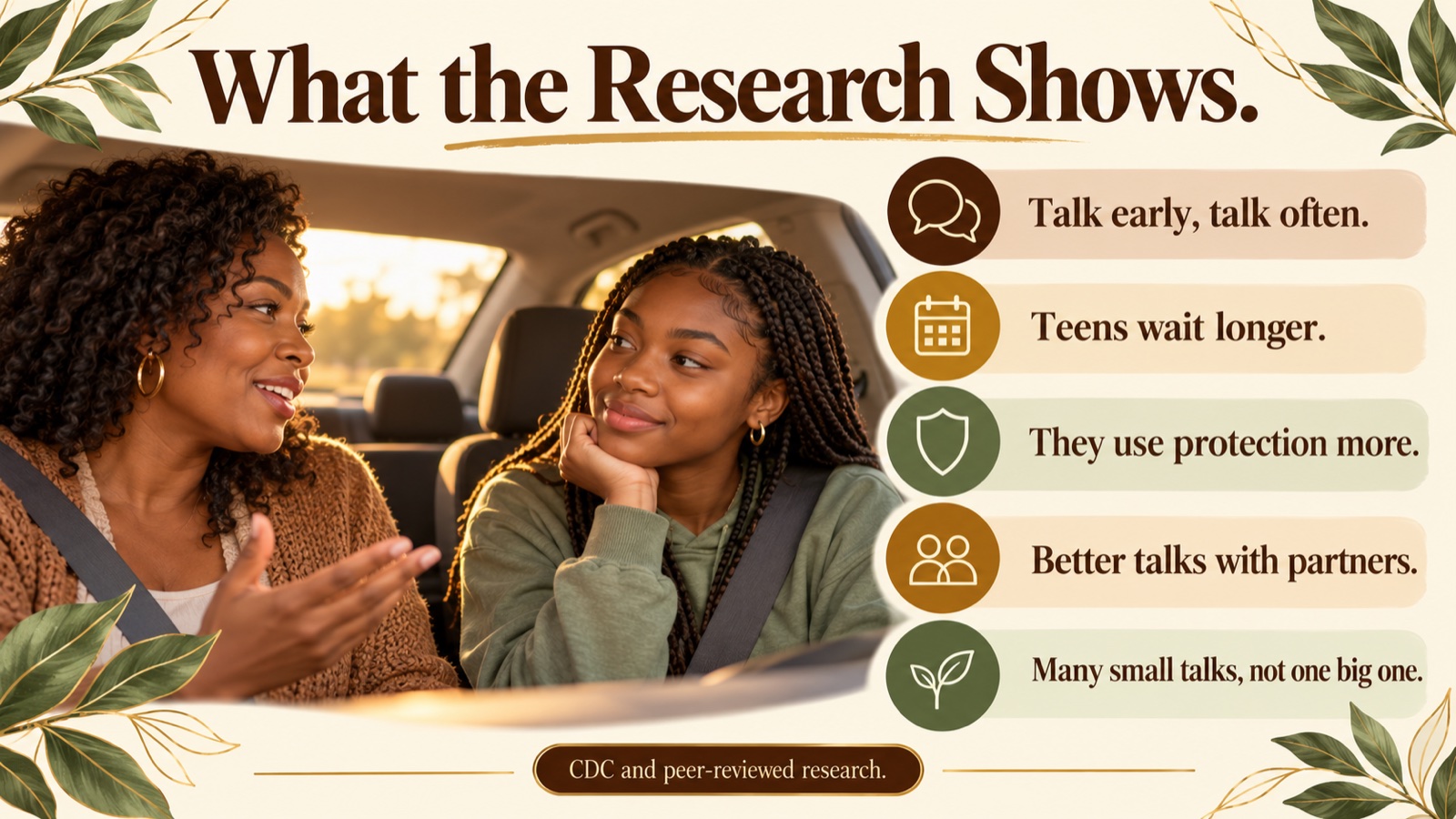
- Talk often. Short talks in the car, at bath time, after a TV show. Many small talks beat one big talk.
- Share your values and the facts. Talking about sex is not the same as saying yes to sex.
- Keep the door open. Make sure your child knows nothing they tell you will stop you loving them.

Baby, I have taught school for years, and I can tell you the children who are safest are not the ones who know nothing. They are the ones who know the right words, know their body belongs to them, and know they can come home and tell Mama anything.
Sources: AAP HealthyChildren, Talking to Your Child About Sex · CDC, Going Beyond "the Talk"
Small talks, big difference
Some of the best talks happen in the car
You do not need a sit-down meeting at the kitchen table. Side by side in the car, nobody has to look anybody in the eye, the radio fills the quiet, and the ride ends on its own. Researchers who study these talks suggest keeping them short, with a few points you planned ahead, at a set time like a quick drive.
- Use what you see: a song on the radio, a billboard, a couple arguing at the bus stop. "What did you think about that?"
- Ask more than you tell. The AAP's advice is "ask, don't tell."
- Dads and granddads, this is your seat too. Daughters need to hear from the men who love them what respect looks like.
- End warm. "Thanks for talking with me. You can always bring this up again."
Sources: NPR, How to talk to kids about tricky subjects (27 Nov 2024) · AAP, Talking to Your Child About Sex

What the research says
Does talking really make a difference?
Yes. Not magic, but a real, steady difference. Here is what the studies actually found, with honest labels for how strong the evidence is.
Teens who talk with parents wait longer
The CDC says research shows teens who talk with their parents about sex, relationships, birth control and pregnancy tend to start having sex at a later age, have sex less often, and use condoms and birth control more often if they do have sex.
A small but real protective effect
Psychologist Laura Widman and colleagues pooled 52 studies of more than 25,000 teens (JAMA Pediatrics, 2016). Teens who talked with parents about sex were more likely to use condoms and birth control. The effect was small but consistent, and strongest for girls and for talks with mothers.
Teens say parents matter most
Teens report that their parents have more influence over their decisions about sex than friends, brothers and sisters, or the media. They also say they want to talk with you, even when they roll their eyes.
Knowing does not mean doing
The American Academy of Pediatrics says sex education does not push children into early sex. Young people with good information tend to wait longer, not shorter.
Dads, your talks count too
Most studies measured moms. Only a few looked at fathers separately, so the research on dads is thin, not negative. Experts still urge dads to talk, especially about respect, consent and how a man should treat a woman.
Most high schoolers are waiting
In the CDC's 2023 national Youth Risk Behavior Survey, 32% of high school students said they had ever had sex, down from 47% in 2013. Two out of three had not. So "everybody's doing it" is simply not true. Tell your teen that.
At a glance: the research on parent talks
| Finding | Who found it | Evidence |
|---|---|---|
| Teens who talk with parents start sex later and have sex less often | CDC summary of research | Strong |
| Parent talks linked to more condom and birth control use | Widman et al., JAMA Pediatrics 2016 (52 studies, 25,314 teens) | Some (small effect) |
| Link strongest for daughters and for talks with mothers | Widman et al. 2016 | Some |
| Same benefit for younger (under 16) and older teens | Widman et al. 2016 | Some |
| High schoolers who ever had sex: 32% in 2023 (31% of girls, 32% of boys), down from 47% in 2013 | CDC YRBS Data Summary & Trends Report, 2013–2023 | Strong |
| Condom use at last sex among currently sexually active teens fell to 52% in 2023 (from 59% in 2013) | CDC YRBS Data Summary & Trends Report, 2013–2023 | Strong |
Sources: CDC, Tips for Parents and Guardians · Widman et al., JAMA Pediatrics 2016 · CDC, Going Beyond "the Talk" · AAP, Common Sexual Concerns · CDC, YRBS Data Summary & Trends Report 2013–2023 · Child Trends on YRBS 2023
Age by age
What to talk about, and when
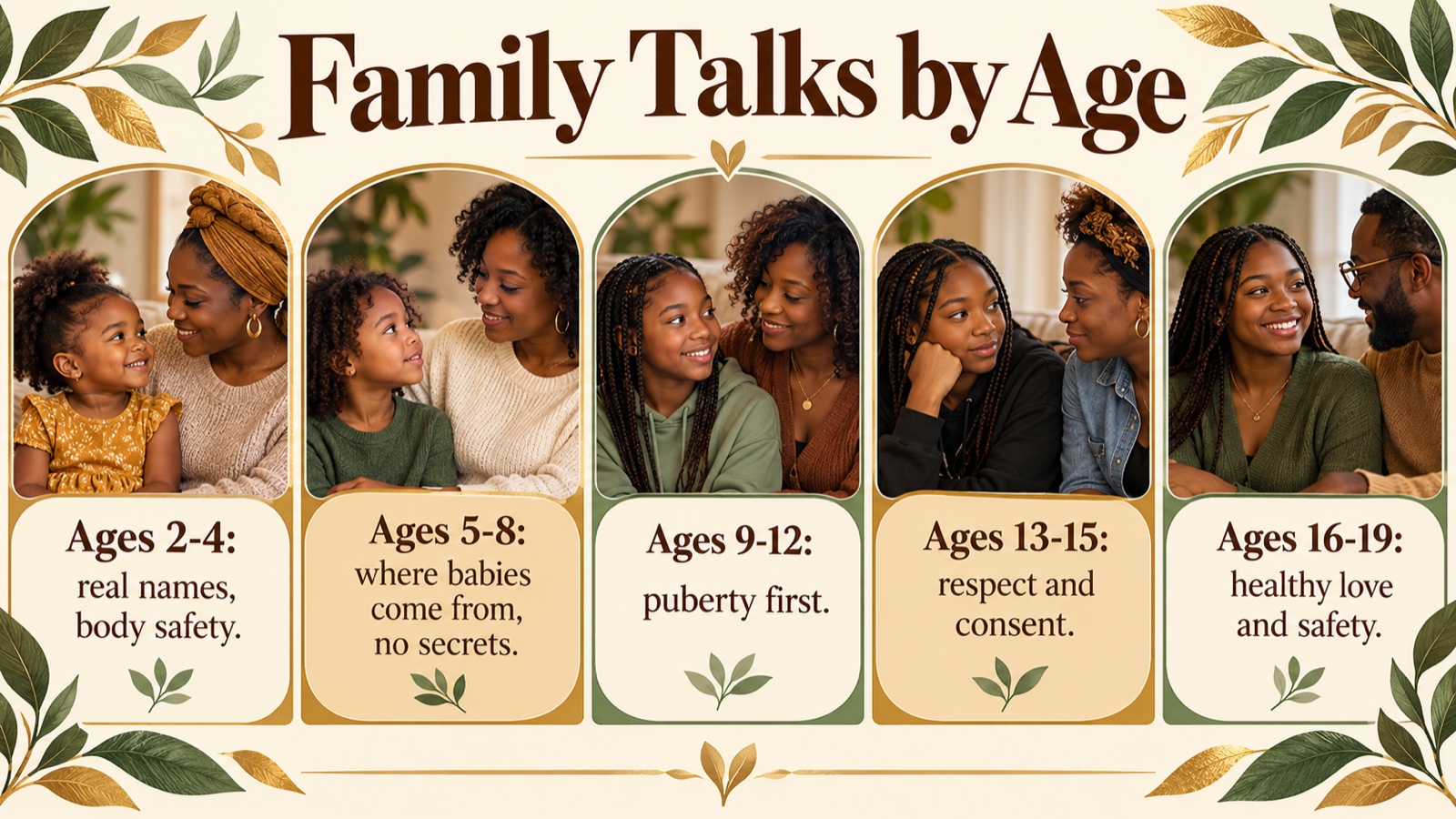
Every child is different, so use this as a map, not a rulebook. Start each stage with what came before. If your child asks something "too early," answer it simply and honestly. A question means they are already hearing about it somewhere.
| Age | Main topics | What it sounds like |
|---|---|---|
| Toddlers 2 to 4 | Correct names for every body part, including penis, vulva, vagina, breasts and buttocks. Private parts are the parts a swimsuit covers (and the mouth is private too). Body safety: no one touches or looks at your private parts except to keep you clean or healthy, and you tell Mommy if they do. You do not have to hug anyone. | "That's your vulva. It's a private part. Only you, and Mommy or the doctor helping keep you clean and healthy, ever touch it." |
| Early school 5 to 8 | Where babies come from, simply (a baby grows in a part of the mother called the uterus; it takes a sperm from a man and an egg from a woman). Good touch, bad touch and secret touch. Consent basics: "no" and "stop" mean stop, for them and for others. No secrets from parents. Who their safe grown-ups are. | "Surprises are fun, like a birthday present. But secrets about touching or private parts are never OK. You can always tell me, even if someone said not to." |
| Preteens 9 to 12 | Puberty and periods before they start (Black girls often begin breast development around 8 or 9). Body changes for boys and girls. Crushes and feelings are normal. Online safety: never send photos of your body, never meet an online "friend," tell me if anyone asks. What sex is, in plain words, and what your family believes about it. | "Your body is going to start changing soon. That's God's design and it's healthy. I want you to hear about it from me first." |
| Young teens 13 to 15 | Relationships and what respect looks like. Consent in depth. Pressure from partners and friends, and how to say no. Your family's values about waiting. Birth control and how STIs spread, with facts, not fear. The first reproductive health visit (ACOG suggests ages 13 to 15). Older partners are a red flag. | "A person who really cares about you will never pressure you. If someone says 'if you loved me you would,' that is not love. That's pressure." |
| Older teens 16 to 19 | Healthy vs. unhealthy relationships. Signs of dating violence: jealousy, checking your phone, cutting you off from friends, threats. How to get birth control and STI testing (and that teens have confidential care rights). Sexting and sextortion. Alcohol, parties and consent. Planning for college, work and the future you want. | "You're almost grown, and I trust you. I'd still rather you call me at 2 a.m. than be stuck somewhere unsafe. No lecture that night. I'll just come get you." |
Toddler words to use
- Penis, testicles
- Vulva, vagina
- Breasts, nipples
- Buttocks, bottom
- "Private parts"
Cute nicknames can make body parts seem shameful or secret. Real words also help a child tell a teacher or doctor exactly what happened.
Puberty starts sooner than you think
In large studies, Black girls began breast development on average around age 8.8, about a year earlier than white girls. So "before middle school" is often too late for the period talk. Read our puberty guide and periods guide together.
Teens and the doctor
Pediatricians spend some time alone with teens. That is normal and good. It gives your child a safe, accurate place to ask what they are too shy to ask you. See our care guide for teen-friendly clinics.
Advocacy guideline, not law: the age sequence above also lines up with the National Sex Education Standards (2nd edition), written by the Future of Sex Education group (Advocates for Youth, Answer and SIECUS). These are advocacy-group guidelines. You decide what fits your family; the safety topics are the part no child should miss.
Sources: AAP, 10 Tips for Body Safety · AAP, Talking to Your Child About Sex · AAP, Helping Teens Make Choices About Sex · ACOG, Your First Gynecologic Visit · Herman-Giddens 1997 (Education Week) · National Sex Education Standards, 2nd ed. (advocacy guideline)
Word for word
Scripts for the moments that catch you off guard
You do not need a speech. You need a first sentence. Borrow these, change the words to sound like you, and breathe.
"Mommy, where do babies come from?" (ages 3 to 7)
First, find out what they are really asking. Then answer just that question.
Child: "From your tummy?"
You: "Close! Babies grow in a special place inside the mother called the uterus. It's not the tummy where food goes. A baby starts when a tiny egg from a woman and a tiny sperm from a man come together. Then it grows for about nine months until it's ready to be born."
If they ask "how does the sperm get there?":
Leave out the last sentence about marriage if it doesn't match your beliefs, and put in your own. Then stop. If they want more, they will ask.
After a sexy scene on TV or in a song
Child: "I don't know. It was kind of weird."
You: "I thought so too. On TV it all happens fast and nobody asks. In real life, a person who respects you asks, and listens if you say no. And nobody shows the part where somebody gets pregnant or gets an infection."
APA psychologist Mitch Prinstein suggests using age-appropriate shows as conversation openers. Supreet Mann, research director at Common Sense Media, suggests keeping these talks brief, with a few planned points, at a set time like a short car trip: no eye contact, and it ends on its own.
The first crush (ages 9 to 13)
Child: "Mom! ...Maybe."
You: "That's OK, baby. Crushes are normal, and that fluttery feeling is part of growing up. What do you like about him?" (Listen.) "Just remember: anybody worth liking will like you for your mind and your heart, and will never ask you to keep secrets or send pictures."
Don't tease, and don't tell the whole family. If you laugh at a crush, you may not hear about the next one, or the one that matters.
When you're nervous (say so!)
Admitting you're nervous shows your child that hard talks are survivable. You do not need every answer. "Let's look it up together" is a fine answer, as long as you look it up on a trusted site like this one or HealthyChildren.org.
When you didn't get this talk yourself
This is how generational silence ends: one parent, one sentence, one honest moment at a time.
When your teen asks "Did YOU wait?"
You don't owe your child your whole story. Honesty about the lesson is enough.
When you find out your teen is having sex
The AAP says to make safety non-negotiable and to make sure your child knows they can come to you when something goes wrong. Shouting usually ends the conversation. See birth control and care for next steps.
Setting up a "code word" for unsafe moments
The AAP suggests a code word so a child can ask for help without losing face.
The car is my favorite classroom. Nobody has to look at anybody, and the ride ends when it ends. Some of the best talks I've had with young people happened at a red light on Broad Street.
Sources: AAP, Talking to Your Child About Sex · NPR, How to talk to kids about tricky subjects (27 Nov 2024) · HHS, Talking with Teens about Sex, Dating, and Relationships
Expert voices
What the Psychologists Say
Psychologists study how children think, feel and grow. Here is what leading psychologists and the American Psychological Association (APA) have found. We only quote people and reports we could verify.
Dr. Laura Widman, psychologist, NC State University
Her team's 2016 review in JAMA Pediatrics found that parent-teen talks about sex play what the authors called "a small protective role" in safer sex. Small effects matter when they reach millions of teens, and talks are free.
What it means for you: talk, and keep talking. Mothers' talks with daughters showed the clearest benefit.
APA Task Force on the Sexualization of Girls (2007)
Chaired by psychologist Dr. Eileen Zurbriggen, the APA task force linked the sexualization of girls (valuing a girl mainly for her sex appeal) to low self-esteem, depression and eating disorders, and to harm to healthy sexual development.
What it means for you: the report said parents can feed sexualization or play "a protective and educative role." Praise your daughter's mind, effort and character, not only her looks.
Dr. L. Monique Ward, psychologist, University of Michigan
Dr. Ward studies media and Black girls and women. In a 2023 study of 884 teen girls, including 248 Black girls, more social media use and engagement was linked to more self-sexualization, which was linked to lower well-being. Her earlier work connected mainstream media to Black women's gender beliefs.
What it means for you: talk about what she sees online, and help her question it, rather than only banning it.
Dr. Mitch Prinstein, APA chief science officer
Speaking to NPR in 2024, Dr. Prinstein urged parents to talk with kids about sexuality in the media, starting early, using age-appropriate shows as conversation starters. He was clear: "I'm not talking about watching porn with your children, of course."
What it means for you: the show you're already watching together is your lesson plan.
What psychology tells us works
Warmth first
Children open up to parents who listen more than they lecture. The AAP calls it "ask, don't tell."
Topics, not just times
A 2025 study of Black mothers and daughters found that what mothers talked about mattered more than simply how often, and shaped how daughters felt about sex as grown women.
Shame backfires
Shame teaches a child to hide, not to stop. Hidden problems grow. Facts plus love lets them come to you early.
Sources: Widman et al., JAMA Pediatrics 2016 · APA, Sexualization of Girls (2007) · APA Monitor on the task force · Ward et al., social media and self-sexualization (2023) · Ward et al., J Sex Research 2019 · NPR with Mitch Prinstein · AAP, Dr. Nienow · J Black Sexuality & Relationships 2025
Just between us
In Our Community
Black families carry some special gifts into this conversation, like faith, the village and strong grandmothers. We also carry some special weights. Naming both helps us raise girls and boys who are safe, wise and free.

"Adultification": when people forget our girls are children
In 2017, Georgetown Law's Center on Poverty and Inequality published Girlhood Interrupted. Adults in the study saw Black girls as seeming older than white girls of the same age, needing less nurturing, protection, support and comfort, and knowing more about adult topics and sex. The biggest gaps were for girls ages 5 to 14. A 2019 follow-up heard from Black girls and women that they feel this bias regularly.
Why it matters for these talks:
- Teachers, coaches or other adults may treat a developing 11-year-old like a grown woman. Tell her plainly: "You are a child. Any adult who talks to you like a grown woman is wrong, and you tell me."
- Early curves are not an invitation and are never her fault. Never blame a child for how her body looks in clothes.
- Protect her childhood on purpose: dolls, play, silliness and being "young" are her right.
Our girls develop earlier
Large studies (Herman-Giddens 1997; Biro and colleagues 2013) found Black girls start breast development around 8.8 years on average, about a year earlier than white girls. In the 1997 study, nearly half of Black girls showed first signs by age 8. Body weight was the strongest predictor in the newer study.
So: have the puberty and body-safety talks by age 7 or 8. Early bodies draw early attention.
Watch for older "boyfriends"
In a national study of nearly 2,000 girls, 13-year-olds with a partner six years older were more than six times as likely to have sex with that partner as girls dating someone their own age. An adult who dates a young teen is not a boyfriend. It is a danger, and often a crime.
Say: "Any grown man who wants to date a girl your age is a man who can't get a woman his age. That's a red flag, every time."
Grandmothers and aunties are raising us
About a quarter of U.S. children being raised by grandparents are Black. Many of our children's "talk" will come from Grandma, Auntie, an older cousin or a godmother. That is a strength. It just means those elders need good, current facts too. See tips for the village below.
Breaking the generational silence
Researchers have documented a long "culture of silence" around sexual health in many Black families. Some of it came from pain: our grandmothers and great-grandmothers lived through a history where Black women's bodies were not protected, and silence and strict modesty felt like protection. Studies of Black and Afro-Caribbean mothers find that women who got little or no talk growing up often find it harder to talk with their own children.
Other studies describe "respectability" messages, a focus on modesty and reputation to push back against racist stereotypes. In one 2024 study, 48 Black college women described family lessons about "protecting virtue" and policing appearance. The love behind that is real. But modesty alone does not teach a girl how to spot grooming, what consent means, or how to get care.
Some · qualitative studiesHow to break it, gently
- Name it: "Nobody talked to me. I'm going to do it differently."
- Keep the love, drop the shame: you can keep high standards and still use real words.
- Start a family habit: one question at Sunday dinner or in the car each week.
- Heal your own story: if you carry hurt from your childhood, a counselor or your pastor can help. See our mind page.
- Bring in the elders: ask Grandma what she wishes someone had told her. Those stories are powerful.
The church: a powerful partner
Black church families talk more
A national youth and religion study found parents who attend church regularly were less likely to talk about sex and birth control, but families in traditionally Black Protestant churches had more of these talks than other Christian or Jewish families. Our tradition already leans toward talking.
Faith alone is not a seatbelt
In one large study, parents' church attendance was linked to later first sex in most groups, but not among Black teens. Strong family religiosity was also linked to less birth control use at first sex. The lesson: faith and facts work best together.
Churches are ready to help
Researchers worked with three Black churches to adapt a proven youth program, adding faith tools, pastor training and parent-child communication skills. Faith leaders in other studies were willing to teach health but less willing to discuss specific behaviors, so parents are still needed.
Community programs with real evidence
| Program | Who it serves | What it found | Evidence |
|---|---|---|---|
| Parents Matter! Program (CDC) | African American parents of children 9 to 12 | In a randomized trial with 1,115 parent-child pairs, parents in the full program felt their child was more ready to learn, discussed more topics and gained communication skills. (A later re-analysis found weaker differences.) | Some |
| Focus on Youth + ImPACT, adapted for Black churches | Black youth and parents in church settings | Community study in three churches; built in faith tools and parent-child communication training. Early-stage research. | Weak (pilot) |
| Take Control Philly (Philadelphia Dept. of Public Health) | Philly teens | Free condoms by mail, at schools and at partner sites including some churches and salons, plus testing information. A service, not a study. | Service |
Our grandmothers kept quiet because they were trying to protect us in a world that did not. I honor that. But now we know silence leaves our babies guessing. Love them out loud, with the truth.
Sources: Georgetown Law, Girlhood Interrupted (2017) · Georgetown Law, 2019 follow-up · Herman-Giddens 1997 · Biro et al. 2013 · Guttmacher, older partners (Add Health) · Generations United 2025 · Review on culture of silence · Afro-Caribbean mothers study · Latimer et al. 2024, respectability messages · National Study of Youth and Religion · Manlove et al. 2006, Journal of Adolescent Health · FOY+ImPACT in Black churches · Parents Matter! trial · CDC Families Matter! fact sheet · City of Philadelphia, Take Control
Protect them
Body safety and abuse prevention
Darkness to Light, a national child-protection group, estimates about 1 in 10 children are sexually abused before age 18. Most are hurt by someone the family knows and trusts, not a stranger. Abuse rarely starts with touch. It starts with small steps that build trust and secrecy. That is called grooming.
Watch the grown-up, not just the child
- Gives one child special attention, gifts, money or phone time
- Looks for alone time: rides, sleepovers, "I'll babysit for free"
- Tests boundaries: tickling that won't stop, wrestling, dirty jokes, walking in on bathing
- Asks the child to keep "our little secret"
- Slowly cuts the child off from parents and friends
- Wins the parents' trust first, so no one questions them
- Texts or messages the child privately, especially late at night
Abusers can be charming, respected, church-going, family, and sometimes older kids or women. That is why we watch behavior, not reputation.
Family rules that protect
- No secrets from parents. Surprises are OK; secrets about bodies, touching or pictures never are.
- Real words for every body part.
- No forced hugs or kisses, even for Grandpa. Offer a high-five or wave instead.
- Your body belongs to you. You can say no to any touch, even from a grown-up.
- Tell, and keep telling until someone helps. "I will listen and I will believe you."
- Fewer one-on-one moments with any adult when others can't see or drop in.
- Revisit at bath time, before sleepovers, camps and doctor visits.
Signs a child may be hurting
| What you might see | What to do |
|---|---|
| Sudden fear of a certain person or place; not wanting to be left with someone | Believe the feeling. Don't force the visit. Gently ask open questions. |
| Sexual words or knowledge far beyond their age | Stay calm. Ask "Where did you learn that?" |
| Bedwetting, nightmares, clinginess or acting much younger again | Talk with your pediatrician. |
| Anger, sadness, falling grades, pulling away; in teens, self-harm or running away | Get help early. In a crisis call or text 988. |
| New gifts, money or a phone you didn't give them | Ask who gave it and why. Check messages together. |
If your child tells you: stay calm, even if you're shaking inside. Say, "I believe you. It's not your fault. You did the right thing telling me. I'm going to keep you safe." Do not confront the person in front of your child. Call one of the numbers below, or 911 if your child is in danger right now.
Who to call
Childhelp National Child Abuse Hotline
1-800-422-445324/7. Call, or text "GO" to the same number. Free, confidential. For kids, parents and anyone worried.
Pennsylvania ChildLine
1-800-932-031324/7. Anyone can report suspected child abuse in PA. You may stay anonymous unless you are a mandated reporter.
RAINN National Sexual Assault Hotline
1-800-656-467324/7, free, confidential. Online chat at rainn.org. For survivors of any age and their families.
Crisis Text Line
Text HOME to 74174124/7, free. Darkness to Light now points families to this text line and to RAINN's hotline for questions about child sexual abuse.
"We don't air our business" has kept too many of our babies hurting in silence. Protecting a child is not airing business. It is the business. If somebody at church, in the family or on the block is harming a child, you call. Every time.
Sources: AAP, 10 Tips for Body Safety · Darkness to Light, Red Flags and Grooming · Darkness to Light, Why prevention (1 in 10) · Darkness to Light, Get help · RAINN, Grooming warning signs · Childhelp · PA DHS, Report Child Abuse · RAINN

Phones, games and apps
Online safety and sextortion
Sextortion is when someone gets a child or teen to send a nude or sexual picture, then threatens to share it unless they send more pictures or money. The FBI has warned of an explosion in financial sextortion cases targeting teens. Criminals often pose as a cute teen online, and the FBI has interviewed victims as young as 10. Boys ages 14 to 17 are the most frequent targets, but girls are targeted too.
Strong · FBI and NCMECTeach your child these rules
- Never send a picture of your private parts to anyone, ever, even someone you like.
- People online are not always who they say they are.
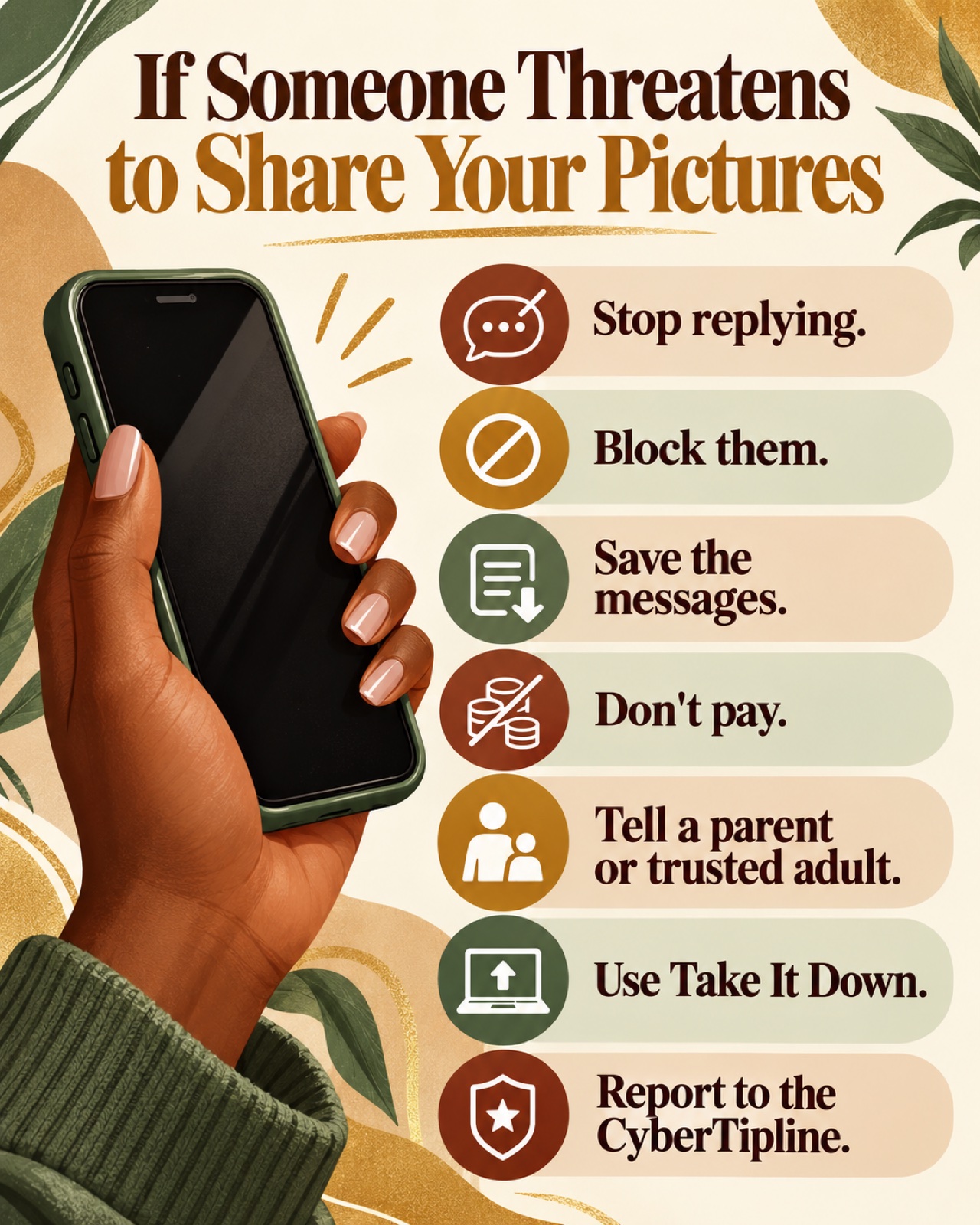
- If anyone asks for pictures, threatens you or asks for money: stop replying, block them, but do not delete the messages. Tell me.
- Do not pay. Paying rarely makes it stop.
- You will not be in trouble with me. You are the victim, not the criminal.
NCMEC Take It Down
For nude or sexual images taken before age 18. The tool makes a digital "fingerprint" of the image right on your device; the picture itself is never uploaded. Participating apps use the fingerprint to find and remove copies. takeitdown.ncmec.org. For adults, use StopNCII.org.
NCMEC CyberTipline
Call 1-800-843-5678 (1-800-THE-LOST), 24 hours, or report at report.cybertip.org. NCMEC also offers counseling referrals for families.
FBI
Report at tips.fbi.gov or call 1-800-CALL-FBI (1-800-225-5324). If your child talks about wanting to hurt themselves, call or text 988 now.
Family media habits
- Make a Family Media Plan (AAP's free tool).
- Phones charge outside the bedroom at night.
- Know their apps and games. Many include chat with strangers.
- Turn on parental controls and privacy settings, and check them together.
- Talk about pornography before they find it: "It's fake, it's often violent, and it's not what love looks like."
- Talk about sexting: forwarding a nude of a minor can be a crime, even between teens.
- Ask what they see, without panic. Curiosity keeps them talking.
- Watch for secrecy, a new "friend," sudden mood drops, or money requests.
Sources: FBI, Sextortion · FBI IC3 alert · NCMEC, Can you remove nudes from the internet · NCMEC CyberTipline · Take It Down · AAP, Sexting · AAP, Media and Children
Teens 13 to 19
Healthy love vs. harmful love
Dating violence is not only hitting. It can be control, threats, jealousy and pressure. Only some teens in abusive relationships tell a parent, so teach the signs early.
| Healthy | Unhealthy or abusive |
|---|---|
| Respects your "no" the first time | Pressures, guilts or sulks until you give in |
| Glad you have friends and family | Wants you all to themself; cuts you off from people |
| Trusts you | Checks your phone, tracks your location, demands passwords |
| Supports your goals: school, church, sports, work | Makes you skip things or feel bad for your dreams |
| Disagrees kindly | Yells, insults, threatens, breaks things, hits |
| Your age or close to it | Much older; asks you to keep the relationship secret |
loveisrespect helps teens and young adults 13 to 26, and the parents who love them: call 1-866-331-9474, text LOVEIS to 22522, or chat at loveisrespect.org. Free, 24/7.
Sources: loveisrespect · Child Trends, Teen dating violence · AAP, Helping Teens Make Choices About Sex
Faith & family values
Share your beliefs and still tell the truth
Some parents worry that giving facts about birth control is the same as giving permission. The AAP says it plainly: acknowledging sexuality is not the same as approving of sex. You can teach that sex is sacred and belongs in marriage, and make sure your child knows how bodies work, how infections spread and how to stay safe.
Why both? Because research shows faith alone does not always protect, and a teen who makes a choice you didn't want still needs to be safe and still needs to come home to you.
A faith-friendly approach
- Start with worth: "God made all of you, and every part is good. Your body is a gift, so we take care of it."
- Say the why: explain why your family believes in waiting, not just "because I said so."
- Give the facts: accurate, from doctors, at the right age.
- Make grace part of it: "If you ever make a choice you regret, you still come to me. There is nothing you can do that stops my love, or God's."
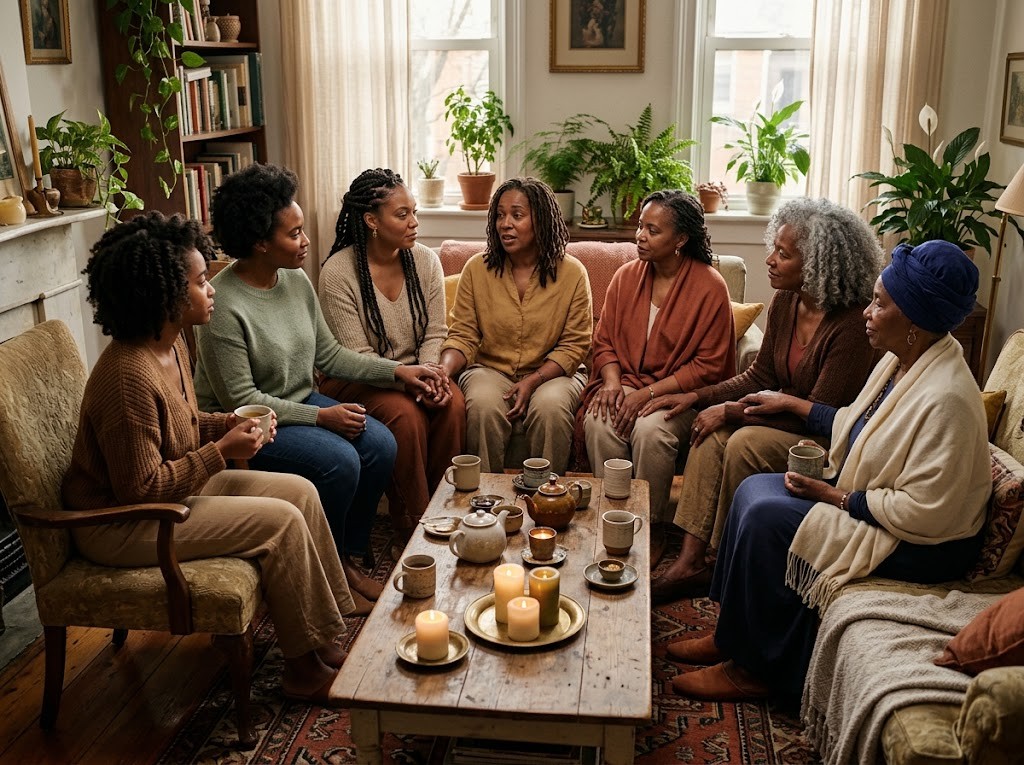
- Ask your pastor or first lady to host a parents' night, or bring in a nurse from the congregation.
Sources: AAP, Talking to Your Child About Sex · Manlove et al. 2006, parent religiosity and teen sex · National Study of Youth and Religion
It takes a village
Tips for dads, grandparents and aunties
The AAP encourages parents to name other trusted adults a child can turn to when talking with a parent feels hard. In our families, that is often an auntie, a grandmother or a big cousin.

Dads and father figures
- Your daughter learns what a good man looks like from you. Show respect to the women in your life.
- Talk with sons about consent: "No means stop, and silence is not yes."
- Don't joke about "locking her up" or "getting the shotgun." It tells her boys are dangerous and she can't talk to you.
- Learn about periods. Keep pads in the car.
Grandparents raising grandchildren
- Facts have changed: puberty comes earlier, phones bring strangers home, and teens have confidential care rights.
- Your stories are gold. "When I was your age..." opens doors.
- Ask the pediatrician or school nurse for help. You do not have to do this alone.
- Ask your caseworker, church or pediatrician about grandparent and kinship-care support near you.
Aunties, godmothers and big sisters
- Sometimes a teen will tell Auntie first. That's OK.
- Agree with the parents ahead of time: what you'll keep private, and what you must share (any danger, any abuse).
- Never promise to keep a secret about safety.
- Back up the parents' values even if you'd do it differently.
My aunt Bernice was the one I could ask anything, and my mother was glad of it. Pick your village on purpose. Tell your child, "If you can't tell me, tell Aunt so-and-so." Then tell Aunt so-and-so to call you if it's serious.
Sources: AAP, Talking to Your Child About Sex · HHS, Talking with Teens (2024) · Generations United
Learn from us
Mistakes to avoid
- Shame. "Nasty," "fast," "hot in the pants." Shame teaches hiding, not waiting. Correct the behavior, never the child's worth.
- The one-time talk. One awkward speech at 13 is too late and too little. Talk often.
- Scare tactics. Horror stories and graphic pictures don't work for long and make kids stop asking.
- Waiting for them to ask. Many children never will. You bring it up.
- Blaming girls for their bodies. "Go change, you're tempting grown men" puts the blame in the wrong place.
- Nicknames for body parts. Use the real words.
- Forcing affection. "Go hug your uncle" teaches that adults can override a child's "no."
- Overreacting to a question. A question is not a confession. Stay calm, ask what they've heard.
- Interrogating. The AAP warns that too many direct questions shut teens down.
- Leaving out the boys. Sons need body safety, consent and respect talks just as much.
| Instead of saying... | Try... |
|---|---|
| "Don't you come home pregnant." | "I want you to finish school and choose your future. Let's talk about how to protect it." |
| "Why are you asking that? Who told you?" | "Good question. What have you heard about it?" |
| "Boys only want one thing." | "Good people want to know you. Watch how someone treats your 'no.'" |
| "We don't talk about that." | "I'm not sure how to say this, but I want you to hear it from me." |
Sources: AAP, Talking to Your Child About Sex · AAP, Body Safety · APA, Sexualization of Girls
Read together
Books and trusted resources
Preview every book yourself first. Every family's comfort level is different, and you know your child best.
| Book | Author | Ages | Good to know |
|---|---|---|---|
| God Made All of Me: A Book to Help Children Protect Their Bodies | Justin & Lindsey Holcomb (2015) | 2 to 8 | Christian, faith-based body-safety book. Real names, safe and unsafe touch, no secrets. |
| It's Not the Stork! | Robie H. Harris & Michael Emberley | About 4+ | Bodies, babies and families for little ones. Secular. |
| It's So Amazing! | Robie H. Harris & Michael Emberley | About 7+ | Eggs, sperm, birth and families. Includes drawings of bodies; preview first. |
| The Care & Keeping of You: The Body Book for Younger Girls | Valorie Schaefer (American Girl) | 8+ | Gentle puberty basics, hygiene and periods. Volume 2 for older girls. |
| Celebrate Your Body (and Its Changes, Too!) | Sonya Renee Taylor (2018) | 8 to 12 | Body-positive puberty book by a Black author. Does not cover intercourse. |
| It's Perfectly Normal | Robie H. Harris & Michael Emberley | 10+ | Detailed puberty, sex and health. Some families find it too detailed; preview first. |
For parents
- HealthyChildren.org Dating & Sex (AAP)
- CDC Tips for Parents
- HHS Talking with Teens guide
- Darkness to Light (Stewards of Children training)
For teens
- loveisrespect.org
- Take It Down
- Office of Population Affairs clinic finder
- Philly: Take Control Philly (free condoms and testing info, city health dept.)
Hotlines
- Childhelp: 1-800-422-4453
- PA ChildLine: 1-800-932-0313
- RAINN: 1-800-656-4673
- NCMEC: 1-800-843-5678
- Crisis: call or text 988
- Emergency: 911
Sources: God Made All of Me listing · WAMC on Robie Harris books · Publishers Weekly, It's So Amazing! · The Care & Keeping of You · Celebrate Your Body (AALBC) · Take Control Philly coverage
Keep going
Read together next
Puberty
What changes, when, and the first-period kit.
Periods
Cycles, cramps, products and red flags.

Birth control
Every method, explained plainly.
Getting care
Teen-friendly clinics and your rights.
You will not say it perfectly. I never have. Say it anyway, say it with love, and say it again next week. That's the whole secret.