
Womanhood · Your Care, Your Voice
Your care. Your voice.
The plain truth about unequal care for Black women in this country, and the tools to get the care you deserve: what to check and when, what to say in the exam room, and where to go in Philadelphia when money is tight.

Read this first
Facts, not fear
Some of the numbers on this page are hard to read. We put them here for one reason: so you know what to watch for and what to ask for. None of these gaps are written in your DNA. Most of them come from how care is given, how late problems are found, and who gets listened to.
That means a lot of it can change. It changes when we know our screening dates, keep our own records, bring someone with us, and say clearly, "Something is wrong, and I need you to look into it."
- Every number has its source under the section.
- Where the evidence is still unsettled, we say so.
- This page teaches. It does not replace your own doctor, nurse or midwife.

Baby, I'm not telling you this to scare you. I'm telling you because my mother didn't know half of it, and I learned the rest the hard way. Knowing is how we stop being surprised. Read it, then go make your appointment.
The facts, plainly
Where care falls short for Black women
These are the gaps the biggest U.S. health agencies and researchers have measured. Read them as a map of where to be extra careful.
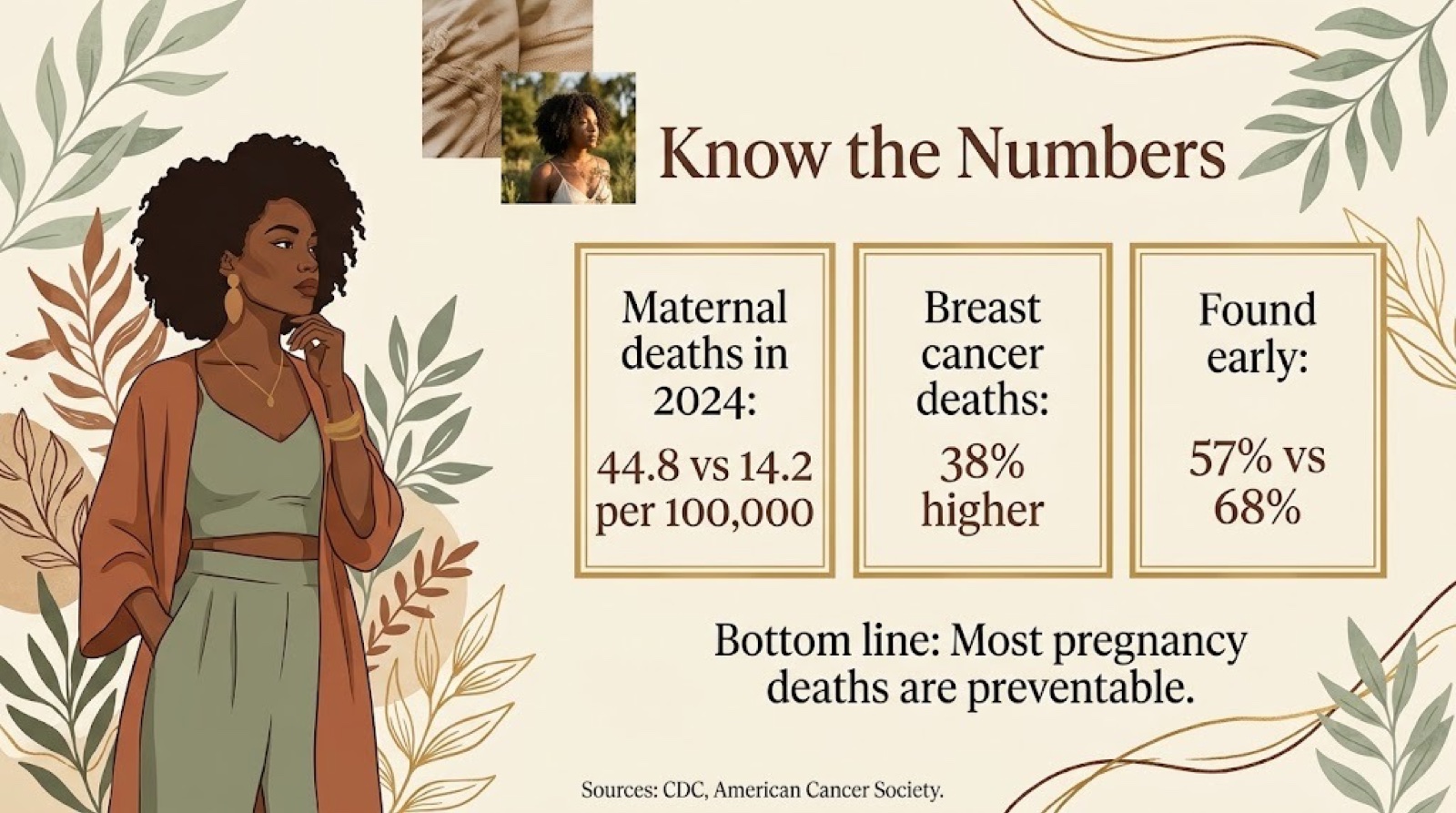
44.8
Maternal deaths
In 2024, Black women died of maternal causes at 44.8 per 100,000 live births. The rate for white women was 14.2. That is about three times higher. The Black rate was 50.3 in 2023; CDC says the drop was not statistically significant.
80%+
Most can be prevented
CDC review committees found that more than 8 in 10 pregnancy-related deaths in 2020 could have been prevented. Changes by patients, families, doctors, hospitals and systems could have saved those lives.
38%
Breast cancer deaths
Black women are 38% more likely to die of breast cancer than white women, even though slightly fewer are diagnosed with it (American Cancer Society, 2025). Reports have shown a gap of about 40% for more than ten years.
57%
Found later
Only 57% of breast cancers in Black women are found at the earliest, localized stage, compared with 68% in white women. Cancers found later are harder to treat.
2×
Aggressive types
Black women have about twice the risk of triple-negative breast cancer. This fast-growing type often shows up younger. Uterine cancer death rates in Black women are also about double those of every other group of women.
40%
Discrimination in maternity care
In a 2023 CDC survey, 4 in 10 Black mothers said they faced discrimination during maternity care, and 3 in 10 said they were mistreated. That included being ignored, shouted at, or having requests for help refused.
| Measure | Black women | White women | Source |
|---|---|---|---|
| Maternal deaths per 100,000 live births (2024) | 44.8 | 14.2 | CDC / NCHS Health E-Stat 113 |
| Pregnancy-related deaths judged preventable (2020, all races) | More than 80% | CDC Maternal Mortality Review Committees | |
| Likelihood of dying of breast cancer | 38% higher | Comparison group | American Cancer Society, 2025 |
| Breast cancers found at localized (earliest) stage | 57% | 68% | American Cancer Society, Breast Cancer Statistics 2022 |
| Risk of triple-negative breast cancer | About 2 times | Comparison group | American College of Radiology, 2023 |
| Cervical cancer death risk | 40–50% higher (Black vs. White people) | Comparison group | American Cancer Society, 2025 |
| Uterine cancer death rate | About 2 times every other group | Comparison group | American Cancer Society, 2025 |
| Reported discrimination in maternity care (2023 survey) | 40% | 29% (all women) | CDC Vital Signs, Aug 2023 |
| Reported mistreatment in maternity care (2023 survey) | 30% | 20% (all women) | CDC Vital Signs, Aug 2023 |
About the survey numbers: the CDC maternity survey asked 2,402 mothers to look back on their care. People chose to join the panel, and it was in English only. It tells us what women lived through, but it is not a count of every hospital stay.
Sources: CDC NCHS, Maternal Mortality Rates 2024 · CDC Maternal Mortality Review data · ACS Cancer Facts & Figures for African American/Black People · ACS Cancer Statistics for African American and Black People 2025 · ACS Breast Cancer Statistics 2022 · American College of Radiology 2023 · CDC Vital Signs: Maternity Care Experiences
Why it happens
It isn't your body. It's the care around it.
Researchers point to a few big reasons. Knowing them helps you see where to push.
False beliefs about pain
In a 2016 study, about half of the white medical students and residents surveyed believed at least one false idea about Black bodies, like "Black people's skin is thicker." The ones who held those beliefs rated a Black patient's pain as lower and made less accurate treatment choices.
A 2019 review of 14 emergency-room studies found Black patients were less likely than white patients to get pain medicine for the same kind of sudden pain.
Being dismissed
In the CDC maternity survey, 45% of all mothers said they held back questions or worries during maternity care. Women on public insurance or no insurance reported more mistreatment than women with private insurance.
When a woman stays quiet, warning signs can be missed. That's why speaking up, and having someone speak up with you, matters so much.
Late diagnosis of fibroids and endometriosis
More than 80% of Black women will have fibroids by age 50. Even so, many women live with heavy, painful periods for years before they get treatment, because they've been told it's "normal."
A 2019 review found Black women were about half as likely to be diagnosed with endometriosis as white women. The authors and other experts say this may come from doctors not looking for it, not from Black women having it less.
Insurance and access
Black adults are more likely than white adults to have no health insurance, and about 1 in 10 U.S. women ages 19–64 had no coverage in 2024. The extra federal tax credits that lowered marketplace prices ended after 2025, and KFF expects more people to lose coverage.
Federal reports have found that Black patients get worse care than white patients on many quality measures. Follow-up care after an abnormal mammogram is often slower, too.
Clear health information
A national adult survey found that many Americans struggle with health forms, medicine labels and test results. Black and Hispanic adults were more likely to score at the lowest level. This is about whether clear teaching reached people, not about how smart they are.
No one should have to decode their own care. You can say "Explain that in plain words" as many times as you need.
Trust that was broken
Tuskegee, 1932–1972: the U.S. Public Health Service followed 600 Black men in Alabama, 399 of them with syphilis. They were never told the truth. When penicillin became the treatment of choice in 1943, it was kept from them.
Henrietta Lacks, 1951: doctors at Johns Hopkins took her cervical cancer cells without her knowledge or consent. Her cells became HeLa, the cells behind decades of research. In 2013 the NIH finally gave her family a say in how her genetic data is used.
Our grandmothers had every reason not to trust a hospital. I understand that feeling deep down. But staying home doesn't protect us. What protects us is going in prepared, going in with company, and making them write it all down.
Sources: Hoffman et al., PNAS 2016 · Lee et al., Am J Emerg Med 2019 · CDC Vital Signs 2023 · Baird et al. 2003 (fibroids) · Bougie et al., BJOG 2019 (endometriosis) · KFF uninsured rates by race · KFF Women's Health Insurance Coverage · AHRQ National Healthcare Quality and Disparities Reports · Commonwealth Fund 2026 state disparities report · NCES, Health Literacy of America's Adults · CDC Tuskegee timeline · NIH–Lacks Family Agreement · more history on our History page
Now the good part
Here's where your power is
The gaps are real. So are the tools. Every one of these is free to use, starting today.
1
Know your dates
Pap, mammogram, blood pressure, colon. Use the checklist below and put them in your phone.
2
Know your history
Ask the family who had breast, ovarian, colon or uterine cancer, fibroids, diabetes or high blood pressure, and how old they were.
3
Say it plainly
Name your symptom, how long you've had it, and how it changes your life. Ask for the test by name.
4
Don't go alone
A sister, friend, daughter or doula can take notes and speak up when you're tired or hurting.
The well-woman visit
Your once-a-year check-in
A well-woman visit is a preventive visit. You don't have to be sick to go. It's your yearly time to catch problems early and plan ahead.

What usually happens
- Talk first. Your health history, your periods, birth control or pregnancy plans, family history, medicines, mood, sleep and stress.
- Basic checks. Blood pressure, weight, and a look at your overall health.
- Screening tests that match your age: a Pap or HPV test, a mammogram order, blood sugar or cholesterol tests.
- Vaccines you may need, like HPV, flu or tetanus.
- Breast and pelvic exams only when they make sense for you. ACOG calls this a decision you and your clinician make together.
- Your plan: whether you want a baby, when, or not at all. Care should fit your plan.
How often
ACOG recommends a well-woman visit once a year. Your clinician may adjust that for you. Under the Affordable Care Act, most plans cover a yearly well-woman visit with no copay.
You can go to a gynecologist, a family doctor, a nurse practitioner, a physician assistant or a nurse-midwife. Pick someone you can talk to about private things.
First gynecologist visit: ages 13 to 15
ACOG recommends a girl's first reproductive health visit between 13 and 15. For most girls it is mostly a talk: normal periods, body changes, healthy relationships, how to stay safe, and vaccines.
- An inside (pelvic) exam is usually not needed at the first visit unless there's a problem like very heavy bleeding or bad pain.
- She can ask to talk with the doctor alone for part of the visit.
- Moms: bring her period tracker or notes about her cycle.
More for girls and parents on our Puberty and Periods pages.
Bring these to every visit
- A list of every medicine, vitamin, herb and tea you take, with doses. (Herbs can interact with medicines. See our Herbs page.)
- The date your last period started, and anything unusual.
- Your family health history.
- Your last test results, if they're from another office.
- Your top 3 questions, written down.
Sources: ACOG Committee Opinion: Well-Woman Visit · MSD Manual: Well-Woman Visits · ACOG: Your First Gynecologic Visit · ACOG first visit 13–15 (Obstet Gynecol 2018) summary · Women's Preventive Services Initiative
Cervical cancer screening
Pap and HPV tests: your schedule
Cervical cancer is caused by HPV, a very common virus. Screening finds changes years before they turn into cancer. Black women have a higher risk of dying from cervical cancer, so staying on schedule matters.
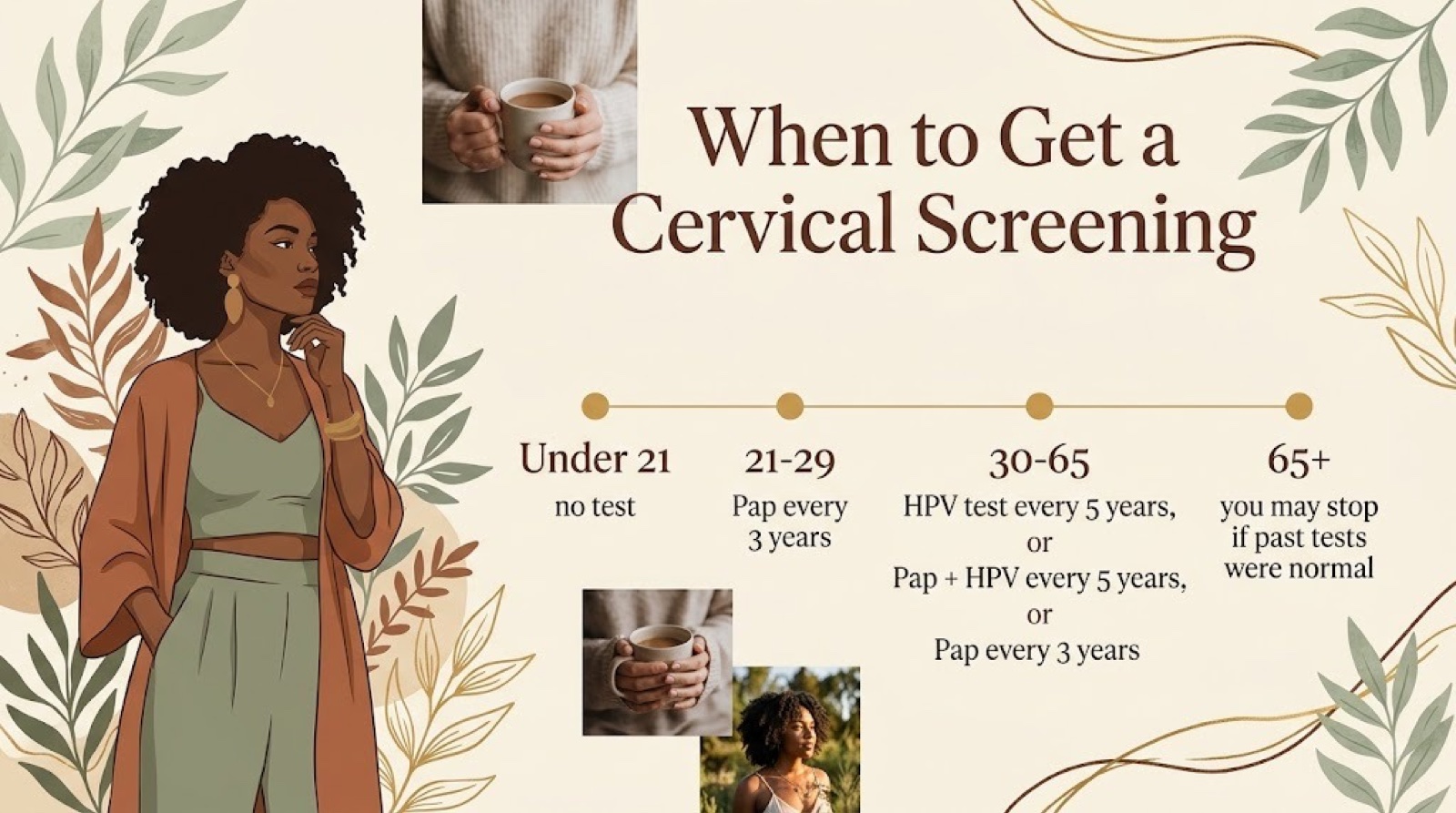
| Age | What to get | How often | Notes |
|---|---|---|---|
| Under 21 | No screening | None | Even if sexually active. HPV vaccine is best at 11–12 and can start at 9. Catch-up shots go through age 26. |
| 21–29 | Pap test | Every 3 years | HPV testing alone is not the first test at this age. |
| 30–65 | Choose one: HPV test alone, Pap plus HPV (co-test), or Pap alone | HPV alone: every 5 years. Co-test: every 5 years. Pap alone: every 3 years. | In a 2024 draft, the Task Force added an HPV test you collect yourself. Ask if your clinic offers it. |
| Over 65 | Usually stop | None | Only if you've had regular normal results and you're not at high risk. If you're unsure, keep going and ask. |
| After hysterectomy | Usually stop | None | Only if your cervix was removed and it was not for cancer or pre-cancer. Check your records. |
Don't wait for your next screening date if you have bleeding after sex, bleeding between periods or after menopause, unusual discharge, or pelvic pain. Those need a visit now.
Sources: USPSTF Cervical Cancer Screening (2018, current final) · USPSTF December 2024 draft (self-collection) · CDC HPV vaccine · ACS 2025
Breast health
Breasts: risk check, mammograms, and knowing your normal
Black women are more likely to get breast cancer young and more likely to get aggressive types. That's why the experts now say: know your risk by 25.
By 25: a risk check
The American College of Radiology says every woman, especially Black women and Ashkenazi Jewish women, should get a breast cancer risk assessment by age 25. It's a conversation and a short questionnaire about family history, genes, past chest radiation and more.
Ask: "Can you calculate my lifetime breast cancer risk? Do I need to start screening before 40?"
From 40: mammograms
The U.S. Preventive Services Task Force says women at average risk should get a mammogram every 2 years from 40 to 74. The ACR recommends every year from 40.
Talk with your clinician about which schedule fits you. Both groups agree on one thing: start at 40, not 50.
Higher risk: start earlier
If you have a gene change like BRCA1, a lifetime risk of 20% or more, or chest radiation when you were young, the ACR recommends a yearly breast MRI starting at 25–30, and yearly mammograms starting between 25 and 40 depending on your risk.
Women diagnosed before 50, or with a past cancer and dense breasts, should get a yearly MRI too.
| Who | USPSTF (2024) | American College of Radiology (2023) |
|---|---|---|
| Average risk, 25–39 | No routine mammogram | Risk assessment by 25, especially for Black women |
| Average risk, 40–74 | Mammogram every 2 years | Mammogram every year from 40 |
| 75 and older | Not enough evidence to decide; talk with your doctor | Talk with your doctor about your health and wishes |
| Higher risk (genes, 20%+ lifetime risk, chest radiation) | Talk with your clinician | Yearly MRI from 25–30; yearly mammogram from 25–40, depending on risk |
| Dense breasts | Not enough evidence for extra tests | Supports extra imaging (often MRI) for some women; ask what fits your risk |

"Dense breasts" on your letter
Since September 10, 2024, a federal FDA rule says every mammogram report must tell you if your breasts are dense or not dense. Dense breasts are common and normal, but dense tissue can hide cancer on a mammogram and slightly raise risk.
If your letter says dense, ask:
- "How dense: heterogeneously dense or extremely dense?"
- "With my risk, should I get an ultrasound or an MRI too?"
- "Will my insurance cover extra imaging?"
Breast self-awareness
ACOG no longer tells women to do a monthly self-exam by a set method. Instead, it asks you to know what's normal for you: how your breasts look and feel across your cycle, so you notice when something changes.
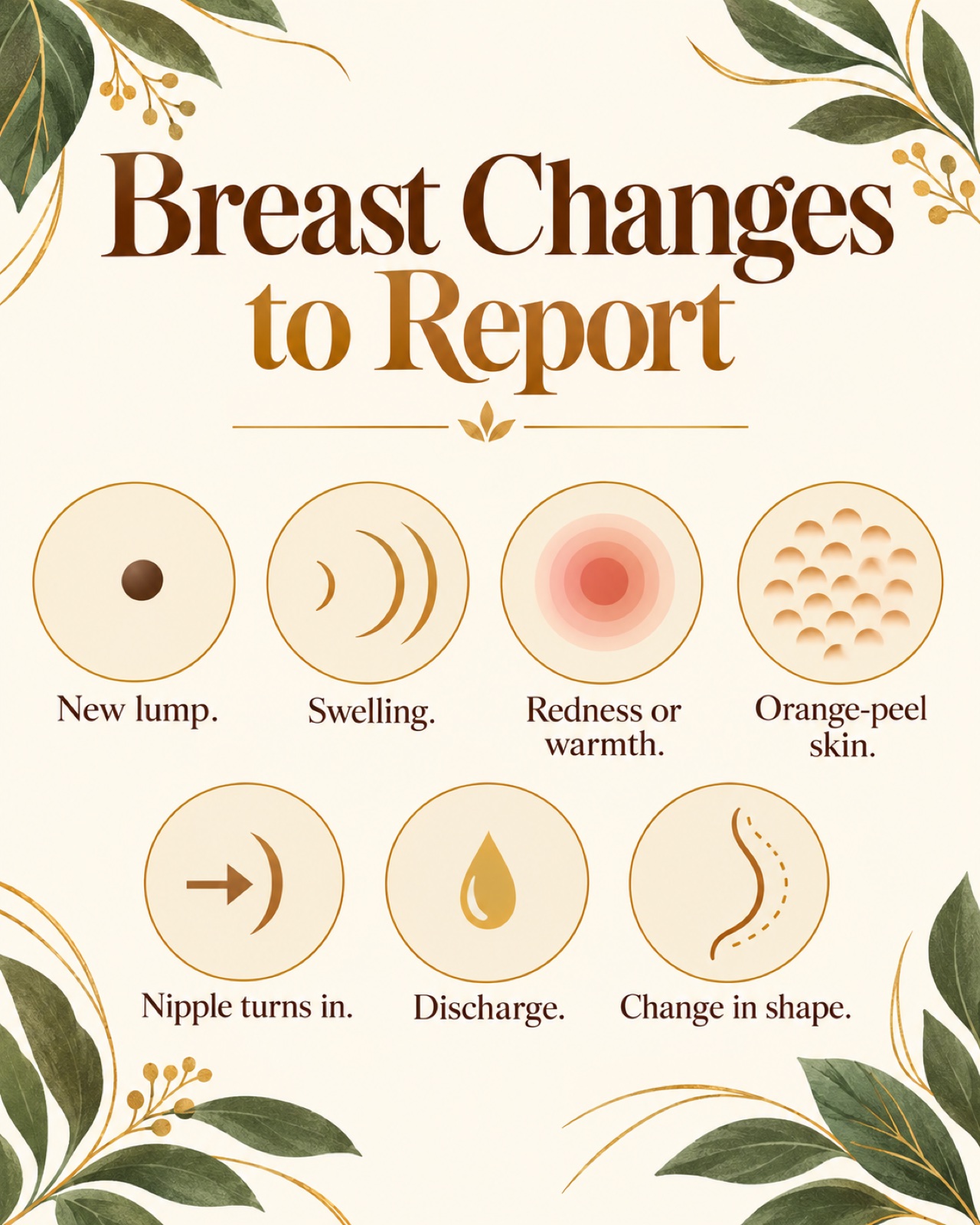
Changes to get checked
- A new lump or thick spot in the breast or underarm, even if your last mammogram was normal
- Swelling, warmth, or redness or darker color of the skin
- Skin that dimples or looks like an orange peel
- A nipple that turns inward, or discharge you didn't squeeze out (especially bloody)
- Pain in one spot that doesn't go away
- A change in size or shape of one breast
Triple-negative and inflammatory breast cancer
Triple-negative breast cancer doesn't respond to hormone treatments. It is more common in Black women, younger women and women with a BRCA1 gene change. It often shows up as a lump you can feel, and it can grow between mammograms. A new lump needs a diagnostic test right away. It should not wait until your next screening.
Inflammatory breast cancer is rare, but more common in Black women. It often has no lump. Look for swelling, redness, warmth and orange-peel skin that comes on over weeks. If an antibiotic doesn't clear a "breast infection" quickly, ask about it by name.
If you find a lump and somebody says, "You're too young, let's wait and see," you say, "I'd like an ultrasound today, please. If you won't order it, write in my chart that I asked and you said no." You'd be surprised how fast that ultrasound gets ordered.
Sources: ACR 2023 screening guidelines · USPSTF Breast Cancer Screening 2024 · FDA Mammography Quality Standards Act · FDA breast density rule summary (effective 10 Sept 2024) · ACOG Practice Bulletin 179 · NCI triple-negative breast cancer · NCI inflammatory breast cancer · Breastcancer.org IBC
Print it · Save it · Share it
Your yearly checklist by age
This is for women at average risk. If you have a family history, a condition, or symptoms, you may need tests sooner or more often. Bring this table to your visit and ask, "What do I need this year?"
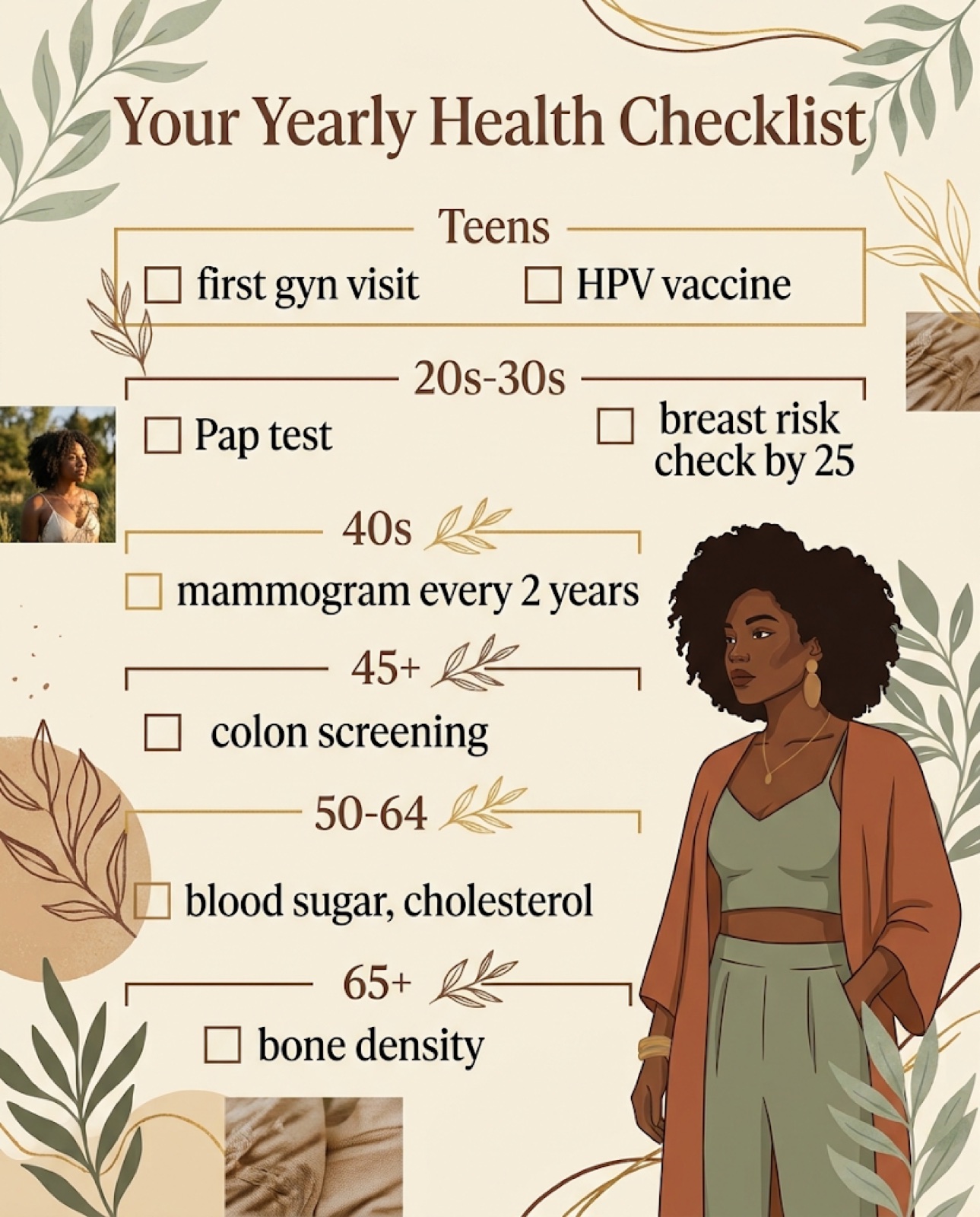
| Check | Teens 13–19 | 20s–30s | 40s | 50–64 | 65+ | Source |
|---|---|---|---|---|---|---|
| Well-woman / gyn visit | First visit 13–15, then yearly | Yearly | Yearly | Yearly | Yearly (yes, still) | ACOG |
| Cervical (Pap/HPV) | Not before 21; HPV vaccine 9–12 | Pap every 3 yrs from 21; from 30, HPV every 5 yrs is an option | HPV every 5 yrs, co-test every 5, or Pap every 3 | Same as 40s | May stop if past results were normal; ask | USPSTF, CDC |
| Breast | Know your normal | Risk assessment by 25; know your normal | Mammogram from 40 (every 1–2 yrs) | Mammogram every 1–2 yrs | Every 2 yrs to 74; then decide together | ACR, USPSTF |
| Blood pressure | At checkups | At least every 3–5 yrs if normal; yearly if higher risk | Yearly | Yearly | Yearly | USPSTF |
| Blood sugar (A1C) | If overweight with risk factors | Earlier if overweight with a risk factor; ADA screens all at 35 | Every 3 yrs if normal | Every 3 yrs if normal | Ask | ADA, USPSTF |
| Cholesterol | Ask at checkups | Every 4–6 yrs from 20 | Every 4–6 yrs, or more often | As advised | As advised | AHA |
| Colon cancer | No | No (unless family history) | Start at 45 | On schedule for your test type | Through 75; then decide | USPSTF |
| Bone density (DXA) | No | No | Only if high risk after menopause | If high risk after menopause | At 65 | USPSTF |
| Skin check | Know your spots | Monthly self-check, including palms, soles and nails | Same | Same | Same | AAD |
| Eyes | School/vision checks | If problems or diabetes | Baseline exam at 40, then every 2–4 yrs | Every 1–3 yrs (55–64) | Every 1–2 yrs | AAO |
| Dental | Regular cleanings | Regular cleanings | Regular cleanings | Regular cleanings | Regular cleanings | ADA |
| Mental health | Depression screening from 12 | Depression and anxiety screening; also during and after pregnancy | Depression and anxiety | Depression and anxiety | Depression | USPSTF |
| One-time tests | HIV test at least once from 15 | Hepatitis C once (18–79); know your sickle cell trait status | Catch up on anything missed | USPSTF, CDC | ||
More on blood pressure, diabetes, heart and kidney health for Black women is on our Body page, and what each age needs day to day is on Every Age.
Sources: ACOG · USPSTF cervical · USPSTF breast · USPSTF blood pressure · USPSTF diabetes · ADA Standards of Care · AHA cholesterol · USPSTF colorectal · USPSTF osteoporosis · AAD skin cancer in skin of color · AAO baseline eye exam · ADA MouthHealthy · USPSTF depression · USPSTF anxiety · USPSTF hepatitis C · USPSTF HIV · CDC sickle cell

Pregnant or had a baby this year?
Hear Her: warning signs
CDC's Hear Her campaign lists signs that need care right away, during pregnancy and for a full year after. Say out loud: "I am pregnant" or "I had a baby in the last year."
- Headache that won't go away or keeps getting worse; vision changes
- Dizziness or fainting
- Fever of 100.4°F or higher
- Sudden swelling of the face or hands
- Trouble breathing, chest pain or a racing heart
- Severe belly pain or severe nausea and vomiting
- Baby moving less or stopping
- Heavy bleeding or bad-smelling discharge after birth
- Thoughts of hurting yourself or your baby
- Overwhelming tiredness
If you can't reach your provider, go to the emergency room or call 911. Pennsylvania Medicaid now covers moms for 12 months after birth. More on our Pregnancy page.
Sources: CDC Hear Her · CDC urgent maternal warning signs · Pennsylvania Health Law Project: 12-month postpartum Medicaid
Speak up
How to be heard in the exam room
You know your body better than anyone. These steps help the person in the white coat know it too.
Before, during and after
- Before: write your symptoms down. When did it start? How often does it happen? What makes it better or worse? How does it affect work, sleep or family? Rate pain from 0 to 10, and say what it stops you from doing.
- Bring your list of medicines, herbs and supplements, your questions, and your family history.
- Lead with your main worry: "The most important thing I need today is…"
- Take notes, or ask your support person to. You may ask to record the visit on your phone. Ask first.
- Repeat it back: "So what I'm hearing is… Is that right?"
- Before you leave: "What happens next? When will I get results? Who do I call if it gets worse?"
- After: read your visit notes in the patient portal. If something's wrong or missing, ask to fix it.
Words that work
Bring a support person
A sister, friend, partner, daughter or doula can take notes, remember what was said, and speak up when you're in pain or worn out. Tell the front desk they're with you. In labor, a doula is a trained support person. Ask your Medicaid plan if it covers one.
Get a second opinion
You can always ask another doctor to look at the same problem, especially before surgery, for a cancer diagnosis, or when you've been told "nothing's wrong" and you still feel bad. Ask for copies of your tests and images to bring along. Call your plan and ask how it covers a second opinion.
Your records are yours
Under HIPAA you have the right to get a copy of your medical records. You can also ask the office to correct or add to them. They must answer within 60 days. If they say no, you can put your own written statement in your file.
Questions to ask about a new diagnosis
- What exactly is it, and what caused it?
- What tests confirmed it? Can I have copies?
- What are all my treatment options, including ones that save my uterus or fertility?
- What are the side effects? What happens if I wait?
- How many patients like me have you treated?
- Is there a specialist I should see?
Questions to ask about a new medicine
- What is it for, and how will I know it's working?
- How and when do I take it? With food?
- Does it mix badly with my other medicines, herbs or teas?
- Is it safe if I'm pregnant, trying, or breastfeeding?
- Is there a cheaper generic?
Questions to ask about surgery
- Why do I need it, and what happens if I don't have it?
- Is there a less invasive option, like a smaller cut or a procedure instead of surgery?
- How long is recovery? When can I go back to work, lift my grandbaby, or drive?
- Can I get a second opinion first?
If you were treated unfairly: where to complain
- The hospital's patient advocate or patient relations office. Every hospital has one. Ask the front desk.
- Your insurance plan's member services line, which is on the back of your card.
- U.S. HHS Office for Civil Rights: for discrimination by race, sex, disability or language, or for problems getting your records.
- You also have the right to a free interpreter and to accessible care under federal law (ACA Section 1557).
Sources: AHRQ Questions Are the Answer · HHS: Your right to access your records · HHS: Medical records and HIPAA · 45 CFR 164.526 (amendment of records) · HHS Office for Civil Rights complaints · ACA Section 1557 · CDC Vital Signs 2023
Find your people
Finding Black women doctors
Black women doctors are still few in number, but they are out there. These directories help you find them. Providers sign up for these lists themselves, so always check that a doctor is board-certified and takes your insurance before you book.
Directory · national
Health in Her HUE
healthinherhue.com
A directory of providers chosen for safe, affirming care of Black women and women of color, plus member reviews and health articles.
Directory · national
HUED
huedco.com
Connects patients of color with doctors of color and with providers trained in culturally responsive care.
Directory · national
Find A Black Doctor
findablackdoctor.com
A list of Black physicians and dentists in active practice, in all 50 states. Doctors create their own listings.
Professional association
National Medical Association
nmanet.org
The oldest and largest group of Black physicians in the U.S. Its website can help you find member doctors.
Mental health
Therapy for Black Girls
providers.therapyforblackgirls.com
Directory of therapists for Black women and girls, plus a weekly podcast. More on our Mind & Sleep page.
Ask locally
Your insurer & your circle
Member services · church · sister circle
Your insurance website can filter doctors by gender and languages spoken. Word of mouth from women you trust is still one of the best guides.
Sources: Healthcare Brew on Health in Her HUE (2025) · HUED news report · Find A Black Doctor: About · National Medical Association · AAMC physician workforce data. Listings checked 16 October 2026.
Philadelphia
Low-cost and free care in Philly
No insurance, or insurance that doesn't cover enough? You still have options. Call ahead, because hours and services change.
Free mammograms & Pap tests
PA Breast and Cervical Cancer Early Detection Program
Formerly "HealthyWoman" · run in Philly by AccessMatters · Hotline 215-985-3300 (outside Philadelphia 1-800-848-3367)
A PA Department of Health program with CDC funding. Free mammograms, Pap and HPV tests, and follow-up tests for Pennsylvanians who are uninsured or underinsured and below an income limit (250% of the federal poverty level). Breast screening: ages 40–64, or younger if you're high risk or have symptoms. Cervical: ages 21–64. If cancer is found, you can be enrolled in Medicaid for treatment.
Title X family planning
AccessMatters Health Center Network
70+ health centers in 5 SE PA counties · Hotline 215-985-3300
Birth control, pregnancy planning, breast and cervical screening, and STI and HIV testing. They serve everyone, whether or not you can pay and whether or not you have insurance. Many sites have evening and weekend hours and teen-friendly services. Federal Title X money was held up for four months in 2025 and then restored. Call to confirm.
Insurance marketplace
Pennie
Pennsylvania's official marketplace · 1-844-844-8040
Open enrollment for 2027 coverage runs November 1, 2026 to January 15, 2027. Sign up by December 15 for coverage that starts January 1. The extra federal tax credits that lowered prices ended after 2025, but many families still qualify for help. Certified helpers are free.
Medicaid
Medical Assistance (PA Medicaid)
Apply at COMPASS · 1-866-550-4355
Free or low-cost coverage for people with lower incomes, pregnant women and children. New moms keep coverage for 12 months after birth. Apply online any time of year. If you get stuck or denied, the Pennsylvania Health Law Project offers free help.
City health center · West Philly
Health Center 3
555 S. 43rd St. · Medical (215) 685-7504 · Dental (215) 685-7506
Primary care from the Philadelphia Department of Public Health.
City health center · West Philly
Health Center 4
4400 Haverford Ave. · Medical (215) 685-7601 · Dental (215) 685-7605
Primary care and dental.
City health center · North Philly
Health Center 5
1900 N. 20th St. · Medical (215) 685-2933 · Dental (215) 685-2938
Primary care and dental.
City health center · North Philly
Strawberry Mansion Health Center
2840 W. Dauphin St. · (215) 685-2401
Primary care, prenatal care, family planning, breastfeeding support and mammography screening, plus dental.
City health center · Germantown
Mattie L. Humphrey Health Center
131 E. Chelten Ave. (formerly Health Center 9) · Medical (215) 685-5701 · Dental (215) 685-5738
Primary care and dental.
City health center · South Philly
Health Center 2
1700 S. Broad St., Unit 201 · Medical (215) 685-1800 · Dental (215) 685-1822
Primary care and dental.
City health center · North Philly
Health Center 6
301 W. Girard Ave. · Medical (215) 685-3803 · Dental (215) 685-3816
Primary care and dental.
City health center · Northeast
Health Center 10
2230 Cottman Ave. · (215) 685-0639
Primary care and dental.
City health center · South Philly
Health Center 1 (STD clinic)
1930 S. Broad St., 2nd floor · (215) 685-6570
Walk-in STD testing and treatment only.
How City Health Centers charge: they take Medicare, Medicaid and most insurance. If you have no insurance, they charge a small fee based on your family size and income, and staff can help you apply for coverage. Pay at the center with cash or money order. The City will never call you asking for card or bank numbers. Questions? Call 311.
Sources: City of Philadelphia, City Health Centers (checked 16 Oct 2026) · PA Department of Health, PA-BCCEDP · AccessMatters Early Detection · AccessMatters Family Planning · HHS Office of Population Affairs, Title X grantee · PHLP on Pennie 2027 · Pennie · PA COMPASS. Also see our Philly Guide.

Crowned, rooted, and heard
You are worth the follow-up call.
The women who came before us caught babies, mixed remedies and nursed whole communities, often with no one listening. We get to do it differently. We get to walk in with our questions written down and our sister beside us, and walk out with answers.
- Pick one check from the table above that you're due for.
- Make the appointment this week.
- Tell one woman you love to do the same.
Talk with your own doctor, nurse or midwife about what's right for you. In an emergency call 911. In a mental-health crisis call or text 988.