
Womanhood · Your body, your choice, your timing
Birth Control & Pregnancy Prevention
Whether you are waiting, planning, spacing your children or finished growing your family, you deserve the whole truth: how each method works, how well it works, what it can feel like, and the history that makes so many of us careful. No pressure. No judgment. Just facts and your decision.

Start here
Your decision, made with full information
Birth control is not one thing. It is a menu: some choices last for years, some you use only when you need them, some protect against infections, some do not. And one choice, waiting, is free and works every time.
This page lays out every option side by side using numbers from the Centers for Disease Control and Prevention (CDC). It also talks plainly about something many health pages skip: why a lot of Black women walk into a birth control visit with their guard up, and how to walk out feeling respected.
- You can choose any method, or no method, and change your mind at any time.
- You can ask for a method to be removed or stopped, and that request should be honored.
- You can say "I need time to think" and leave without deciding.

Baby, this page isn't here to tell you what to do. It's here so nobody, not a boyfriend, not a doctor, not even me, can make the decision for you. Knowledge is how we keep our crowns on straight.
Abstinence
Choosing to wait is a real choice, and a strong one
Many families, many churches and many young women choose to wait for sex until marriage or until they feel ready. That choice deserves respect, not jokes.
100% when you wait
Not having vaginal sex is the only way to be completely sure you will not get pregnant. The American Academy of Pediatrics has called abstinence 100% effective at preventing pregnancy and STIs, and an important part of counseling.
It is not "all or nothing"
Some people wait for years, some wait again after having sex before. Each new day is your choice. You never owe anyone sex because you said yes once, or because you are dating, engaged or married.
Waiting and knowing
Pediatricians are asked to support teens who wait and give clear information about birth control at the same time. Knowing about methods does not push anyone into sex. It means that if plans change, you are protected and not panicked.
Sources: AAP, Contraception for Adolescents (2014 policy) · AAP 2025 policy update (Contemporary Pediatrics) · CDC, Condom use
Every method, side by side
How well does each method work?
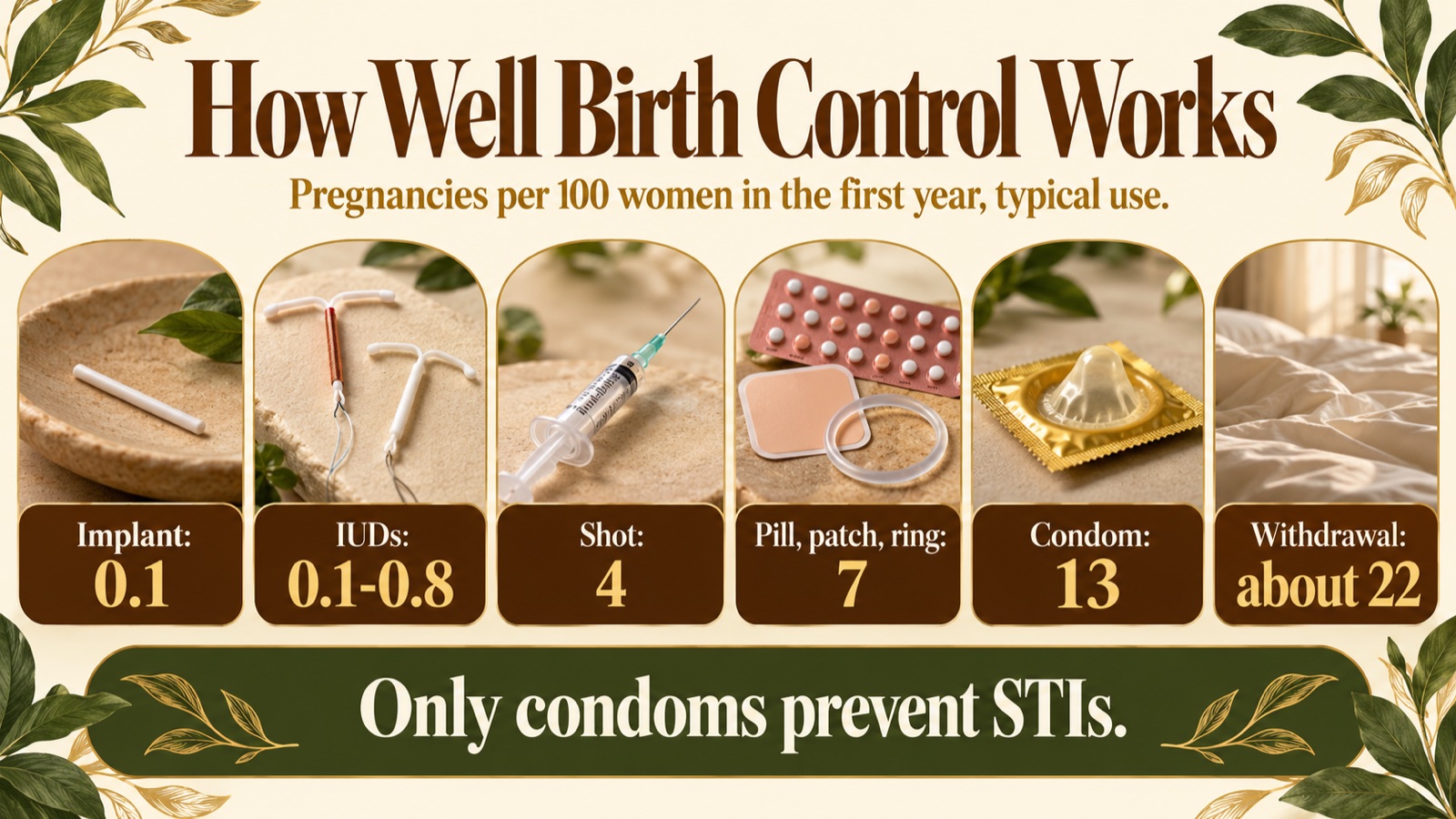
"Typical use" means real life: a pill taken late now and then, a condom put on halfway through. The number shows how many out of 100 women using that method get pregnant in the first year. Lower is better.
Set it and forget it
Implant, hormonal IUD, copper IUD, tubal surgery, vasectomy.
Remember on schedule
Shot every 3 months. Pill daily. Patch weekly. Ring monthly.
Use every single time
Condoms, diaphragm, sponge, cap, spermicide, withdrawal.
Learn your body
Fertility awareness: 2 to 23 in 100 depending on the method and how closely it is followed.
| Method | How it works | Typical use: pregnancies per 100 women, year one (CDC) | How often | Prescription? | Notes |
|---|---|---|---|---|---|
| Implant | Thin rod in the upper arm releases progestin, which stops egg release and thickens cervical mucus | 0.1 | Lasts 3 years (FDA label) | Yes, placed by a clinician | Most effective reversible method. Irregular or no bleeding is common. |
| Hormonal (levonorgestrel) IUD | Small T in the uterus releases progestin; thickens mucus, thins lining | 0.1 to 0.4 | 3 to 8 years, depending on brand | Yes, placed by a clinician | Periods often get lighter; some stop. Placement can cramp; ask about pain relief. |
| Copper IUD | No hormones; copper makes the uterus unfriendly to sperm | 0.8 | Up to 10 years | Yes, placed by a clinician | Hormone-free. Periods may be heavier or crampier at first. Also works as emergency contraception. |
| Shot (DMPA) | Progestin injection stops egg release | 4 | Every 3 months | Yes (some clinics teach self-injection) | Private. Can affect bone density and delay return of fertility; see myths section. |
| Combined pill | Estrogen + progestin stop egg release | 7 | Every day | Yes | May not be advised if you smoke and are over 35, have certain migraines or clot history. |
| Progestin-only pill, including Opill (OTC) | Progestin thickens mucus; some brands also stop egg release | 7 | Every day, same time | Opill: no, sold on the shelf, no age limit. Others: yes | Good for people who cannot take estrogen. With Opill, more than 3 hours late means backup for 48 hours. |
| Patch | Skin patch releases estrogen + progestin | 7 | New patch weekly for 3 weeks, week 4 off | Yes | Same safety checks as the combined pill. |
| Vaginal ring | Soft ring releases estrogen + progestin | 7 | 3 weeks in, 1 week out | Yes | You put it in and take it out yourself. |
| External condom | Barrier worn on the penis | 13 | Every time | No | Helps prevent HIV and many STIs. Free in Philly. |
| Internal condom | Barrier placed inside the vagina | 21 | Every time; can go in up to 8 hours before | No | Helps prevent STIs. Puts protection in your hands. |
| Diaphragm | Cup covers the cervix, used with spermicide | 17 | Every time | Yes | Hormone-free; does not protect against STIs. |
| Sponge / cap / spermicide | Barrier and/or chemical that stops sperm | Sponge 17 · Cap 22 · Spermicide 21 | Every time | Sponge & spermicide no; cap yes | Less effective alone; often paired with condoms. |
| Fertility awareness | Track temperature, mucus and/or cycle days; avoid sex or use a barrier on fertile days | 2 to 23 (varies by method) | Daily tracking | No; classes help | Hormone-free and accepted by many faiths. Works best with training and regular cycles. |
| Withdrawal ("pulling out") | Penis removed before ejaculation | About 22 (Planned Parenthood) | Every time | No | Depends fully on the partner. No STI protection. |
| Tubal surgery | Tubes are cut, blocked or removed | 0.5 | Once, permanent | Surgery | Meant to be permanent. Never let anyone rush this choice. |
| Vasectomy | Tubes carrying sperm are cut or blocked | 0.15 | Once, permanent | Office procedure | Simpler and safer than tubal surgery. Use backup until a test shows zero sperm (about 12 weeks). |
Sources: CDC, Contraception and Birth Control Methods · Guttmacher Institute, Contraceptive Effectiveness · Planned Parenthood, Withdrawal · FDA, Opill approval (2023) · CDC, U.S. Medical Eligibility Criteria 2024
Method by method
What each one is really like
Open the ones you are curious about. Your clinician uses the CDC's 2024 safety guide (the "U.S. MEC") to check each method against your health history: blood pressure, migraines, clots, sickle cell disease, lupus, breastfeeding and more.
The implant
A matchstick-sized rod placed under the skin of the inner upper arm after a numbing shot. It releases progestin for 3 years (FDA label). It is the most effective reversible method on the CDC chart.
- Good for: people who want years of protection without thinking about it.
- Know: bleeding becomes unpredictable for many users: lighter, heavier, spotty or gone.
- Removal: a short office visit, any time you ask. Periods usually return within 3 to 4 weeks (MedlinePlus).
Hormonal and copper IUDs
A small, flexible T placed through the cervix into the uterus. Hormonal IUDs last 3 to 8 years depending on brand; the copper IUD lasts up to 10 years and has no hormones.
- Placement: most people feel strong cramping; Planned Parenthood says the worst part is usually over in under a minute.
- Pain relief is your right to ask about. CDC's 2024 practice guide says every patient should be counseled on placement pain and options, and that lidocaine (numbing) may help. Make a plan you agree with before the visit.
- Fertility: returns almost right away after removal (MedlinePlus).
The shot
An injection of progestin every 3 months. Nobody can see it or find it. Some clinics teach you to give it to yourself at home.
- Bone health: the FDA label carries a boxed warning about bone density loss and says it is not recommended for longer than 2 years unless other options are not suitable. Ask your clinician about calcium, vitamin D and how long to use it.
- Planning a baby soon? The label warns that fertility can take longer to return after the last shot than with other methods.
- Weight: ACOG says the shot can cause an average gain of about five pounds in the first year.
The pill, including Opill over the counter
Combined pills (estrogen + progestin) and progestin-only pills both work at about 7 in 100 with typical use. In July 2023 the FDA approved Opill, a progestin-only pill sold on store shelves and online with no prescription and no age limit.
- Take Opill at the same time every day. More than 3 hours late: take it when you remember and use condoms for the next 48 hours.
- Do not use Opill if you have or have had breast cancer. Ask a doctor first if you have another cancer or take other medicines, which can interfere.
- Pills can ease cramps, acne and heavy periods for many women. See Period Care.
Patch and ring
Same hormones as the combined pill, but weekly (patch) or monthly (ring). Same typical-use number: 7 in 100. Same safety screening for blood clots, smoking over 35, high blood pressure and migraine with aura.
Condoms, external and internal
The only methods that also lower the risk of HIV, gonorrhea and chlamydia. CDC says protection is less complete against infections spread by skin contact, like HPV, herpes and syphilis. Use a new one every time, from start to finish, with water- or silicone-based lube for latex.
Fertility awareness (natural family planning)
You learn the signs of your fertile window, such as cervical mucus, morning temperature and cycle days, and avoid sex or use a barrier on those days. CDC puts typical use anywhere from 2 to 23 in 100, depending on the method. It asks real discipline from both partners and works best with formal teaching and regular cycles. Many couples of faith choose it; it deserves respect and good training, not eye-rolling.
Permanent methods: tubal surgery and vasectomy
Meant to be forever. A vasectomy is a quicker, lower-risk procedure than tubal surgery and is just as permanent. Given the history in the next sections, take your time: no one should ever ask you to sign for sterilization while you are in labor, in pain, frightened, or told your benefits depend on it. ACOG's ethics guidance says this decision belongs to the patient alone.
The "best" method is the one that fits your life and that you trust. A method with a great number that you hate and stop using isn't protecting anybody. Be honest with yourself about what you'll really do.
Sources: CDC, Birth control methods · CDC, U.S. Selected Practice Recommendations 2024 · Planned Parenthood, IUD insertion · MedlinePlus, Slow-release methods · FDA-approved Depo-Provera label · ACOG, Hormonal birth control facts · Bedsider, Missed Opill · ACOG, Permanent contraception ethics
When something went wrong
Emergency contraception: sooner is better
A condom broke, pills were missed, or sex happened that you did not choose. Emergency contraception (EC) can lower the chance of pregnancy. It is not an abortion pill: the FDA says levonorgestrel EC works before an egg is released and will not affect a pregnancy that has already started.
| Option | Time window | How to get it | Good to know |
|---|---|---|---|
| Levonorgestrel pill (Plan B One-Step and generics) | As soon as possible, within 72 hours (3 days) | On the store shelf. No prescription, no ID, no age limit since 2013 | ACOG notes it may work less well at higher body weight. Ask a pharmacist. |
| Ulipristal (ella) | Up to 120 hours (5 days) | Prescription in the U.S. (clinic, telehealth) | Keeps working better closer to ovulation than levonorgestrel. |
| Copper IUD | Placed within 5 days | Clinic visit | The most effective EC, not affected by weight, and then stays as birth control for up to 10 years. |
Sources: FDA, Plan B One-Step information · ACOG Practice Bulletin, Emergency contraception · CDC, Birth control methods · ACOG, Emergency contraception FAQ · WOAR Philadelphia
Honest evidence
Side effects and myths, straight talk
KFF's 2024 national survey found that among Black women not using the method they would prefer, 44% named worry about side effects as the main reason, compared with 18% of White women. Those worries are real and deserve real answers.
| What people say | What the evidence shows | Evidence |
|---|---|---|
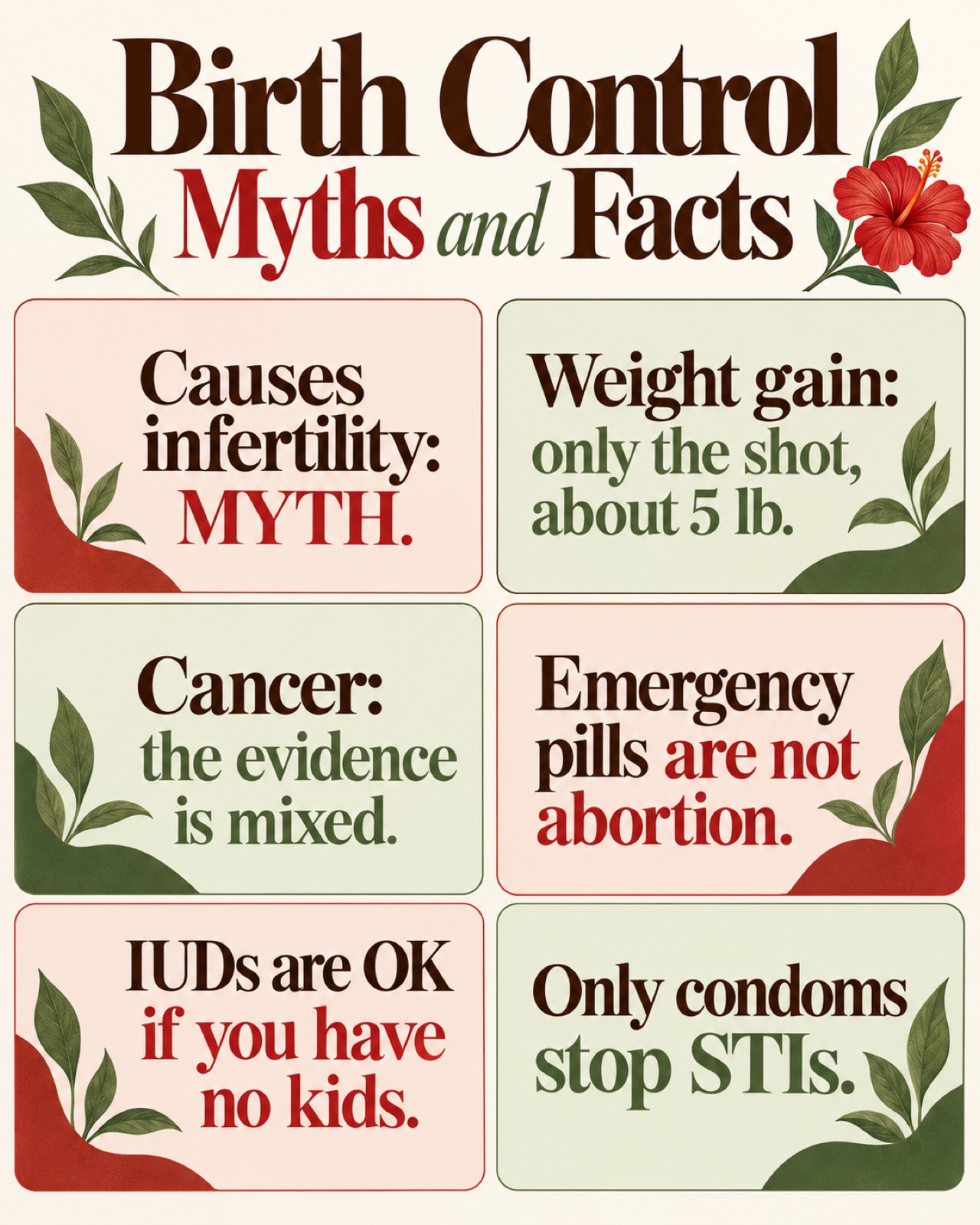
| "Birth control will make you infertile." | Fertility returns almost immediately after an IUD is removed and quickly after the pill or implant (MedlinePlus, NICHD). The shot is the exception: return of fertility can be delayed for months, per its FDA label, but it does come back. | Strong |
| "It makes everybody gain weight." | ACOG: the shot can cause an average gain of about five pounds in the first year. ACOG finds no proven cause-and-effect link between other hormonal methods and weight gain. | Strong |
| "The pill causes cancer." | Mixed, and honest: ACOG reports a small increased risk of breast cancer with hormonal methods while overall risk stays low; the American Cancer Society reports a lower risk of ovarian and endometrial (uterine) cancer in pill users. | Some |
| "Emergency contraception is an abortion." | FDA: levonorgestrel EC acts before egg release and does not end an existing pregnancy. | Strong |
| "IUDs are only for women who've had babies." | ACOG calls IUDs and implants safe for most women, including teens and women who have never given birth. | Strong |
| "Birth control protects you from STIs." | Only condoms do. Pills, IUDs, implants and shots do not. | Strong |
| "No period on birth control is dangerous." | With hormonal IUDs, implants, the shot or continuous pills, a light or absent period is an expected effect, not a buildup of blood. If you are worried you are pregnant, take a test. | Some |
| "Hormonal birth control changes your mood." | Some women report mood changes after starting a method. If you feel low or not like yourself, tell your clinician; there are many other options to switch to. Your mental health counts. | Uncertain |
Sources: KFF Women's Health Survey 2024 · ACOG, Hormonal birth control facts · ACOG, Hormonal contraception and breast cancer · American Cancer Society · MedlinePlus, Deciding about an IUD · NICHD, Contraception FAQs · Depo-Provera label
Protection is more than pregnancy
Preventing STIs and HIV
Condoms
CDC: effective against HIV, gonorrhea and chlamydia when used every time and correctly. Less complete protection against skin-to-skin infections.
PrEP for HIV
Daily pills or shots that lower the risk of getting HIV from sex by about 99% when taken as prescribed (CDC). PrEP does not prevent other STIs or pregnancy.
HPV vaccine
Prevents the virus behind most cervical cancer. CDC: routine at 11 to 12 (can start at 9), catch-up through 26; ages 27 to 45, talk it over with your clinician.
Testing
CDC: everyone 13 to 64 tested for HIV at least once. Sexually active women under 25: chlamydia and gonorrhea tests every year (older if at risk).
Sources: CDC, Condom use · CDC, Preventing HIV with PrEP · CDC, #SheIsWell · CDC, HPV vaccine recommendations · CDC, HIV testing · CDC, STI screening
Why we are careful
The history Black women carry into the exam room
Many of our grandmothers warned us about doctors and birth control. They were not being paranoid. They were remembering. These are documented events.
- 1932–1972The U.S. Public Health Service syphilis study at Tuskegee followed Black men without informed consent and withheld treatment after penicillin became standard. CDC calls it a lasting barrier to trust.
- 1929–1974North Carolina's Eugenics Board program sterilized an estimated 7,600 people "by choice, force or coercion," most of them women. North Carolina was the only state that let social workers petition to sterilize members of the public, and in the program's later years sterilizations rose sharply among African Americans. In 2013 the state set aside ten million for surviving victims.
- 1961Fannie Lou Hamer had a hysterectomy without her consent during surgery for a uterine tumor in Mississippi. Sterilizations like hers were so common that Black Mississippians called them a "Mississippi appendectomy."
- 1973In Montgomery, Alabama, Minnie Lee Relf (14) and Mary Alice Relf (12) were sterilized at a federally funded clinic. Their mother, who could not read, signed an "X" believing it allowed birth control shots. The Southern Poverty Law Center sued (Relf v. Weinberger). A federal judge found that poor women had been pressured into sterilization with threats of losing welfare benefits, and barred federal money for sterilizing people who could not legally consent.
- 1990–1991Within weeks of the Norplant implant's approval, a Philadelphia Inquirer editorial suggested it could reduce the "underclass," naming poor Black families; the paper apologized after outcry from readers and its own Black staff. In California, a judge offered a mother the implant as a condition of probation. The ACLU documented how court and welfare proposals fell hardest on low-income women of color.
- 1994 & 1997A group of Black women meeting in Chicago coined the term reproductive justice in June 1994. In 1997, women-of-color organizations founded SisterSong to build a national movement.

Reproductive justice, in SisterSong's words
The human right to keep personal bodily autonomy, to have children, to not have children, and to parent the children we have in safe and sustainable communities.
That means your right to birth control and your right to refuse it. Your right to a big family and your right to none. Both are protected by the same principle.
I tell my girls: the history is why we ask questions, not why we stay home. Our grandmothers fought so we could walk in, ask everything, and walk out with exactly what we chose. Nothing more, nothing less.
Sources: CDC, Tuskegee timeline · N.C. Office of Justice for Sterilization Victims · PBS American Experience, Fannie Lou Hamer · SPLC, Relf v. Weinberger · ACLU, Norplant: potential for abuse · Christian Science Monitor, 1991 · N.C. compensation fund (2013) · SisterSong, Reproductive justice · Our History page
Not just the past
What researchers have found about our care today
Psychologists, physicians and public-health researchers have studied how race shapes birth control visits. Here is what the studies actually say, with how much weight each can carry.
| Study | What they found | Evidence |
|---|---|---|
| Dehlendorf and colleagues, UCSF, 2010 (American Journal of Obstetrics & Gynecology). 524 clinicians watched videos of "patients" who differed only by race and income. | Clinicians were more likely to recommend an IUD to a low-income Black or Latina patient than to a low-income White patient. No race difference for higher-income patients. The authors warned of possible bias in who gets steered toward which method. | Some randomized, but measured intentions, not real visits |
| Downing, LaVeist & Bullock, 2007 (American Journal of Public Health). 339 Los Angeles mothers. | Low-income women of color were more likely than middle-class White women to say a provider had advised them to limit how many children they have. | Some small, self-reported |
| Thorburn & Bogart (RAND; Bogart is a social psychologist), mid-2000s. Phone survey; 326 African American women analyzed. | 67% of women who had used family planning services reported some race-based discrimination there, mostly infrequent. A companion study found that beliefs about birth control being used against Black people were common and linked to more negative views of contraception. | Some survey, one sample |
| Kossler and colleagues, 2011 (Contraception). About 2,500 St. Louis women. | Black women who had experienced discrimination were more likely to have been using less effective methods. When cost barriers were removed and full counseling given, women with discrimination histories mostly chose long-acting methods themselves. | Some large cohort |
| Rosenthal & Lobel (health psychologists), 2020 (Ethnicity & Health). Two surveys of mothers. | Black and Latina women reported more gendered racism and more mistrust about birth control than White women; mistrust was tied to having less power in sexual relationships. | Some surveys |
| KFF Women's Health Survey, 2022 (national). | Among women who saw a provider in the past two years, 18% of Black women vs 15% of White women said a provider did not believe they were telling the truth. | Strong national survey |
What the doctors' own guidelines now say
ACOG's 2022 statement on patient-centered contraceptive counseling tells clinicians to acknowledge the history of coercion against people of color, to watch for their own bias, to let the patient's values lead, and to support stopping or removing a method when the patient asks. The goal is your choice, not a number.
Mistrust is a reasonable response
Researchers increasingly describe medical mistrust among Black women as a learned, protective response to real events, not ignorance. The fix is trustworthy care: full information, time to decide, and respect for "no."
Sources: Dehlendorf et al. 2010 · Downing, LaVeist & Bullock 2007 · Thorburn, perceptions of discrimination · Thorburn & Bogart, conspiracy beliefs (RAND) · Kossler et al. 2011 · Rosenthal & Lobel 2020 · KFF 2022 · ACOG Committee Statement No. 1

Faith & family
Church, family and your conscience
For many of us, decisions about sex and children happen with Scripture, a pastor and a grandmother in mind. That is part of who we are, and it can be a gift. Nationally, Pew Research found in 2016 that only 4% of Americans call using contraception morally wrong; most people of faith see family planning as a matter of conscience and stewardship.
Research inside Black churches shows a mixed picture. A study of North Carolina congregations found many pastors felt uneasy talking about sexual health and mostly counseled abstinence, while nearly all the young women surveyed said they would welcome a church program on it. Other studies of faith leaders describe secrecy and stigma as barriers. These are small studies, so treat them as a window, not a verdict.
- Waiting fits many faith traditions and is fully protective.
- Fertility awareness is accepted by many churches that discourage other methods.
- Married couples often use any method to space children and protect a mother's health.
- SisterSong runs a faith program for people who hold both their faith and their right to choose.
Pray on it, talk with your mama, sit with your pastor. Then make sure the facts in your hand are true ones. Faith and good information were never enemies in my house.
Sources: Pew Research Center 2016 · Journal of the National Medical Association 2006, NC churches · IJERPH 2020, Memphis faith leaders · SisterSong, Faith Work
Your voice in the room
How to talk to your doctor, and how to say no
You lead this conversation. A good clinician lays out all your options, answers questions and supports your choice. See Your Care, Your Voice for more ways to be heard.
Say what matters to you
"What matters most to me is no hormones / lighter periods / something private / something I can stop on my own."
If you feel rushed
"I'm not ready to decide today. Please give me the information in writing and I'll call back."
If you want it out
"I want my implant (or IUD) removed. I'm not asking for permission. Please schedule the removal."
If you feel pushed
"I'm hearing a lot about one method. Can you walk me through all of them, including ones I control myself?"
About pain
"What will you do for my pain during the placement? I'd like numbing medicine."
Bring a person
You may bring a friend, auntie, partner or doula. You may also ask for a different clinician or a chaperone.
Questions to ask before you choose
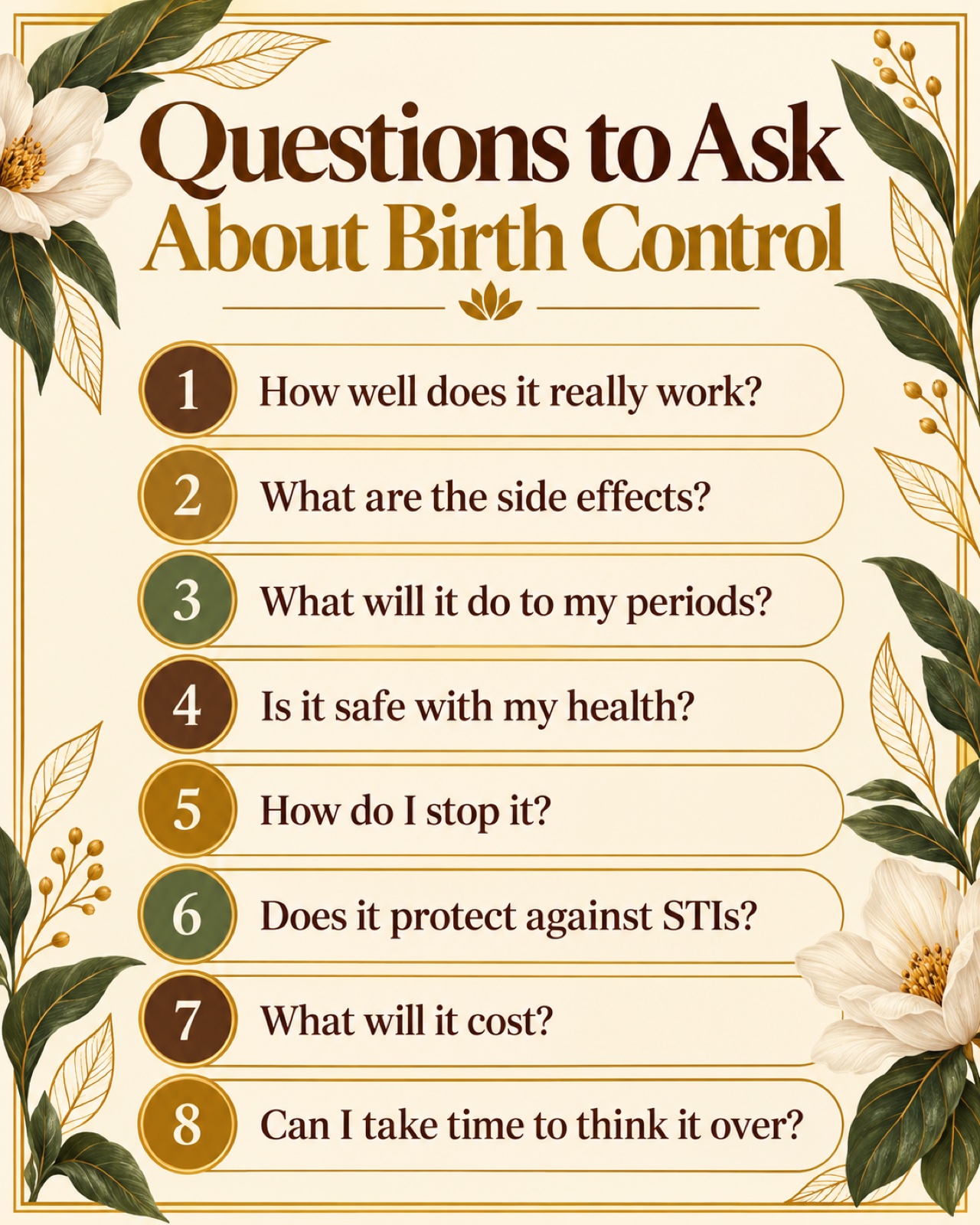
- How well does this work in real life, not perfect use?
- What side effects are common in the first 3 months, and which ones mean I should call?
- How will this change my periods?
- Is it safe with my blood pressure, migraines, sickle cell trait or disease, lupus, or other health conditions?
- Does it interact with any medicine or supplement I take?
- How fast can I get pregnant after I stop?
- How do I stop it, and can I stop it on my own?
- Does it protect against STIs? If not, what should I add?
- What will it cost me, and does my insurance or Medicaid cover it fully?
- Who sees my records, and will anything be mailed home?
- Should I keep emergency contraception at home?
- Can I take a day to think it over?
Sources: ACOG, Patient-centered contraceptive counseling · CDC, U.S. SPR 2024 · CDC, U.S. MEC 2024

For teens in Pennsylvania
Your rights to confidential care
We hope every teen can talk with a parent or trusted adult, and many do. But the law also protects teens who are not ready to, so they still get safe care. Here is what Pennsylvania sources say:
| Service | Need a parent's OK? |
|---|---|
| Birth control, including IUDs and implants | No. The PA Department of Health says minors can get contraception without parental consent or involvement. Title X clinics may not require a parent's consent under federal rules. |
| Condoms, Opill, emergency contraception from a store | No. No age limit on the shelf. |
| Pregnancy tests and prenatal care | No. Any minor can consent (Minors' Consent Act, 35 P.S. § 10103). |
| STI and HIV testing and treatment | No. The same law covers "reportable diseases," including STIs (35 P.S. § 10103; 28 Pa. Code § 27.97). |
| Abortion | Yes, one parent, or a confidential court process (judicial bypass). |
Parents, hear me: a daughter who knows where to go for help is not a daughter who's been "told it's okay." She's a daughter who'll be safe. Have the talk early and keep the door open.
Sources: PA Department of Health, Teen pregnancy · Drexel College of Medicine, PA minors' rights · 28 Pa. Code § 27.97 (minors and STI care) · ACLU of PA, Minors, health care & the law · Guttmacher, Minors' access to STI services · FDA, Plan B
Free and low-cost in Philadelphia
Where to go
Hours and services change, and federal family-planning money has been unsteady (AccessMatters' Title X funds were withheld for four months in 2025 before being restored). Always call ahead.
City Health Centers (Philadelphia Department of Public Health)
Family planning, gynecology and pregnancy options counseling. Uninsured pay a small fee based on income and family size; staff help with insurance.
Call 311 or see phila.gov/healthcenters
Health Center 1 (STI clinic)
1930 S. Broad St., Floor 2 · (215) 685-6570
Free, confidential STI and HIV testing and treatment (urgent-care STI clinic). The city says Health Center 5's sexual health clinic has been temporarily closed since September 2025, so Health Center 1 is the place to go.
AccessMatters hotline
(215) 985-3300
Finds you a family planning center among 70+ in five Southeastern PA counties that serve everyone, regardless of ability to pay or insurance.
Planned Parenthood Southeastern Pennsylvania
Elizabeth Blackwell Health Center, 1144 Locust St. · appointments 1-800-230-7526 (1-800-230-PLAN) · main office (215) 351-5500
Birth control, emergency contraception, STI testing, PrEP. Ask about sliding fees and Medicaid.
Take Control Philly
takecontrolphilly.org
Free condoms at 100+ city sites, and mailed discreetly to Philadelphia teens 13 to 19.
Strawberry Mansion Health Center
2840 W. Dauphin St. · (215) 685-2401
City health center listing family planning and prenatal care.
Full Philly Guide Your Care, Your Voice
Sources: City of Philadelphia, City Health Centers · AccessMatters, Family planning · AccessMatters, Title X restored · Take Control Philly · Planned Parenthood Southeastern PA
Keep reading
Related pages

The Talk
How to talk with daughters about bodies, boundaries, sex and waiting.

Period Care
Cramps, heavy bleeding, and how some methods can help.
Your Care, Your Voice
Screenings, speaking up and getting heard.
Waiting, planning, spacing, or finished: whatever you choose, choose it on purpose, with your eyes open and your head high. That's what a crowned woman does.